September 18, 2014

George Harrison reissue: The Apple Years 1968-75.


In November 1968, George Harrison released 'Wonderwall Music'. A soundtrack to an art film called 'Wonderwall' this predominantly Indian music collection was the first solo album to be released by a Beatle and also the first album on the newly formed Apple Records. George would continue to release albums on Apple (and EMI) through to 1975's soul-influenced 'Extra Texture (Read All About It)' touching on experimentalism with 'Electronic Sound', the magnificent triple album 'All Things Must Pass', the chart-topping 'Living In The Material World' and the, perhaps, less well-known 'Dark Horse'. This box brings all these eclectic albums together in one set that mirrors 2004's 'Dark Horse Years' box set and will contain a perfect bound book with a DVD. All albums have been remastered by Dhani Harrison and Paul Hicks and all will be packaged in high-quality card packs and all albums, apart from 'All Things Must Pass' and 'Living In The Material World' contain newly written notes by Kevin Howlett. The DVD contains a brand new, never before seen video which has been painstakingly overseen by Olivia Harrison and all packages contain new photos many never seen before.


George Harrison's first six solo albums are being reissued as a box set called George Harrison: The Apple Years 1968-75. Those albums, from his days on The Beatles' label Apple Records, were I think his strongest, most interesting records: Wonderwall Music, Electronic Sound, All Things Must Pass, Living in the Material World, Dark Horse and Extra Texture (Read All About It). Though I liked something about all the post-Beatles George Harrison records (there were 12), I found those first half-dozen records to be a window into a famous guitar player and songwriter we hardly knew.
Those first two albums, which he did while still a Beatle, were like very few albums out there in the world of pop in the late 1960s. Wonderwall, released in 1968, was a soundtrack album, the first album on Apple Records, and was a response to Harrison's time in Bombay. Electronic Sound was his explorations on a Moog synthesizer. All Things Must Pass is his masterpiece and highlighted Harrison as a prolific emotional songwriter.
His final three records on Apple were all strong. Today we have a bonus track from the reissue of Extra Texture (Read All About It), an alternate version of one of my favorite songs from that album, "This Guitar (Can't Keep from Crying)." The recording was done in 1992 as a demo for Eurythmics' Dave Stewart, who recorded electric guitar on it at the time. The song itself is a sequel of sorts to Harrison's masterful tune "While My Guitar Gently Weeps," a song recorded with The Beatles that featured a brilliant guitar solo from his buddy Eric Clapton. "This Guitar" is a reaction to poor and sometimes scathing reviews, including ones from Rolling Stone that Harrison received when he toured in 1974 ignoring his Beatles legacy in favor of Indian Classical music and his new music.
Learned to get up when I fall
Can even climb rolling stone walls
But this guitar can't keep from crying
This here guitar can feel quite sad
Can be high strung, sometimes get mad
Can't understand or deal with hate
Responds much better to love
For the reissue, this version of the song got overdubs from George's son Dhani Harrison on guitar, Ringo Starr on drums and Kara DioGuardi on vocals. Dhani Harrison also oversaw the reissues. All of the records have been remastered from the original analog tapes and feature bonus tracks, booklets and a DVD. The box set comes out on Sept. 23, but you can pre-order here.

Source: http://www.npr.org/blogs/allsongs/2014/09/10/347156982/george-harrison-this-guitar-cant-keep-from-crying

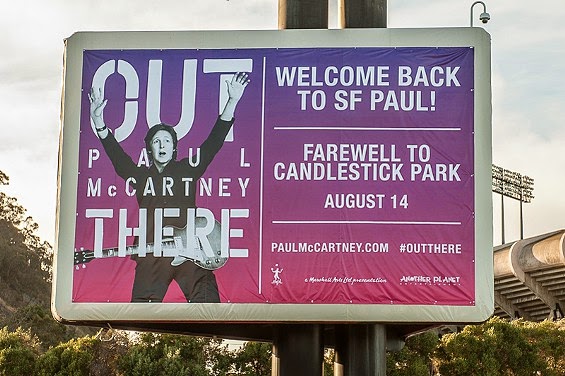
August 24, 2014

Paul McCartney Plays Final Concert at Candlestick Park 08-14-2014


San Francisco said goodbye on Thursday to Candlestick Park -- the stadium where the city's beloved Giants and 49ers celebrated some of their greatest triumphs.

The storied venue shut down after an evening concert by former Beatle Paul McCartney that finished around midnight. It will then be demolished to make way for a housing, retail and entertainment development.
The Stick, as it is known, opened more than 50 years ago and served as the home field for the 49ers and Giants. It hosted greats from both teams, including Joe Montana, Jerry Rice and Willie Mays, and was the site of The Catch -- Montana's touchdown pass to Dwight Clark to win the NFC championship game in January 1982 that sent the 49ers to their first Super Bowl.


The Giants played their last game at Candlestick in September 1999. The 49ers will play at a new stadium about 45 miles south starting this year.
Candlestick was also the site of a 1987 mass by Pope John Paul II and the Beatles' last live concert in 1966.

"Anyone you talk to about Candlestick Park is going to have mixed emotions about it: It's not a pleasant place physically. It gets windy and cold, but it's where the Giants and 49ers played for so many years," said Greg Breit, 50, before the concert's start. "There's so much history here. You can't deny it."
Fans savored the final event at The Stick by holding tailgate parties and taking snapshots of the stadium before the late-afternoon fog rolled in.


San Francisco police warned people attending Thursday's concert not to take any chairs or other mementos from the stadium, saying anyone caught with such items could face vandalism charges.


"We don't want people to be trying to take any pieces of Candlestick Park," officer Gordon Shyy told KGO-TV. "Just come enjoy the concert tonight and have a safe night."

Source: http://www.billboard.com/articles/news/6221743/paul-mccartney-closes-san-franciscos-candlestick-park

You can hear this concert in full here:
http://tela.sugarmegs.org/MostListened.aspx

July 19, 2014

Ron Howard to Direct New Beatles Documentary Focusing on Band's Early Years

July 16, 2014 9:00 AM ET Ron Howard,Courtesy Imagine Entertainment When Ron Howard was 9 years old, he was already a national television star on The Andy Griffith Show – and there was only one thing he wanted for his next birthday. "The gift that I was begging for was a Beatle wig," he tells Rolling Stone with a laugh. "And on March 1st, 1964, that's what I got: the Beatle wig of my dreams."

Now the Academy Award-winning director is coming full circle with his Fab Four obsession, having signed on to direct and produce an authorized, as-yet-untitled documentary about the touring years of the band’s career (approx. 1960-1966), a period in which the Beatles crossed the globe, sparked Beatlemania and released several classic albums (including A Hard Day’s Night and Rubber Soul). For it, he will interview surviving members Paul McCartney and Ringo Starr, as well as talk with Yoko Ono and Olivia Harrison (wife of the late George Harrison).

"What's so compelling to me is the perspective that we have now, the chance to really understand the impact that they had on the world," Howard says. "That six-year period is such a dramatic transformation in terms of global culture and these remarkable four individuals, who were both geniuses and also entirely relatable. That duality is something that is going to be very interesting to explore."

Howard is joined by Nigel Sinclair, the Grammy-winning producer behind the documentaries George Harrison: Living in the Material World and No Direction Home: Bob Dylan, as well as the producers Brian Grazer (Apollo 13, Get on Up) and Scott Pascucci (George Harrison). They will have access to the vast archives of Apple Corps, the Beatles’ company, as well as incorporate fan-sourced amateur video footage to recreate previously unseen concerts. It's Howard’s second music documentary, following last year’s Jay-Z festival film Made in America.

"We are going to be able to take the Super 8 footage that we found, that was all shot silent. We'll not only be able to digitally repair a lot of that, but we've also been finding the original recordings," explains Howard. "We can now sync it up and create a concert experience so immersive and so engaging, I believe you're going to actually feel like you're somewhere in the Sixties, seeing what it was like to be there, feeling it and hearing it. And as a film director, that's a fantastic challenge."

Sinclair says the team has already unearthed some surprising footage from the Beatles’ final concert at San Francisco's Candlestick Park in 1966. "Their last concert in ’66, when they were probably the most famous people on the planet, [they] ended up carrying their own amps onstage. I think that’s almost emblematic of the charm of this story," he says. Also a longtime Beatles fan, he saw the band in Glasgow in 1964. "It was a memory to treasure."

The film will also explore the "multigenerational quality" of Beatles fandom, according to Howard. "I hope we find some of that in the footage," he says. "We may have a shot of a boy or a girl very early in their life at a concert, and then we may be able to find them today and talk to them, and talk to their grandchildren and see what their relationship is with the Beatles, and understand how multiple generations find tremendous value and relevance in their music."

The documentary is scheduled for a tentative late-2015 release, and Howard says he is eager to begin interviewing McCartney and Starr. Turns out, he has a history with his heroes; half of the band met him on the set of his hit 1970s sitcom Happy Days. "We got word that John Lennon wanted to come by and bring his son [Julian], and he was a big Fonzie fan. I managed to sneak in a picture," he recalls. "He was graciously cool, but mostly it was for his kid, which we all really appreciated."

Howard adds, chuckling, "A year or so later, Ringo and Keith Moon wandered by. I don't know what they were doing in the lot, and I'm not even sure they knew where they were, but they seemed happy to be there."

Source: Read more: http://www.rollingstone.com/music/news/ron-howard-directing-new-beatles-doc-focusing-on-bands-early-years-20140716#ixzz37w28bbfe
Follow us: @rollingstone on Twitter | RollingStone on Facebook

July 04, 2014

Review: Essential Beatles movie 'A Hard Day's Night' is back on DVD

There should be a law that “A Hard Day's Night,” which was just re-released by the Criterion Collection on DVD, should never be allowed to go out of print. It is a movie that was a landmark film when it was released in 1964 and still is today.
Movie critics, including the late Roger Ebert, praised it to the skies. “It was clear from the outset that 'A Hard Day's Night' was in a different category from the rock musicals that had starred Elvis and his imitators,” he wrote in “Roger Ebert: The Great Movies.” “It was smart, it was irreverent, it didn't take itself seriously, and it was shot and edited by Richard Lester in an electrifying black-and-white semi-documentary style that seemed to follow the boys during a day in their lives.”

The new Criterion DVD does what the company is famous for – present movies in an intelligent setting for film fans. It starts, of course, with the movie, which looks absolutely fantastic, sharper and cleaner and than ever thanks to a transfer from the original negative.

The audio got a big improvement with this new DVD over the previous Miramax version, which only featured a mono soundtrack. The new DVD features both a Dolby stereo and 5.1 surround audio supervised by Giles Martin. His mix makes the music sound dimensional.

The new DVD reorganized the special features from the Miramax set and includes most, though not all. Some of the DVD-ROM interviews on the Miramax set have been incorporated as commentary. Also included is “The Making of 'A Hard Day's Night,'” which included comments by Ebert and Roger McGuinn, plus Phil Collins showing where exactly he was in the movie.

Two of the new features are especially great. “The Road to 'A Hard Day's Night'” is an interview with author Mark Lewisohn about the history of the movie. The new DVD also includes an over-the-film commentary taken from a discussion from the special features of the Miramax DVD. Not that it's bad, but since it was not made specfically for a commentary track, it sounds disjointed since few of the comments match what's happening onscreen. There's also a new feature called “Picturewise” that looks at Lester's movie style.

There are two versions of the release: a single disc regular DVD and the dual-format version that includes Blu-ray and two regular DVDs which include everything on the Blu-ray. Spend the extra and get the dual-format, which also comes with a great little book with an interview with Richard Lester and rare movie pictures, some in color. You won't regret it.

But don't get rid of that Miramax DVD just yet. While it was criticized in some circles and unfairly for the overabundance of special features, a strange complaint, some of those features are missing in the new DVD, among them access to the shooting script. And the video for “I'll Cry Instead” from the original MPI DVD (and the earlier Voyager CD-ROM) isn't here, either.

Criterion has a respected reputation for its film releases. “A Hard Day's Night,” which will be released in England July 21, is no exception and well worth getting.
(Note: Pattie Boyd will appear at a special 50th anniversary screening this Sunday at Catalina Island in Southern California. You can find information here. Also, "A Hard Day's Night" will open a special theatrical engagement July 4. The theaters are listed on the Janus Films website.)

Source:

July 02, 2014

A Digitally Restored 'Hard Day's Night'


The 1964 screen debut of The Beatles became a cultural phenomenon. Take a look at scenes from the movie. Bruce and Martha Karsh/Janus Films. Rock movies were never the same after "A Hard Day's Night."


The 1964 screen debut of The Beatles was meant to cash in on the wave of Beatlemania sweeping the band's native England and produce a soundtrack album that American movie studio United Artists could market through its music division. It did that and more: Like its stars, the movie became a cultural phenomenon.
"It elevated the art of the pop-music film," said Beatles biographer Mark Lewisohn, author of "Tune In: The Beatles: All These Years." After a string of peppy jukebox musicals in the late 1950s such as "Rock Around the Clock," the Beatles film set a new standard. "It was the first of its kind to treat the subject with some intelligence and a more sophisticated level of humor."


Janus Films will release a digitally restored version of the film in about 100 cities on July 4, commemorating the 50th anniversary of its premiere at the Pavilion Theatre in London's Piccadilly Circus. The Criterion Collection released a DVD/Blu-Ray edition Tuesday.
"This is the film where we literally get to meet the Beatles," said Peter Becker, president of The Criterion Collection and a partner in Janus Films. The distributor, which released Academy Award-winning "The Great Beauty" digitally to theaters, said a digital projection of the Beatles movie allowed for a much wider simultaneous release than a film version. "It just plays like gangbusters," he said.
The loose-limbed comedy, directed by Richard Lester, follows the Fab Four—Paul McCartney, John Lennon, George Harrison and Ringo Starr—as they travel from Liverpool to London for a TV performance. Antics ensue, many instigated by a mysterious older man (Wilfrid Brambell) that Mr. McCartney claims is his grandfather. Mr. Starr goes on a walkabout. And when they're not singing, or on the run from screaming fans, the performers riff as only slightly exaggerated versions of themselves—making the most of clever one-liners concocted by screenwriter Alun Owen. 


The movie made an impact on generations of Beatles fans. Some of them grew up to direct their own pop-oriented films.

"To me it's probably the greatest rock film ever made," said Morgan Neville, a longtime director of music documentaries whose "20 Feet from Stardom" won the Academy Award this year. "There were a thousand ways that movie could have gone off the rails, but every other pop band since has tried to make it."
Mr. Neville credits much of the movie's success to Mr. Lester. The American filmmaker, then known for his work with British comedians Peter Sellers and Spike Milligan ("The Goon Show"), infused the film with a spirit of "sheer humor and anarchy," Mr. Neville said. It anticipated the work of ensembles like Monty Python's Flying Circus. "He was really at the forefront of the British new wave." Mr. Lester's inventiveness was such that when Lennon was unable to appear in part of the "Can't Buy Me Love" sequence, which was shot outdoors, the director stood in for him: He put on the absent Beatle's shoes and pretended to be Lennon holding the camera.


The film version of "A Hard Day's Night," whose title was taken from one of Mr. Starr's off-the-cuff comments and became the last song written for the film, has many other distinctions. One of the most conspicuous is the group's thick Liverpool accents. "The biggest pop star in Great Britain before the Beatles, Cliff Richard, had adopted a mid-Atlantic accent in the hope that he would be more acceptable to Americans for not sounding completely English," Mr. Lewisohn said. "The Beatles said, 'Here we are and this is us and you can take it or leave it.' Everyone took it."
The seminal Beatles film "A Hard Day's Night" is hitting more than 100 theaters July 4 in a digitally restored version. WSJ contributor Steve Dollar joins Tanya Rivero with a look at the revival of the 1964 classic and its influence. Photo: Janus Films 


The film also reveled in running jokes and sight gags that might slip by a casual viewer. The elderly gent played by Brambell is continually referred to as "clean." As an actor, he was better known as the grubby lead in the BBC comedy "Steptoe and Son," the basis for the American series "Sanford and Son." And in a moment typical of the film's attitude, there's a glimpse of John Lennon with a bottle of Coca-Cola raised to his nose. "Sniffing coke," Mr. Lewisohn said. "It's just there and it's gone."
Some of those subtleties may be more apparent in the restored film, which includes a soundtrack remixed for stereo and surround formats by Giles Martin, son of Beatles' producer George Martin. To ensure the highest fidelity, Mr. Martin went back to original source materials, including stock sound effects that were archived by the BBC. 


In other instances, the producer enlisted a little help to stir some extra Beatlemania. During the performance at the end of the movie, he instructed co-workers to shout out the names of individual Beatles, which weren't very audible in the film amidst all the shrieking. 


"There's a little girl who does the Internet here," Mr. Martin said. "She's the quietest character. She went ballistic. 'PAULLLLLL!!!'"
Despite such enduring enthusiasm, Mr. Martin was mindful of not overdoing it. "You want to have a feeling like you're there," he said. "But I'm not remixing a Michael Bay film."

Source: http://online.wsj.com/articles/a-digitally-restored-hard-days-night-1403814666


REVIEW: "A HARD DAY'S NIGHT"- RESTORED 50TH ANNIVERSARY THEATRICAL RELEASE 


By Mark Cerulli
After a meticulous 4K restoration by none other than the Criterion Collection, the Beatles’ first film, A Hard Days Night, was unveiled at LA’s Raleigh Studios. Yes, the image was crisp and clean, not a smudge or scratch in sight. (No surprise there as the film’s director Richard Lester personally approved the restoration.) And yes, the music sounded glorious in a new 5.1 mix. In fact, George Harrison’s iconic opening riff on the title track just about knocked this Cinema Retro scribe off his seat! But what was really special about this whimsical film was watching it through the prism of fifty years. From frame 1, we know how we lost both John Lennon and George Harrison. We are living with climate change, al-Qaeda, overpopulation and deforestation, so this movie is a welcome relief, capturing a simpler time in a quainter London which was then still throwing off the shadows of WW II. Most importantly, the film delivers The Beatles in close-up after close-up – all are young, strong and so full of life. To say they “stole the show” doesn’t apply, they ARE the show. The plot, about the trials and tribulations of getting the white-hot group to a live performance is basically filler between musical set pieces, but it earned writer Alun Owen a 1965 Oscar nomination. George Martin’s thumping score also landed an Oscar nod.


Along for the ride is Paul’s cranky grandfather (Wilfrid Brambell) who keeps the band and their managers (dour Norman Rossington and goofy John Junkin) on their toes. Odd looking and angular, Brambell, a major UK TV star at the time, was a sneering contrast to the Fab Four’s glowing charisma.


The film is as much about movement as it is music. The band is always on the move, - on foot, in trains, cars and a helicopter. Richard Lester’s cameras are on the move as well, with numerous hand-held shots and a beautiful aerial sequence where the band escapes a stuffy rehearsal to mess about in a playing field accompanied by Can’t Buy Me Love. With much of the dialogue improvised on the spot, A Hard Day’s Night has a breezy, cinéma vérité feel that obviously worked for its stars as they seem to be having a blast from start to finish.


When The Beatles finally go “live”, the climactic concert delivers vintage “Beatlemania” in all its screaming glory. The lads blast out Tell Me Why, If I Fell, I Should Have Known Better and She Loves You, intercut with an audience full of hysterical teens and the show’s harried director (Vincent Spinelli) having a meltdown in the control booth. It’s all innocent, upbeat and just simply, fun. Are there plot holes you could drive a double-decker bus through? Sure. But who cares? For a brief shining moment the Beatles are together again and all is well with the world.


On July 4th, Janus Films will re-release this restored version of A Hard Days Night in more than 50 cities across America.


June 29, 2014

Vinyl Albums Being Re-Released in Mono 09-2014


With an audiophile audience in mind, The Beatles’ mono albums have been newly mastered for vinyl from quarter-inch master tapes at Abbey Road Studios. While the corresponding CD boxed set from 2009 was created from digital remasters, these new vinyl versions have been cut without the use of any digital technology.  Manufactured for the world at Optimal Media in Germany, The Beatles’ albums are presented in their original glory, both sonically and in their packaging


London – June 16, 2014 – The Beatles in mono

This is how most listeners first heard the group in the 1960s, when mono was the predominant audio format. Up until 1968, each Beatles album was given a unique mono and stereo mix, but the group always regarded the mono as primary. On September 8 (September 9 in North America), The Beatles’ nine U.K. albums, the American-compiled Magical Mystery Tour, and the Mono Masters collection of non-album tracks will be released in mono on 180-gram vinyl LPs with faithfully replicated artwork. Newly mastered from the analogue master tapes, each album will be available both individually and within a lavish, limited 14-LP boxed edition, The Beatles In Mono, which also includes a 108-page hardbound book.

The Beatles, 1968. © Apple Corps. Ltd.

In an audiophile-minded undertaking, The Beatles’ acclaimed mono albums have been newly mastered for vinyl from quarter-inch master tapes at Abbey Road Studios by GRAMMY®-winning engineer Sean Magee and GRAMMY®-winning mastering supervisor Steve Berkowitz. While The Beatles In Mono CD boxed set released in 2009 was created from digital remasters, for this new vinyl project, Magee and Berkowitz cut the records without using any digital technology. Instead, they employed the same procedures used in the 1960s, guided by the original albums and by detailed transfer notes made by the original cutting engineers.

Working in the same room at Abbey Road where most of The Beatles’ albums were initially cut, the pair first dedicated weeks to concentrated listening, fastidiously comparing the master tapes with first pressings of the mono records made in the 1960s. Using a rigorously tested Studer A80 machine to play back the precious tapes, the new vinyl was cut on a 1980s-era VMS80 lathe.

Manufactured for the world at Optimal Media in Germany, The Beatles’ albums are presented in their original glory, both sonically and in their packaging. The boxed collection’s exclusive 12-inch by 12-inch hardbound book features new essays and a detailed history of the mastering process by award-winning radio producer and author Kevin Howlett. The book is illustrated with many rare studio photos of The Beatles, fascinating archive documents, and articles and advertisements sourced from 1960s publications.

Available now for preorder at www.thebeatles.com.

The Beatles In Mono
* Available individually and collected in a limited 14-LP boxed edition, accompanied by an exclusive 108-page hardbound book.
  • Please Please Me
  • With The Beatles
  • A Hard Day's Night
  • Beatles For Sale
  • Help!
  • Rubber Soul
  • Revolver
  • Sgt. Pepper's Lonely Hearts Club Band
  • Magical Mystery Tour
  • The Beatles (2-LP)
  • Mono Masters (3-LP)

"The Beatles", affectionally known as "the White album". © Apple Corps Ltd.


Official promotional film for the mono vinyl releases.


The prices from Amazon in USA for the boxed set is $409.26, single-LPs are $26.60, the 2LP "The Beatles" $43.97 and the 3LP "Mono Masters" $77.52.

Official press release.

Source: http://wogew.blogspot.com/2014/06/the-beatles-mono-vinyls-press-release.html

June 26, 2014

Alternate Abbey Road

Alternate takes and mixes from Abbey Road era. All the material presented here has already been bootlegged before. This CD circulates in two versions. The contents are the same (the two medleys have been separated in tracks) but the art is different.


Alternate Abbey Road - Tracklist - Pear Records
August 1972 - "One To One" rehearsal

1     Come Together  - Take 37
2     Something Take 21 - Piano notes at the start, different vocals, no ynth and guitar overdubs
3     Maxwell's Silver Hammer - Early version - different vocal
4     Oh! Darling -  Take 32 - no sound effects, different vocal
5     Octopus's Garden - Experimental take - lead vocal by Paul (22/02/69)
6     I Want You (She's So Heavy) - Live - 18th November 1976, George with Paul Simon live on the Saturday Night Live show
7     Here Comes The Sun - Isolated vocal for the first minute of the song, made for the 1983 Abbey Road Video show
8     Because - Alternate take with instrumental jam at the end
9     You Never Give Me Your Money - Alternate take, starts with organ note, no sound effects
10     Sun King - Alternate take, different ending
11     Mean Mr. Mustard - Original
12     Her Majesty - Alternate take, different beginning
13     Polythene Pam - Alternate take
14     She Came In Through The Bathroom Window - Alternate take, different vocals, no chorus, no strings, more piano
15     Golden Slumbers / Carry That Weight - Alternate take from the Anthology video
16     The End - Acetate - as used for Anthology in an earlier stage, this lasts a few seconds longer
17     Something - Alternate take
18     Oh! Darling - Alternate take
19     Because - Original Abbey Road mix
20     The Huge Melody (Part 1) - Original Abbey Road mix
21     A Huge Melody (Part 2) - Alternate take, with final guitar chord
22     Her Majesty - Medley of Abbey Road tracks
23     Abbey Road Medley - Instrumental of "Because" with comments by all four Beatles
24     The End of The Beatles    


Let It Be Naked

Let It Be - Remastered

White Album

Red Album - Greatest Hits 1962 - 1966 - Remastered

Blue Album - Greatest Hits - 1967 - 1970 - Remastered

May 26, 2014

Top 10 Beatles Bootleg Albums


Top 10 Beatles Bootleg Albums
by Michael Gallucci


The three Beatles ’Anthology’ volumes released in the ’90s were supposed to stop bootleggers. OK, maybe not stop them, because the band has been one of the world’s most heavily bootlegged artists ever since unreleased session tapes started making the rounds in the late-’60s. But the trio of double-disc albums officially released by Capitol Records was certainly designed to keep all but rabid fans from acquiring illegal Beatles records. The ‘Anthology’ albums did a fine of sampling the countless hours of demos, mixes, alternate takes and live shows that are available, but they merely skimmed the surface of all the fabness out there. Our list of the Top 10 Beatles Bootleg Albums surveys the best of them.

10 - Beatles Complete Rooftop Concert   


'The Complete Rooftop Concert' (1998)


On Jan. 30, 1969, the Beatles made their last public appearance together on the London rooftop of Apple Records, where they performed a brief impromptu concert for some lucky lunchtime passersby. This album (which includes other tracks from the 'Get Back' sessions) features the entire performance, which was made up of songs that ended up, in slightly altered takes and mixes, on 'Let It Be.'


9- Beatles 'Sessions' (1994)


In 1985, the Beatles' British record company collected a bunch of leftover tracks from the studio vaults and planned to release 'Sessions.' For one reason or another, the record was scrapped. This 1994 bootleg recovers the career-spanning LP. Most of the songs eventually ended up on the 'Anthology' albums, but it's great to hear gems like 'Leave My Kitten Alone,' 'Not Guilty' and an alternate take of 'Ob-La-Di, Ob-La-Da' the way fans would have heard them in 1985.


8 - Beatles Complete BBC Sessions   

'The Complete BBC Sessions' (1993)


Capitol released a two-disc, 69-track CD in 1994 culled from the radio sessions the Beatles recorded from 1963 through 1965. But this massive 10-volume set gathers every note they played on the BBC, where they performed lots of covers (Chuck Berry, Little Richard, etc.) plus plenty of their own songs with playful rawness.


7 - Beatles Artifacts   

'Artifacts' (1993)


This five-disc series starts in Liverpool in the late '50s with a pre-Beatles cover of Buddy Holly's 'That'll Be the Day' and ends with the band's final overdub session for the 'Let It Be' album. In between are rarities, demos and alternate takes of many favorites. Like the official 'Anthology' albums, 'Artifacts' chronicles the Beatles' story from start to finish.


6 - Beatles Get Back Glyn Johns Final Compilation 
  

'Get Back: The Glyn Johns Final Compilation' (1999)


The 'Get Back' sessions were supposed to bring the feuding Beatles back together for a fun, loose record after the splintered 'White Album.' But things didn't turn out that way, and the sessions turned chaotic almost immediately (various Beatles quit the group at various times during the recording). Engineer Glyn Johns mixed an early version of the album that's preferable to the cobbled-together official release -- retitled 'Let It Be'  and drowned in strings and other mushy decorations by producer Phil Spector.


5 - Beatles Unsurpassed Masters   

'Unsurpassed Masters' (1989)


This seven-volume series, like several other series in our list of the Top 10 Beatles Bootleg Albums, compiles a wide range of leftover takes, demos and unreleased songs from the band's vast studio archive. There's plenty of reworked classics (like songs with flubbed vocals and without overdubs) for Beatlemaniacs here.


4 - Beatles Alternate Abbey Road   

'The Alternate Abbey Road' (1997)


The Beatles' last album, 'Let It Be,' didn't include the final music they recorded; 'Abbey Road' was the last album they worked on together. And unlike the hate-fueled 'Get Back' / 'Let It Be' sessions (see No. 6 on our list of the Top 10 Beatles Bootleg Albums), 'Abbey Road' was loose and relatively stress-free. This great album reconstructs 'Abbey Road' from alternate takes, offering an eye-opening glimpse of the band's meticulous recording process.


3 - Beatles Turn Me on Dead Man   

'Turn Me on Dead Man: The John Barrett Tapes' (1999)


To keep busy while undergoing cancer treatment in the early '80s, John Barrett, an engineer at Abbey Road studios, began combing the vaults and cataloging the hours of tapes buried there. He uncovered a gold mine of unreleased Beatles material. This two-disc set collects his greatest finds, including rough sketches, unheard mixes and some songs that never made it to the official records.


2 - Beatles Ultra Rare Trax   

'Ultra Rare Trax' (1988)


Before Apple got around to releasing the 'Anthology' CDs in the '90s, the excellent 'Ultra Rare Trax' series was the best roundup of unreleased Beatles material (an official skimpy 'Rarities' LP was released in 1980 but soon went out of print). Spanning eight volumes, 'Ultra Rare Trax' features everything from 'Rubber Soul' outtakes to sloppy jams pulled from the 'Get Back' sessions. Even with the official 'Anthology' series available, these sets are indispensable.


1 - Beatles Acoustic Masterpieces   

'Acoustic Masterpieces: The Esher Demos' (1998)


It's no secret that the four Beatles basically served as each other's backing bands on 'The White Album.' This collection offers solid proof that everyone was working on their own material, which they later brought to the studio for group overdubs. Unlike most of the other records on our list of the Top 10 Beatles Bootleg Albums, 'Acoustic Masterpieces' includes revealing solo acoustic demos by John, Paul and George. It's pretty much 'The White Album' before some color was added.

What's Your Favorite Beatles Bootleg Album?

Did we overlook one of your favorite Beatles bootleg albums in our Top 10 list? Let us know what you think we should have included in the comments section below.


Read More: Top 10 Beatles Bootleg Albums | http://ultimateclassicrock.com/beatles-bootleg-albums/?trackback=tsmclip

May 25, 2014

Beatles Mythology Bootleg Series - 3 Volumes

Strawberry Records - "Mythology" is a valuable next bootleg boxset shaped and contains three volumes. In them the Beatles career is reviewed in the form of studio rarities, and unreleased live tracks from the beginning to the final solution.
The quality is not very good, but some of these shots are not entirely known, then it would be worth giving a listen. I leave it and judge for yourself
Mythology Vol I


Disc 1 (1962-1963)

01 - A Taste of Honey
02 - Love Me Do
03 - Some Other Guy
04 - Keep Your Hands Off My Baby
05 - Beautiful Dreamer
06 - I Saw Her Standing There 2-3
07 - I Saw Her Standing There 2-4
08 - I Saw Her Standing There 2-5
09 - Do You Want to Know a Secret
10 - Thank You Girl 6-7
11 - Thank You Girl 6-8
12 - Thank You Girl 6-10
13 - Thank You Girl 6-11
14 - Thank you Girl 6-12
15 - Thank You Girl 6-13
16 - From Me To You 2-8
17 - From Me To You 2-9
18 - From Me To You 2-11
19 - From Me To You 2-13
20 - Side By Side Theme
21 - Memphis Tennessee
22 - Lennon on Juke Box Jury
23 - I'll Get You
24 - Glad All Over
25 - Twist and Shout
26 - You Really Got a Hold On Me
27 - Pop Chat Interview

Disc 2 (1963)

01 - From Me To You
02 - I'll Get You
03 - She Loves You
04 - Twist And Shout
05 - Royal Command Interview
06 - Interview In Gloucestershire
07 - Public Ear Interview
08 - From Me To You
09 - She Loves You
10 - Till There Was You
11 - Twist And Shout
12 - Dickie Henderson Outro
13 - RTE (Radio Telefis Eireann) Interview
14 - This Boy
15 - Intro
16 - This Boy
17 - All My Loving
18 - I Want To Hold Your Hand
19 - Hello Bongo!
20 - (On) Moonlight Bay
21 - Dirty Deckchair
22 - The Beatles On Juke Box Jury
23 - Doncaster Interview

Disc 3 (1963-1964)

01 - From Me To You
02 - I Saw Her Standing There
03 - All My Loving
04 - Roll Over Beethoven
05 - Boys
06 - Till There Was You
07 - She Loves You
08 - This Boy
09 - I Want To Hold Your Hand
10 - Money (That's What I Want)
11 - Twist And Shout
12 - From Me To You
13 - Tie Me Kangaroo Down, Sport
14 - I Want To Hold Your Hand
15 - Public Ear
16 - Public Ear
17 - Public Ear
18 - Public Ear
19 - I Want To Hold Your Hand
20 - This Boy
21 - All My Loving
22 - Money (That's What I Want)
23 - Twist And Shout
24 - Outro Sunday Night At The London Palladium
25 - John Lennon At Foyles
26 - John Lennon At Foyles
27 - Band Introduction
28 - Murray The K Intro
29 - She Loves You
30 - You Can not Do That
31 - Twist And Shout
32 - Long Tall Sally
33 - Can not Buy Me Love


Mythology Vol II


Disc 1 (1964)

01 - Paul On A Degree Of Frost
02 - A Hard Day's Night
03 - Dieter Broer Interview At Hilton Hotel
04 - Radio Network Forth Interview
05 - A Hard Day's Night
06 - Hong Kong Interviews
07 - Scene At 6.30 Interview
08 - Top Gear Trailers
09 - If I Fell
10 - A Hard Day's Night
11 - Things We Said Today
12 - You Can not Do That
13 - If I Fell
14 - Long Tall Sally
15 - George Harrison On Juke Box Jury
16 - What You're Doing
17 - Mr Moonlight
18 - What You're Doing
19 - Tyne Tees Interview
20 - I Feel Fine
21 - She's A Woman

Disc 2 (1965)

01 - That Means A Lot - Take 1
02 - That Means A Lot - Rehearsal
03 - That Means A Lot - Take 20
04 - That Means A Lot - Take 21
05 - That Means A Lot - Take 22 - Take 23
06 - That Means A Lot - Rehearsal
07 - Yes It Is
08 - Intro
09 - I Feel Fine
10 - She's A Woman
11 - Baby's In Black
12 - Ticket To Ride
13 - Long Tall Sally
14 - Outro Musical Express Concert
15 - Help! - Take 4
16 - Peter Sellers - Grandma Awards
17 - British Information Service Interview
18 - The Beatles Abroad
19 - Pop Profile - John Lennon
20 - Pop Profile - George Harrison

Disc 3 (1965)

01 - The Eamonn Andrews Show
02 - Intro
03 - I Feel Fine
04 - I'm Down
05 - Act Naturally
06 - Ticket To Ride
07 - Yesterday
08 - Help!
09 - Outro
10 - Run For Your Life, Take 5
11 - This Bird Has Flown, Take 1
12 - This Bird Has Flown, Take 2
13 - This Bird Has Flown, Take 4
14 - I'm Looking Through You, Take 1
15-12 Original Bar, Takes 1-2
16 - I'm Looking Through You, Take 4
17 - The Word, Take 3 RM-1
18 - Saturday Club

Disk 4 (1966)

01 - Announcement By Charlie Hickman
02 - Rock 'N' Roll Music
03 - She's A Woman
04 - If I Needed Someone
05 - Day Tripper
06 - Baby's In Black
07 - I Feel Fine
08 - Yesterday
09 - I Wanna Be Your Man
10 - Nowhere Man
11 - Paperback Writer
12 - I'm Down
13 - Essen Press Conference
14 - She Said, She Said
15 - New Musical Express Poll Winners
16 - Pop Profile - Paul McCartney
17 - Pop Profile - Ringo Starr
18 - Saturday Club
19 - She Loves You, RS1
20 - She Loves You, RS2


Mythology Vol III


Disc 1 (1966-1967)

01 - When I'm Sixty Four - RM6
02 - Strawberry Fields Forever - Take 7 RM 3
03 - Strawberry Fields Forever - Take 26
04 - Penny Lane - RM8 Take 9
05 - Penny Lane - Take 9 RM9
06 - Top Of The Pops
07 - It's All Too Much - Take 4
08 - John Lennon Intro To Kenny Everett
09 - Where It's At
10 - Intro Ivor Novello Awards
11 - Yellow Submarine
12 - Michelle
13 - Yesterday

Disc 2 (1967)

01 - Ringo Starr Radio London Close Down Message
02 - All You Need Is Love - Take 58
03 - All You Need Is Love - Take 58 RM 11
04 - Your Mother Should Know - Take 1
05 - Blue Jay Way - Stereo Mix
06 - I Am The Walrus
07 - Scene And Heard With George
08 - The Frost Programme With John And George
09 - Where It's At - Magical Mystery Tour
10 - All Together On The Wireless Machine

Disc 3 (1968)

01 - Across The Universe - Take 8
02 - Hey Bulldog - Take 10 Stereo Remix
03 - Kenny Everett Interview Complete
04 - Ob La Di, Ob La Da - Take 5 Rejected Version
05 - While My Guitar Gently Weeps - Take 1 Unedited
06 - Frost On Saturday - John And Yoko
07 - Hey Jude - Communicate!
08 - Step Inside Love
09 - The Paranoias - Complete Version 9.16.68
10 - The Way You Look Tonight - Unreleased McCartney Ditty
11 - Can You Take Me Back
12 - The White Album Radio Luxembourg Interview

Disc 4 (1968-1969)

01 - Everybody's Got Something To Hide Except Me And My Monk
02 - Yer Blues - Rm 3 Edit
03 - Back In The Ussr - Rm1
04 - Helter Skelter - Rom 1
05 - Birthday - Rm1
06 - Dear Prudence - Rom 1
07 - Not Guilty
08 - My Baby Left Me
09 - That's Alright (Mama)
10 - Hallelujah I Love Her So
11 - Rip It Up - Shake Rattle And Roll
12 - Rock Jam - Kansas City - Miss Ann - Lawdy Miss Clawdy
13 - Blue Suede Shoes
14 - Old Brown Shoe
15 - Old Brown Shoe
16 - How Do You Tell Someone
17 - Cannonball - Not Fade Away - Hey Little Girl - Bo Diddley
18 - Teddy Boy - Rs 1
19 - Teddy Boy - Rs 1
20 - All Things Must Pass - Take 2 Unaltered
21 - Old Brown Shoe - Take 2 Unaltered
22 - Mean Mr. Mustard - Her Majesty - Polythene Pam - She Came
23 - Come And Get It - Stereo

January 07, 2014

US Albums Boxed Set Released: Promo & Review


We thought we’d start the new year with something very special. Just before Christmas, Apple Corps/Universal Music invited SuperDeluxeEdition in to take an exclusive look at the forthcoming Beatles box set, The U.S. Albums.

As previously announced on this blog, this special collection is released on 20 January 2014 and contains 13 CDs; titles released by Capitol Records in the 1960s that, for the most part, were quite different from their UK counterparts (new titles, alternate track listing, occasional mix differences).

The U.S. Albums box (the individual titles are also being released separately) celebrates 50 years since The Beatles’ started the so-called ‘British Invasion’, when I Want To Hold Your Hand hit number one in AmericaHalf a century hasn’t diminished the scale of that achievement. I Want To Hold Your Hand spent seven weeks and the top of the US charts and went on to sell an incredible five million copies. It only relinquished the top-spot to She Loves You (which had by that point already spent five weeks waiting patiently at number two!) and during this time The Beatles made their historic appearance on The Ed Sullivan Show. Beatlemania was in full swing and in April 1964 the band held the top five positions in Billboard’s Hot 100.


WORLD EXCLUSIVE: First Pictures / The Beatles U.S. Albums box set

front


 We thought we’d start the new year with something very special. Just before Christmas, Apple Corps/Universal Music invited SuperDeluxeEdition in to take an exclusive look at the forthcoming Beatles box set, The U.S. Albums.
As previously announced on this blog, this special collection is released on 20 January 2014 and contains 13 CDs; titles released by Capitol Records in the 1960s that, for the most part, were quite different from their UK counterparts (new titles, alternate track listing, occasional mix differences).

The U.S. Albums box (the individual titles are also being released separately) celebrates 50 years since The Beatles’ started the so-called ‘British Invasion’, when I Want To Hold Your Hand hit number one in AmericaHalf a century hasn’t diminished the scale of that achievement. I Want To Hold Your Hand spent seven weeks and the top of the US charts and went on to sell an incredible five million copies. It only relinquished the top-spot to She Loves You (which had by that point already spent five weeks waiting patiently at number two!) and during this time The Beatles made their historic appearance on The Ed Sullivan Show. Beatlemania was in full swing and in April 1964 the band held the top five positions in Billboard’s Hot 100.


open


13 CDs replicate the original Capitol releases
The U.S. Albums box set is very similar in style to The Beatles in Mono box that was issued in 2009. It eschews the stark black and white of previous box designs and boasts a glossy and colourful presentation set largely in blue, with a great photo of John, Paul, George and Ringo positioned in front of the Stars & Stripes (the image is used on both sides of the set). Like the Mono Box an inner ‘drawer’ (complete with Apple Corps logo) slides out containing the 13 CDs in Japanese-style clear resealable plastic sleeves. The box is a high quality affair and is very sturdy.


The individual albums are reproduced in vinyl replica mini-LP CD style, on VERY thick card. These include two gatefolds (The Beatles’ Story and Help!) and Yesterday And Today is reproduced with the infamous ‘butcher’ cover. This comes with a separate sticker which features the replacement ‘trunk’ cover. Replica inner sleeves with period adverts are accurate (“Join the teen set on Capitol“, “Capitol ’66; Sounds Great!“) and the CDs within these paper inner sleeves have a further protection from thin Japanese-style plastic inner wallets.


Starting tomorrow with Meet The Beatles!, we will bring you further photos of the individual albums over the next two weeks.
In the meantime, we’d like to wish you all a very happy twenty fab four-teen and hope you enjoy the many photos of this box set, below. We will answer any questions we can on this set – just leave a comment.

Source: http://www.superdeluxeedition.com/picture-gallery/world-exclusive-first-pictures-the-beatles-u-s-albums-box-set/

1964: Meet The Beatles

The Superdeluxeedition blog kicks off the new year by publishing quite a few real photos of the new US Beatles CD boxed set. Individual shots of each album is to follow the next days. Take a look at the box here.


1964: Second Album

1964: A Hard Day's Night (first time on CD)

1964: Something New

1964: The Beatles' Story (first time on CD)

1964: Beatles '65

1964: The Early Beatles

1965: Beatles VI

1965: Help!

1965: Rubber Soul

1966: Yesterday And Today (first time on CD)
1966: Yesterday and Today (alternate cover sticker)

1966: Revolver (first time on CD)

1970: Hey Jude (aka The Beatles Again) (first time on CD)


The Second Disc

Expanded and Remastered Music News

Review: The Beatles, “The U.S. Albums”

The Beatles - U.S. Albums Box


I. Meet the Beatles!
Did The Beatles save rock and roll?
If John, Paul, George and Ringo didn’t save the still-young form, they certainly gifted it with a reinvigorating, exhilarating jolt of musical euphoria the likes of which hadn’t been seen before – and hasn’t been duplicated since.  The scene was early 1964.  Buddy Holly was long gone, and the big hits had dried up – at the moment, at least – for Jerry Lee Lewis and Little Richard.  Elvis had served his time in the Army, threatening to turn the rebellious rogue into a symbol of The Establishment.  Of course, all was far from lost.  The rise of the Brill Building led to some of the most well-crafted, immaculately-produced records of all time, though many of those were as indebted to classic Tin Pan Alley songwriting as to the youthful spirit of rock and roll.


Enter The Beatles.  By the end of the tumultuous year, the group had charted 28 records in the U.S. Hot 100 (11 in the Top 10) and released five – count ‘em, five – albums on Capitol plus one soundtrack on United Artists.  Capitol had a lot of catching up to do to sate seemingly insatiable demand for the music of the Liverpudlian quartet.  Those heady early days in which The Beatles began the charge that would transform “rock and roll” into “rock” are chronicled on the splendid new 13-CD box set The U.S. Albums.  It presents the unique albums released stateside between 1964 and 1966, plus one from 1970, including five which have never before appeared on CD (well, legally, anyway) anywhere in the world.  [Every album in the box is also available for individual sale save The Beatles’ Story which is exclusive to the box.]

From the time The Beatles broke into the British Top 20 in late 1962 with “Love Me Do,” there was no turning back.  By the end of 1963, the hard-working band had scored five singles in the U.K. Top 20, three of which went to No. 1.  Debut long-player Please Please Me was No. 1 on the U.K. Albums Chart for 30 weeks, only finally displaced with the arrival of sophomore LP With the Beatles.  The stage was set for world domination, and the key to that international success was America.  But could The Beatles repeat that level of success on American shores?

Dave Dexter Jr., head of Capitol’s international A&R, had been rejecting Beatles singles since late 1962 and “Love Me Do.”  Dexter’s recalcitrance led to EMI entering into early licensing agreements with labels like Swan and Vee-Jay (Remember The Beatles vs. The Four Seasons?  Or Introducing…The Beatles?  Altogether unsurprisingly, they’re not included in this box set!).  But the executive could only ignore the future Fabs for so long.  “She Loves You,” rejected by Dexter for U.S. release, had become the first British record to sell one million copies prior to its release; With the Beatles sold 500,000 copies within a week of its release date.  Capitol had no choice but to pay attention to these numbers, especially given the small size of the U.K. compared to the U.S. market.  When Capitol finally acquiesced and signed the lads, Dexter was the one in charge of packaging the band’s music for American audiences.

Meet the Beatles, his first newly-created U.S. album, was based on With the Beatles, the group’s second British LP.  It arrived in stores on January 20, 1964, just weeks before the band debuted on the February 9 broadcast of The Ed Sullivan Show.  73 million viewers tuned in, a higher number than had watched any program in television history.  The reviews weren’t all glowing; in fact, many were far from it.  But Beatlemania couldn’t be stopped.  The ensuing frenzy was, perhaps, a manifestation of the power of the nascent youth culture, but soon the Fab Four dominated culture, period.

The American media was poised to rebel against this revolution, looking upon The Beatles’ seemingly inevitable success with curiosity and distrust.  But America, still smarting from the tragic assassination of President John F. Kennedy in November 1963, was poised to accept these bright young men with all of their enormous promise, goofy humor, and messages of love and hope in their music.  What wasn’t immediately evident except perhaps to the most perceptive listeners was the mélange of influences that informed The Beatles’ revolutionary sound – showtunes, music hall ballads, rockabilly, country-and-western, Brill Building pop, and rhythm and blues, to name a few.  It didn’t hurt that the lads’ looks were as revolutionary as their music.  They were, of course, “the whole package.”    The Beatles were frequently queried about how long such success could possibly last.  Even the most confident of them likely couldn’t have imagined the fact that, 50 years later, their music would remain just as beloved – perhaps even more – as during those heady days of 1964.

Meet the Beatles! didn’t disappoint…far from it.  Dexter’s LP remained at No. 1 on the Billboard chart for eleven weeks, ceding only to The Beatles’ Second Album.  When the United Artists soundtrack album to A Hard Day’s Night arrived, it spent 14 weeks at No. 1, the longest run of any album in 1964.  Capitol’s Something New could have been considered a disappointment as it peaked at No. 2, but it was held from the top position by…A Hard Day’s NightBeatles ’65 spent nine weeks at No. 1 and was crowned the best-selling LP of 1965.  The Beatles were no flash in the pan.
After the jump: what exactly will you find in The U.S. Albums?


Hard Day's Night OST

II.            Yesterday and Today
The discs contained in The U.S. Albums are the records that ushered in the British Invasion, yet their importance wasn’t always recognized.  When The Beatles’ recordings came to CD for the first time in 1987, the U.S. releases were almost completely ignored, as Apple Corps favored an approach to standardize the catalogue with the U.K. albums – which, it’s paramount to note, were the only versions completely created and sanctioned by the band and their producer, George Martin.  One U.S. release did “make the cut” – Capitol’s Magical Mystery Tour, which explains its absence from The U.S. Albums.  Martin also remixed two albums, Help! and Rubber Soul, to provide more natural stereo soundscapes.
Capitol’s American creations were, after all, cobbled together from various U.K. releases, and even when albums bore the same titles as their British counterparts, the material was still often quite different.  For one thing, the U.S. albums were limited to twelve tracks, whereas their British counterparts boasted fourteen.  Capitol also desired to place on albums the non-LP singles recorded by The Beatles overseas.  The British A Hard Day’s Night and Help! LPs were all-Beatles, all-the-time.  Their American counterparts subbed out numerous cuts for instrumental, orchestral tracks.  It wasn’t until 1967’s Sgt. Pepper’s Lonely Hearts Club Band that The Beatles finally were able to demand that their original albums – created and sequenced by the band and their producer in the U.K. – be released worldwide, untouched.


The differences between the U.S. and U.K. releases extended beyond repertoire.  Dexter had frequently altered Martin’s original mixes, adding reverb to several tracks and simulating stereo via Capitol’s “Duophonic” process on other tracks.   Apple delivered on the promise of CD releases for the familiar U.S. titles in 2004 with The Capitol Albums Vol. 1, containing Meet the Beatles!, The Beatles’ Second Album, Something New and Beatles ’65 on CD for the first time. A second volume followed in 2006 with The Early Beatles, Beatles VI, and the U.S. versions of Help! and Rubber Soul.  Both of these box sets retained all of Capitol’s mixes, including the “fake stereo” duophonic tracks.

Clearly, Apple felt the 50th anniversary of the Fabs’ American arrival warranted an upgrade for these beloved albums.  In addition to re-presenting those already reissued via The Capitol Albums Vols. 1 and 2, the new set premieres the five albums never before on CD – the United Artists soundtrack of A Hard Day’s Night (1964), the audio documentary The Beatles’ Story (1964), Yesterday and Today (1966), the U.S. Revolver (1966) and Hey Jude (1970).  Every album in the box includes both mono and stereo mixes save the stereo-only Beatles Story and Hey Jude.  Make no mistake: this set is every bit as lavish as its historically-significant (and still exciting and vibrant) music deserves.

However, the set is not without controversy.  The decision was made by Apple not to replicate the original U.S. albums’ often-dodgy mixes, but rather to use their track listings as a jumping-on point to recreate the albums anew for 2014.  The band’s preferred mixes – as remastered for the core catalogue in 2009 – provide the basis for The U.S. Albums.  For the most part, that is.  (More on that later.)   All of the “duophonic”/fake stereo mixes are absent here, replaced with true stereo versions.  The tracks subjected to additional reverb by Capitol have been largely stripped of it.  The mono tracks which were “folded down” from stereo have been replaced with true mono versions.  George Martin’s 1987 mixes of Help! and Rubber Soul have been utilized, as well, rather than the originals.  Now, here’s the “most part” part.  The 2009 remasters have undergone further audio tweaking and subtle volume adjustments. 

 Producers have also chosen to preserve certain unique U.S. mixes and edits in both the mono and stereo portions of the albums while others have been overlooked.  (For those who are interested, the Usenet Guide to Beatles Recording Variations is one particularly valuable resource in determining what’s what, and a page of a lengthy thread here might also prove helpful.)  The box’s notes indicate that “the original U.S. albums were used as models and set the overall direction for the process” of assembling this set.


Beatles - Hey Jude

III.           What Goes On
Your level of devotion to authenticity will likely determine your mileage concerning this set which has been assembled and remastered, in part, by Greg Calbi of Sterling Sound.  (Remastering for the set is credited to Paul Hicks, Sean Magee, Guy Massey, Sam Okell, Steve Rooke and Greg Calbi, under the supervision of Steve Berkowitz.)  The U.S. Albums raises a question that periodically occurs when considering reissues and catalogue titles: Is it more important that a reissue reflect an original recording, however flawed, or strive for the best possible sound and quality?  Frank Zappa famously re-recorded parts of his released albums when revisiting them for compact disc.  Bruce Springsteen and The Rolling Stones are among the artists who have prepared previously unreleased material for CD by re-recording vocal and instrumental parts decades later.  The last round of American reissues of Frank Sinatra’s Reprise catalogue extensively remixed the original recordings.  In the case of The Beatles, few would argue – though a cursory look around the Internet will easily turn up those few – that true stereo sounds better than “fake” duophonic, or that true mono beats “fold downs.”  Likewise, most would agree with George Martin that The Beatles’ Abbey Road-made recordings didn’t need any additional reverb (reportedly added to achieve a more “American” studio sound).  Should Capitol and Apple have replaced those mixes here, given that they were the mixes with which these tracks were introduced to the American public?  Each person reading this might well have a different answer, but if you’re looking for the best sounding versions of these songs and not necessarily the versions you heard in the sixties, you will, indeed, find them here.
If that’s not enough, keep in mind that the two volumes of The Capitol Albums already have preserved the original U.S. versions of all but five of this box set’s albums on CD.  Of those five making their CD debuts here:
  • The mono Hard Day’s Night soundtrack is accurate to the original U.S. pressing; the album was never released in true stereo, so the true stereo version here is a welcome extra.
  • The Beatles’ Story, an audio documentary written by John Babcock and produced by Gary Usher and Roger Christian of Beach Boys fame, has been derived from its original Capitol stereo masters.
  • The U.S. Revolver and Hey Jude (the former in both mono and stereo, the latter stereo-only) are also said to be wholly accurate to the Capitol and Apple LPs, respectively.
  • That leaves Yesterday and Today as the box set’s one title that still hasn’t appeared on CD in its original form (and likely never will).  The U.S. Albums version preserves unique U.S. mixes of “I’m Only Sleeping,” “Doctor Robert” and “And Your Bird Can Sing” in mono, and “We Can Work It Out” and “Day Tripper” in stereo.  The other eight stereo tracks have been replaced with U.K. versions (many with the 1987 remixes); the U.S. mono tracks were largely identical to the U.K. tracks to begin with, and so only “Drive My Car” and “If I Needed Someone” have been replaced with U.K. mono versions.
In short, other than Yesterday and Today, all of The Beatles’ original U.S. album configurations can now be acquired on CD.
Beatles - Yesterday and Today

IV.          Think for Yourself
The U.S. Albums has been designed by Meire Murakami and Mike Diehl as a companion piece to the 2009 release The Beatles in Mono.  The striking slipcase box is the same size, and like that set, contains each album in deluxe Japanese-style oversized mini-LP jackets.  Each jacket is individually sealed in plastic, and besides the painstakingly recreated artwork, contains replicas of the original inserts and the CD itself in an inner sleeve.  Like the album art, the original labels from Capitol, Apple and United Artists have also all been recreated.  (The individually-released CDs also have OBI strips; these are not included with the box set’s CDs.)  Original gatefold covers have also been retained.  Only the most jaded Beatlefan won’t experience at least a small thrill finally picking up A Hard Day’s Night on CD and discovering the period United Artists logo or the inner sleeve advertising albums from George Jones, Duke Ellington and Ferrante and Teicher plus the soundtracks to From Russia with Love and Never on Sunday!  Even more exciting is the presentation of Yesterday and Today.  At first glance you’ll notice the final “trunk” cover, but once you open the album, you’ll find that the trunk cover is a sticker, and the actual CD boasts the infamous “butcher” cover!   The Capitol Albums boxes were sharply criticized for their oddly shoddy packaging; no such complaints could be leveled against this beautiful, sturdy package. A new “The Beatles 50” logo adorns the box alongside the Apple, Capitol and UMe labels, as well, signaling that future projects may be in the works for 2014.


A squarebound paperback 64-page booklet is included, which is lavishly illustrated with photographs, memorabilia and single sleeve images and original album advertisements.  A page dedicated to each album preserves credits and chart positions, but individual notes aren’t made as to the origins of each track.  The centerpiece of the booklet is Bill Flanagan’s thoughtful and comprehensive essay which places these albums in context and also delves into the variations between the U.S. and U.K. LPs.  Some wags might note the irony of an essay beginning with “How would you feel if someone told you your memories were WRONG?  The way you remember it didn’t happen – or if it did happen, it was a mistake.  You’d be bothered, you’d be annoyed, you’d resent whoever was devaluing your experience.”  Flanagan is, of course, referring to some American fans’ reactions when the Beatles catalogue was standardized in 1987 to the U.K. albums only.  Some readers might feel “bothered, annoyed” and resentful at the liberties taken by The U.S. Albums to its source material.  A second note in the booklet defends the decision as “an effort to preserve the original intentions of the band and the producers”: “While doing so [remastering from the Capitol master tapes] would have been the easiest way to go, it would not have created the best possible listening experience.”  The U.S. Albums is, then, the best of both worlds – the track listings American fans remember from fifty years ago with the sound quality demanded by present-day listeners.  On those counts, it succeeds mightily.


The U.S. Albums is an engrossing and sonically superior presentation worthy of the monumental, significant, and yes, fun music within its slipcase.  It traces the evolution of The Beatles’ liberating sound from Motown and Chuck Berry covers and effervescent originals like “I Want to Hold Your Hand” and “She Loves You” through the creation of their own “new standards” such as “In My Life” and “Yesterday.”  This is music that doesn’t grow old, music that knows no barriers.  Some might prefer the “pure” remasters on The Capitol Albums Vols. 1 and 2.  Those who do should hold onto those volumes and pick up the new Hard Day’s Night, Revolver and Hey Jude titles to all but complete your set.  The U.S. Albums is a new, thrilling, alternative look at the essential records that ignited cultural change and brought generations apart, then together.   You say you want a revolution?  Look no further.


You can order The U.S. Albums at Amazon U.S. and Amazon U.K.  !

Source: http://theseconddisc.com/2014/01/28/review-the-beatles-the-u-s-albums/