June 01, 2021
Remastering The Beatles
Guy Massey, Paul Hicks & Steve Rooke
https://www.soundonsound.com/techniques/remastering-beatles, 10-2009
Remastering projects don't come much bigger than this: a team of engineers spent four years in Abbey Road creating the definitive Beatles collection.
"Today's stuff has no dynamics at all,” says mastering engineer Steve Rooke. "It's really squashed, and if the Beatles were recording today I'm sure they'd be squashing their music. But we've all lived with the sound and the dynamics we've got. We didn't want to destroy that at all, but it's got to appeal to today's CD‑buying public.”
The remastering team readjust to daylight after their four‑year incarceration in Abbey Road Studios. From left (back): Simon Gibson, Sean Magee, Allan Rouse; (front) Guy Massey, Paul Hicks, Sam Okell and Steve Rooke.
The question of whether or not to apply limiting was just one of many dilemmas that faced the Abbey Road team — headed by Allan Rouse, and including Rooke and engineers Guy Massey, Paul Hicks, Sean Magee and Sam Okell — who worked for four years to create the definitive digital versions of the world's most important pop music catalogue. "We know it's going to be put under the microscope,” admits Guy Massey, "but you can't think about it in those terms, because you'd never get anything done. You'd be like 'The people who talk about this sort of thing, are they going to like this? Maybe we shouldn't do it.'”
Faced with, on one hand, the demands of purists, and on the other, the expectations of modern listeners, the team chose to take two directions at once. For collectors and audiophiles, they created a box set comprising all the original mono versions of the Beatles' albums (less Abbey Road, which was not issued in mono, and Yellow Submarine, where the original mono was a straight fold‑down from the stereo), which for the most part was as faithful as possible to the source. Simultaneously, they reworked the stereo catalogue for release in a second box set, and also as individual albums — again treating the material with respect, but not shying away from the application of modern technology, if it was felt that fidelity could be improved.
Here, There And Everywhere
So why the need for remastering in the first place? Well, for one thing, the existing Beatles catalogue on CD was incomplete. When the albums were first made available digitally, George Martin took the decision to use the mono versions of the first four albums, and the stereo versions of the rest — even though, as Guy says, "The mono was always The Mix. On Pepper they spent three weeks mixing that, and the stereo was done in three days.”
Steve Rooke's mastering room at Abbey Road.
"I found it quite fascinating,” says Paul Hicks, "because I wasn't that familiar with all the monos, and it is interesting listening to how different the crossfade is from 'Sergeant Pepper Reprise' to 'A Day In The Life' — that's very different from the mono to the stereo versions — and on 'Lucy In The Sky', the mono's got loads of phasing all the way through the verse vocals that the stereo doesn't. It's fascinating, what is now considered to be the masters and what in the '60s was considered to be the masters, and the differences.”
The Beatles' masters were originally recorded using the EMI 'British Tape Recorder' (top); after extensive tests, a Studer machine (bottom) was chosen for the digital transfers.
The Beatles' masters were originally recorded using the EMI 'British Tape Recorder' (top); after extensive tests, a Studer machine (bottom) was chosen for the digital transfers.What's more, as Paul explains, "When the CDs were released in the '80s, George Martin decided he wanted to remix Help! and Rubber Soul. So basically, the CDs that everyone knows of those two albums are actually new mixes that were done in the '80s by Geoff Emerick and George Martin.” (The original stereo mixes of these two albums are included in the mono box set.)
There's also the issue of audio quality. The catalogue was first digitised in 1986, and although it was done well by the standards of the time, the improvement in digital audio since then has been vast. "People slag off the original CDs, and I definitely think what we've got is a step up, but I don't think they sound awful,” says Guy Massey. He believes that the '80s team did apply some digital noise‑reduction, to the original CDs' detriment, but credits the improvement in sound above all to the new transfer from the original tapes: "We always had the original CDs in a [Pro Tools] Session and I'd always refer to that. Immediately, they were better.”
Studer tape machine was used to remaster The Beatles recordings.
"I think one thing people will notice is more low end and more top end, and the majority of it was what we got out of the tape,” adds Paul.
From Me To You
The transfer process was certainly treated with the utmost care. "We had a good few weeks of basically checking things like the tape machines,” says Paul. "Obviously, somewhere like Abbey Road has got a lot of different test tapes from over the years. The main thing was we didn't rush this! We experimented with different machines. We tried some with valve preamps and things, but we didn't let any of that bias us. We ended up going with the Studer A80 — we just used our ears.”
One machine that never entered into the equation was EMI's own 'British Tape Recorder', which would have recorded the masters in the first place. "They have some in storage in Hayes somewhere, but they're not in working order,” says Guy. "They would have been pretty hard to get back into the scratch they would have been in in the late '60s.”
Because of their importance, the analogue masters had been scrupulously maintained and archived. "All the Beatles tapes are in fantastic order, the multitracks as well as the quarter‑inches,” enthuses Paul. "Guy and I have been doing Beatles stuff for about 15 years, on and off, and we've never baked a Beatles tape. The formula on that EMI tape was just fantastic. The only thing we did find, which we had to be incredibly careful with when we were transferring it — and especially with the monos, which hadn't been played in 40 years — was that a lot of the glue had dried up on the edits. So on the first wind‑back you had to be incredibly careful, because a lot of the edits just split apart when winding. We had to get the gloves on!”
"For the transfer and archiving part of the process, we did it song by song,” continues Guy. "So if the tapes had come apart when we were spooling back, we'd replace all those [splices] — same length, we'd measure them all and make sure it was all pukka — and then song by song we'd transfer them. We'd transfer the first one, go back, clean the whole tape path again. Beginning of each week, we'd de‑mag the heads. We had a speed reader on the capstan all the time so we knew it was running at the right speed.”
"We'd line up and then we'd always play through, manually checking the azimuth,” says Paul. "It was amazing just by tweaking that, if nothing else, how much more top end you could potentially get. That was a significant part of the transfer process.”
George Harrison puts his feet up during a long mixing session at Abbey Road; Ringo Starr looks on.
Fixing A Hole
The digital files were recorded in Pro Tools at 24‑bit, 192kHz through a Prism A‑D converter. "The Pro Tools system was treated as a tape machine,” says Paul.
Guy takes up the story: "There was a listening period once we'd transferred an album and were happy with the transfers. We would have detailed lyric sheets and timing sheets, and between us all, we'd identify areas that we thought we would want to remove — clicks, de‑popping, if we could do it. We've got the luxury of going back to the multitracks and saying 'Is that an electrical noise? Yes it is, let's take it out.' In 'Kansas City' [from Beatles For Sale], the stereo version, there's quite a big drop-out that's very noticeable. We used Retouch in the CEDAR world to fix issues like that. And then we'd cut those fixed portions into the master file, so it wasn't a complete process we were doing there. On some tracks there were quite a few little edits we had to do.”
De‑noising, meanwhile, was confined to gaps and fades. "Until there's a de‑noising system that works properly and doesn't take the air and all that stuff that de‑noising takes off, we didn't want to use it,” insists Guy. "We'd use it in gaps. If there's no programme, just tape hiss, we would use it very subtly. It's less than one percent of the whole thing.”
The amount of restoration that could be done was, of course, limited by the fact that they were working only with the master recordings — even though, in some cases, it would theoretically have been possible to go back to the multitracks for a cleaner fix. "If there's some low‑end stuff under a vocal wind pop, or something, we wouldn't be able to achieve as great a reduction as if the vocal was by itself in the right‑hand channel,” admits Guy. "People have asked us whether we could slot in a bit [from the multitrack], but it was like 'No, we're dealing with the master mixes. That's what they did then. That's what we're presenting.'”
"This is a remaster project,” agrees Paul. "It's basically taking what George Martin, Norman Smith and Geoff Emerick considered to be the masters and making them sound as good as possible.”
Even then, the very idea of issuing the earliest Beatles albums in stereo blurs the boundary between remix and remaster. These were recorded on two‑track, but mono dominated the market at the time. "The stereos are theoretically multitracks, because it was the predecessor of the four‑tracks,” explains Paul. "You've got the band on the left and the vocals on the other side. The purpose of them being done like that was so they could then balance the mono in more detail.”
In theory, then, it would have been possible to re‑balance the vocals against the instruments, but as Guy explains, they were careful to preserve the levels as they made it to the mono originals. "Obviously, if we decided that we'd like a little bit more guitar within the balance that they'd had for the band, if that then increased the left channel a fair amount we'd rebalance the vocal to that; or similarly, if we wanted to EQ a bit of vocal out, if that upset the balance in any way we'd do a bit of jiggery‑pokery in that sense, but we didn't remix it. If we upset the balance in any way because we were EQ'ing quite narrowly, we'd always mono it and make sure we hadn't destroyed the balance.”
Getting Better
After the transfers and restoration were complete, the actual mastering began, with Guy and Steve tackling the bulk of the work on the stereo albums, while Paul and Abbey Road's Sean Magee handled the mono set. Steve Rooke takes up the story: "Guy and Paul came up to my room, we had a listen through to what was now the cleaned‑up master version, and decided how we were going to tackle each track. We took each track in turn and tried to get the best out of it sound‑wise. We were always careful not to go too far, because we were dealing with the Beatles, and everyone knows the Beatles sound, but we wanted to give the public the best possible sound we could. So we were trying to get as much separation between the instruments, as much clarity as possible. If we could put a bit more bass line or kick drum in and give it a bit more punch, we would do. So we listened to each track in turn, once we were happy with the sound, we'd put it onto my workstation. It took about a day to do 14 tracks, something like that.”
The fruits of the project are collected in two box sets. The Beatles In Mono is a faithful reproduction of all the original mono mixes, while the stereo set has been remastered with modern tastes in mind.
The fruits of the project are collected in two box sets. The Beatles In Mono is a faithful reproduction of all the original mono mixes, while the stereo set has been remastered with modern tastes in mind. Apart from surgical tweaks, which were done using a Prism digital EQ, equalisation was done using an almost period‑correct piece of Abbey Road history: "We came through an original EMI TG desk, which dates back to about 1972,” explains Steve Rooke. "We went through that, and once it was all in the workstation we would then compile it in the running order we wanted, gap it, and whatever, limit it and then capture it to CD.”
"A lot of the stuff we transferred flat and left, because there's no point fixing stuff that's perfect,” adds Guy. "A hundred of the tracks, maybe, we did tiny amounts of EQ'ing if we felt something was lacking in the mix. A lot of it was very subtle.”
What, then, of the controversial limiting applied to the stereo albums, which yielded a level increase of 3‑4dB? "On this we used a Junger D01, which we felt suited the sound we were after,” says Steve. "We've got several limters in the room. They've all got different sound and different effects, but this seemed to be the flattest, if you like. We didn't want the limiter to change any of the sound we'd got, and used it very discreetly.”
Remastering The Beatles
"When we did the limiting, we would then level‑correct that with the original capture and listen for any artifacts, make sure there was no pumping or anything odd happening,” explains Guy. "We purely used that as a level gain stage, as it were. So the loudest song's loudest part would be limiting a little bit, but the rest of it would just be level correction.”
Extensive reference was made not only to the original CDs, but also to the vinyl albums — which, in some cases, represent the definitive versions as far as listeners are concerned. These had been cut at Abbey Road, meaning that the team had access to the original cutting notes as well as the resulting discs. "It's very interesting to see what was done,” says Guy. "Quite often, not that much. They had to filter quite a bit of the low end off to get it on and cut a loud vinyl, and then obviously add top towards the centre [to compensate for so‑called 'diameter loss'].”
Yet another debate in which purism and modern tastes clash is over the question of gaps between songs. "In the '60s, there was a set rule that when they were banding an album together, it was six seconds per song, which obviously is incredibly long by today's standards,” says Paul. "So on the monos we did decide to keep it exactly as it was, but on the stereos we got a bit more creative.”
"Even on the '80s CDs we felt some of them were a bit long,” says Guy. "Some of them were maybe a bit short. So we did them on a more musical basis.”
The remasters were revised several times as a result of further listening, before test CDs were sent to the band's Apple HQ for approval. Such was the surviving Beatles' faith in the team that they had allowed the project to run to completion with no intervention at all. "Basically, Apple told us to get on with it!” says Paul. "We did it, and when we were happy we sent discs out to Apple, which went out to the shareholders — ie. Paul [McCartney] and Ringo [Starr], Yoko [Ono] and Olivia [Harrison].”
"And the phone didn't ring,” says Guy, with obvious relief. He pauses for a second. "Yet!”
===============
De‑mixing The Beatles: Rock Band
Few were surprised that the Apple Corporation had decided to revamp the Beatles catalogue for the iTunes age, but the announcement of a special Beatles‑branded edition of the Rock Band video game raised plenty of eyebrows. "Dani Harrison, George's son, was a fan of the game,” says Paul Hicks. "I think he got to know one of the members of the team who make Rock Band, and one thing led to another, and it ended up going to Apple, and everyone thought it would be a good idea to do it. I think more and more people are realising that it's a legitimate outlet for music.”
You can play as any of the four Beatles, and the playing principle requires that their individual instruments be streamed on separate tracks — something of a challenge when, in many cases, they were all recorded to one! Paul worked with Giles Martin to prepare the music for the game. "A lot of people have said, 'Do you just put the stereo mixes in?' Well, no, because if you stop playing the guitar, the guitar has to stop playing. If you stop playing the drums, the drums have to stop playing.
"There's guitar, drums, bass, vocals and, on this game, backing vocals as well, and there's a backing track which is everything else, so maybe strings or something. We did push the boundaries with that sometimes — if there isn't a guitar for three‑quarters of a song, we'd put a string element in or a piano element in, so at least the guitar can still be playing something.
"We start with the multitrack. We basically mix it, we get happy with the sound of it — we've still got the plates and everything here — you make it sound like the mix and then you have to 'de‑mix' it. Every era has its own challenge. When you get to the end [ie. the Abbey Road album] it's a little easier because everything went to 8‑track. Again, Giles and I went through a lot of thought processes, and we ended up utilising Simon [Gibson] here with his Retouch system. With a lot of the processes we'd been fiddling round with on the remasters, it was like 'Maybe we can push it further and try some advanced filtering.' And a lot of the time we'd get it back and Giles and I would look at each other and be like 'Bloody hell, that's brilliant.' We'd be taking the bass line out and this and that — it's one of those things that you don't know until you try it — but obviously, if you just filter the low end out, you're going to be getting rid of the kick drums and stuff, which we weren't comfortable doing. We knew there would be limitations, because a lot of the time you've got drums, bass and guitar all on one track, so you have to look at it as an advanced bottom/middle/top instance.
"Once we were happy with that, it would go off to Harmonix‑MTV Games. They would encode it and we would get it back and play it, and Giles and I would sit down and think 'Maybe for the sake of the game...' We did a few little tweaks, like 'You can't quite hear that guitar.' And for some of the live ones we brought things in a tiny bit.”
Source: https://www.soundonsound.com/techniques/remastering-beatles


May 03, 2021
Beatles - The Alternate Versions Vol. 1 & 2
The Beatles Alternate Versions are 2 collections of alternate takes and unreleased songs. These discs offer some of the the best alternate and unreleased studio-outtakes currently available, by stroke of luck, on the underground Beatles-market. In most cases these are early takes, copied directly from the multi-track master-tapes. That means that the sound of many of the tracks presented here even surpasses that of the 'official' Beatles-releases. This set was designed to provide listening pleasure also for the more 'casual' Beatles fan. Below are the included tracks by volume:


Tracklist
| 1 | I Saw Her Standing There | |
| 2 | There's A Place | |
| 3 | Misery | |
| 4 | Do You Want To Know A Secret | |
| 5 | From Me To You | |
| 6 | Thank You Girl | |
| 7 | One After 909 | |
| 8 | Bad To Me | |
| 9 | One And One Is Two | |
| 10 | I'm In Love | |
| 11 | Please Mr. Postman | |
| 12 | It Won't Be Long | |
| 13 | Hold Me Tight | |
| 14 | Don't Bother Me | |
| 15 | Can't Buy My Love | |
| 16 | A Hard Days Night | |
| 17 | Leave My Kitten Alone | |
| 18 | I'm A Loser | |
| 19 | She's A Woman | |
| 20 | I Feel Fine | |
| 21 | Honey Don't | |
| 22 | If You've Got Trouble | |
| 23 | That Means A Lot | |
| 24 | Ticket To Ride | |
| 25 | Yes It Is | |
| 26 | Help! | |
| 27 | Run For Your Life | |
| 28 | Norwegian Wood | |
| 29 | Day Tripper | |
| 30 | We Can Work It Out | |
| 31 | I'm Looking Through You | |
| 32 | 12-Bar-Original |
01 - I Saw Her Standing There (Take 2) (11 Feb 1963)
02 - There's A Place (Take 1) (11 Feb 1963)
03 - Misery (Take 1) (11 Feb 1963)
04 - Do You Want To Know A Secret (Take 7, Rough Mix) (Different Backing Vocals, No Echo) (11 Feb 1963)
05 - From Me To You (Take 2) (5 Mar 1963)
06 - Thank You Girl (Take 1) (5 Mar 1963)
07 - One After 909 (1963 Version) (Take 2) (5 Mar 1963)
08 - Bad To Me (1963 Demo)
09 - One And One Is Two (1963 Demo)
10 - I'm In Love (1963 Demo)
11 - Please Mr. Postman (Early Take) (30 Jul 1963)
12 - It Won't Be Long (Early Take) (30 Jul 1963)
13 - Hold Me Tight (Rough Stereo Mix Of Released Version) (12 Sep 1963)
14 - Don't Bother Me (Take 10) (12 Sep 1963)
15 - Can't Buy Me Love (Take 2) (Rec. Paris, 29 Jan 1964) (Note- 'official' Is Take 4)
16 - A Hard Day's Night (Take 1) (Rehearsing Opening Chord) (16 Apr 1964)
17 - Leave My Kitten Alone (14 Aug 1964)
18 - I'm A Loser (Take 2) (14 Aug 1964)
19 - She's A Woman (Take 1) (8 Oct 1964)
20 - I Feel Fine (Take 1) (The Key Is Too High For John) (18 Oct 1964)
21 - Honey Don't (Early Take) (26 Oct 1964)
22 - If You've Got Trouble (18 Feb 1965)
23 - That Means A Lot (20 Feb 1965)
24 - Ticket To Ride ('official' Take But Diif. Mix From 4-Track Master) (15 Feb 1965)
25 - Yes It Is ('official' Take But Diif. Mix From 4-Track Master) (16 Feb 1965)
26 - Help! (Take 9) (No Lead Guitar) (13 Apr 1965)
27 - Run For Your Life (Take 5 Extract 1-17) (12 Oct 1965)
28 - Norwegian Wood (Take 2) (21 Oct 1965)
29 - Day Tripper (Take 1 Instrumental Breakdown, Then 'official' Take 3 Diff. Mix) (16 Oct 1965)
30 - We Can Work It Out (Extract Of Home Demo, Then Rough Mono Mix Of Official Single) (20 Oct 1965)
31 - I'm Looking Through You (Early Acoustic) (6 Nov 1965)
32 - 12-Bar Original (4 Nov 1965)


Tracklist
| 1 | Tomorrow Never Knows | |
| 2 | Rain | |
| 3 | Paperback Writer | |
| 4 | For No One | |
| 5 | Here, There And Everywhere | |
| 6 | Strawberry Fields Forever | |
| 7 | A Day In The Life | |
| 8 | Lucy In The Sky With Diamonds | |
| 9 | It's All Too Much | |
| 10 | The Fool On The Hill | |
| 11 | Ariel Instrumental | |
| 12 | Your Mother Should Know | |
| 13 | Lady Madonna | |
| 14 | Across The Universe | |
| 15 | Not Guilty | |
| 16 | Ob-la-di, Ob-la-da | |
| 17 | While My Guitar Gently Weeps | |
| 18 | Happiness Is A Warm Gun | |
| 19 | I'm So Tired | |
| 20 | What's The New, Mary Jane? | |
| 21 | Hey Jude | |
| 22 | Revolution No. 9 | |
| 23 | Goodbye |
May 01, 2021
A Look Back at: Let It Be...Naked
From the time of its release, Let It Be was regarded as an aberration by many of those closely involved in its creation because of the involvement of Phil Spector in the final production process after the basic album had been recorded.
Over 30 yeas later, was advertised as “Let It Be as it was meant to be“, promising the original album as envisages prior to Spector’s involvement. In fact it was a brand new mix of the original tapes, produced by Poul Hicks, Guy Massey and Allan Rouse, all of whom had been involved in Anthology and Yellow Submarine songtrack projects. They created entirely new master version.
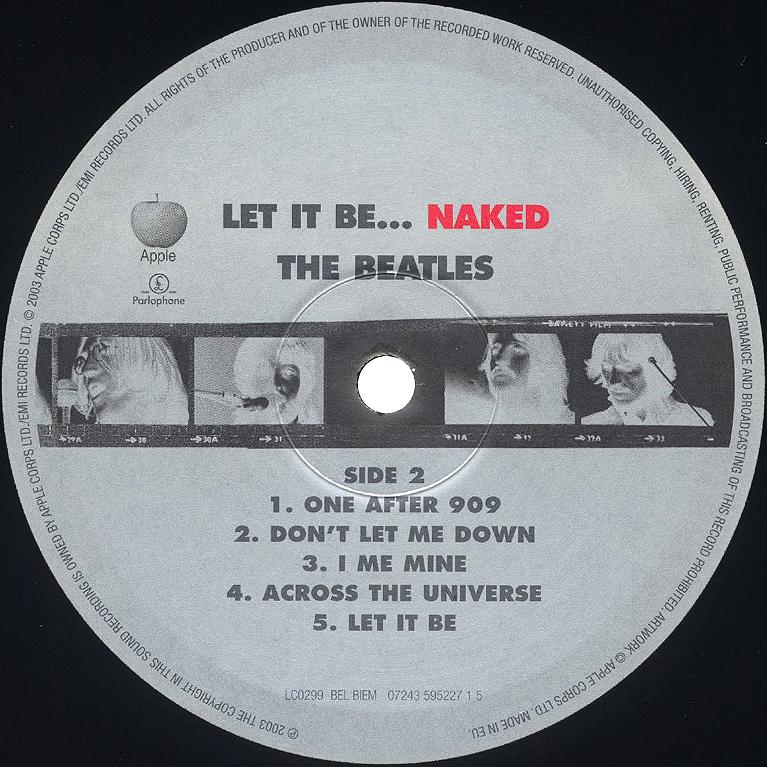
First pressing, November 17, 2003. Set include: ‘Let It Be… Naked’ album, 20-pages booklet and ‘Fly On The Wall’ 7″ single.
Unlaminated gatefold light grey glossy cover with Apple and Parlophone logos on the back side. The earliest gatefold sleeve has a misprint in the the writing credits on the back side. The words, ‘recordingis’ is written as one word. Later pressings have the corrected, ‘recording is’ as two words. Record housed in generic anti-static die-cut poly-lined dust inner sleeve without corners.
Earliest:Latest:


Light grey glossy labels with Apple and Parlophone logos. Matrix numbers scratched: Side 1: 5954380 1A1 SRz; Side 2: 5954380 1B1 SRz.


Booklet:


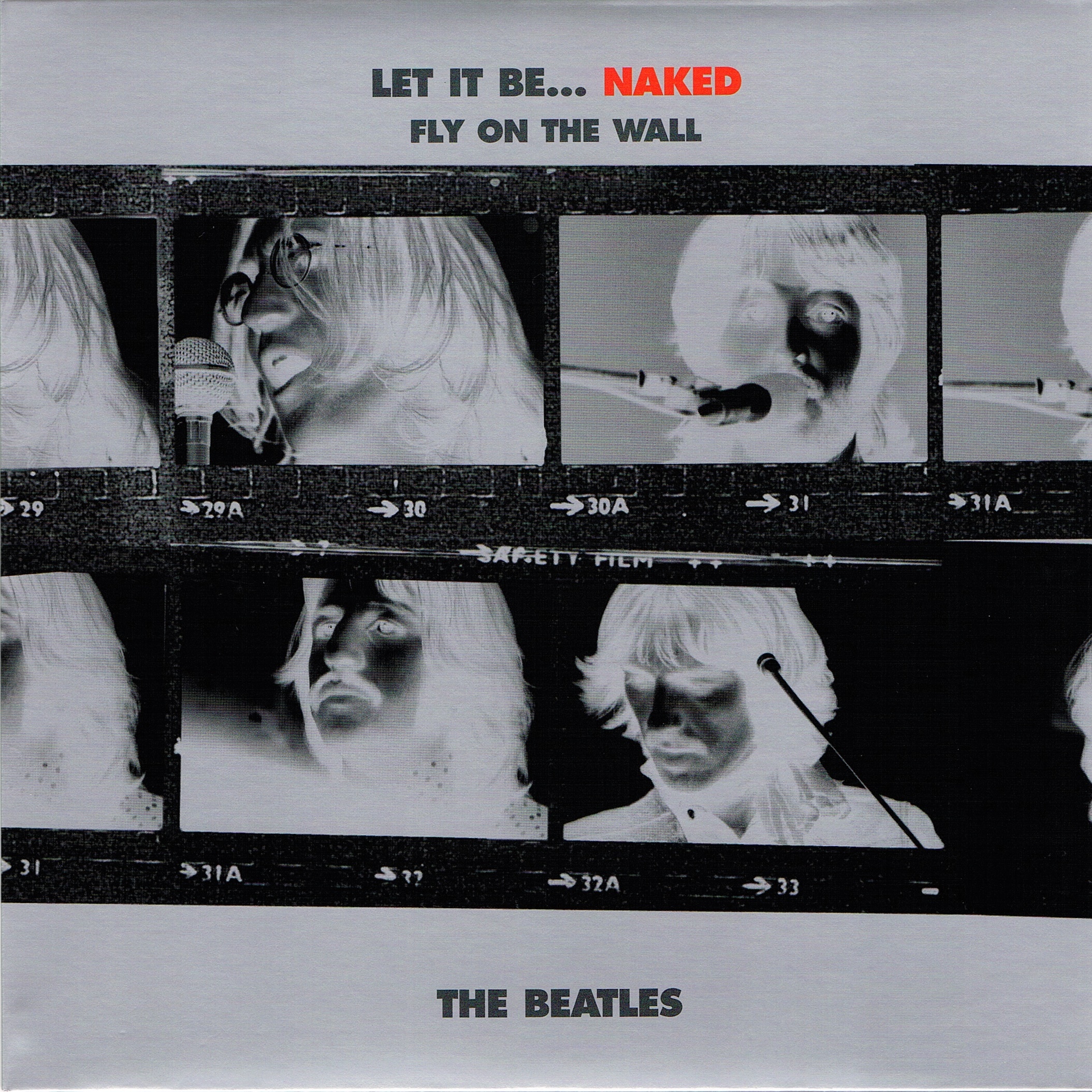
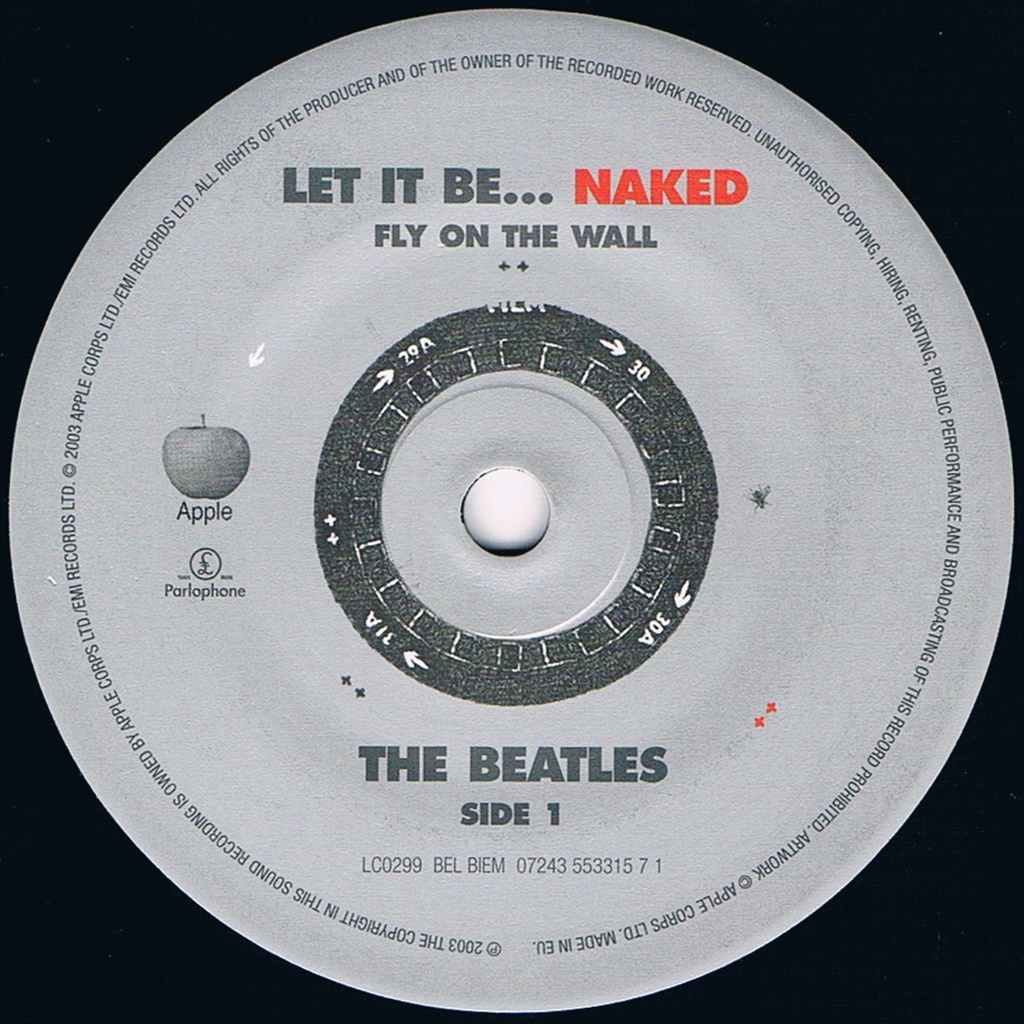
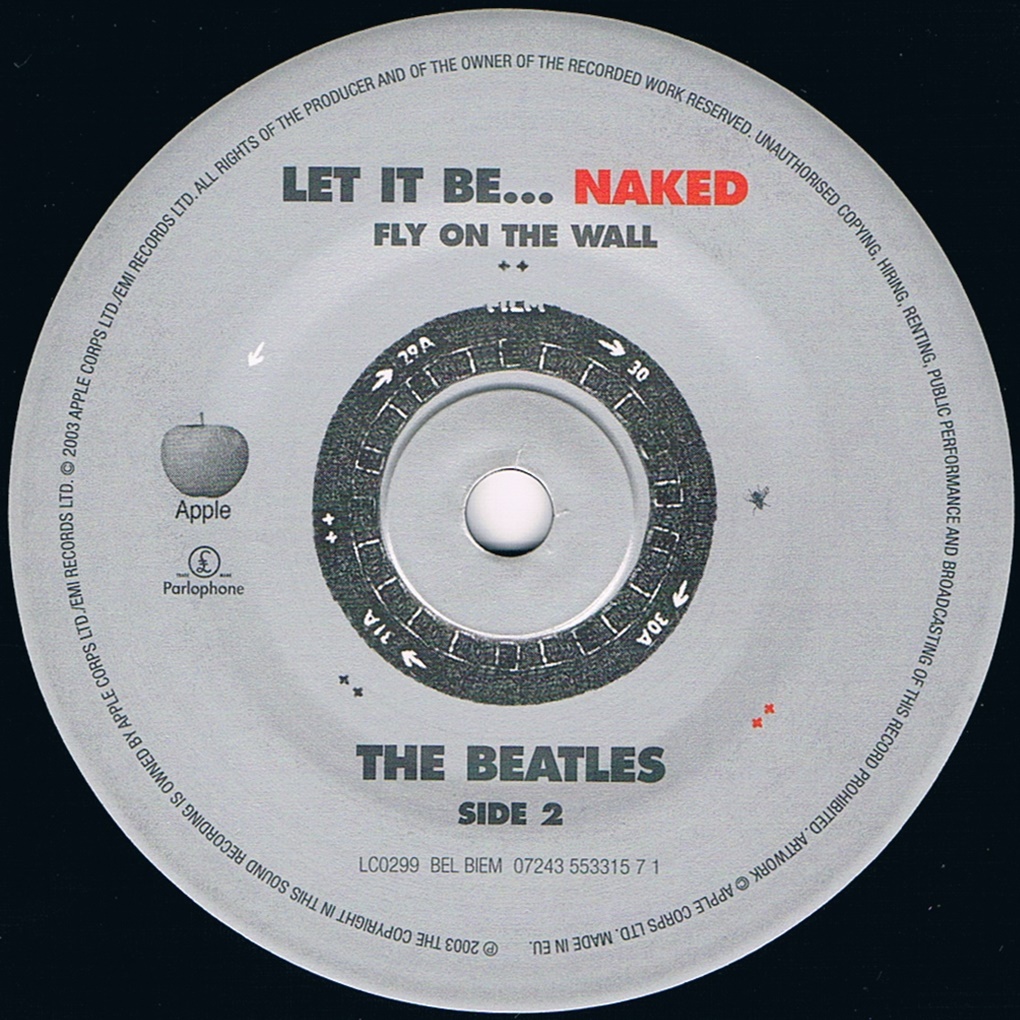
‘Fly On The Wall’ 7″ single. As part of the cleaning-up process, the brief jamming sequences and bits of humorous banter disappeared from the album, but this is more than compensated for by the ‘Fly On The Wall’ bonus single. 7″ sleeve has a misprint where credits are written. The words, ‘recordingis’ is written as one word.
Light grey glossy sleeve with die-cut on the back side.


Light grey glossy labels. Matrix numbers scratched: Side 1: 5954380 1A1; Side 2: 5954380 1B1.


Second pressing, 2010s. The second edition has pronounced differences: polygraphydarker, less contrast, paper thinner, gatefold sleeve has a smaller size. Difference in color is particularly noticeable on the back of the sleeve. In addition, the cover of second edition has is smaller sizes in width and height.
Unlaminated gatefold dark grey glossy cover with Apple and Parlophone logos on the back side.


Compare sizes of sleeves: size of the first edition is 32 x 31.5 cm, wide spine – 10 mm, size of the second edition – 31 x 31 cm, wide spine – 6 mm.


Dark grey glossy labels with Apple and Parlophone logos. Matrix numbers scratched: Side 1: 5954380 1A1 SRz; Side 2: 5954380 1B1 SRz.


‘Fly On The Wall’ 7″ single. Dark grey glossy sleeve without die-cut on the back side. Dark grey glossy labels. Matrix numbers scratched (hard to see): Side 1: 5954380 1A1; Side 2: 5954380 1B1.


posted in 17. Beatles Compilations. E-mail the author
Courtesy of : http://thebeatles-collection.com/wordpress/2016/10/25/let-it-be-naked-apple-parlophone-72435954380/
Over 30 yeas later, was advertised as “Let It Be as it was meant to be“, promising the original album as envisages prior to Spector’s involvement. In fact it was a brand new mix of the original tapes, produced by Poul Hicks, Guy Massey and Allan Rouse, all of whom had been involved in Anthology and Yellow Submarine songtrack projects. They created entirely new master version.
First pressing, November 17, 2003. Set include: ‘Let It Be… Naked’ album, 20-pages booklet and ‘Fly On The Wall’ 7″ single.
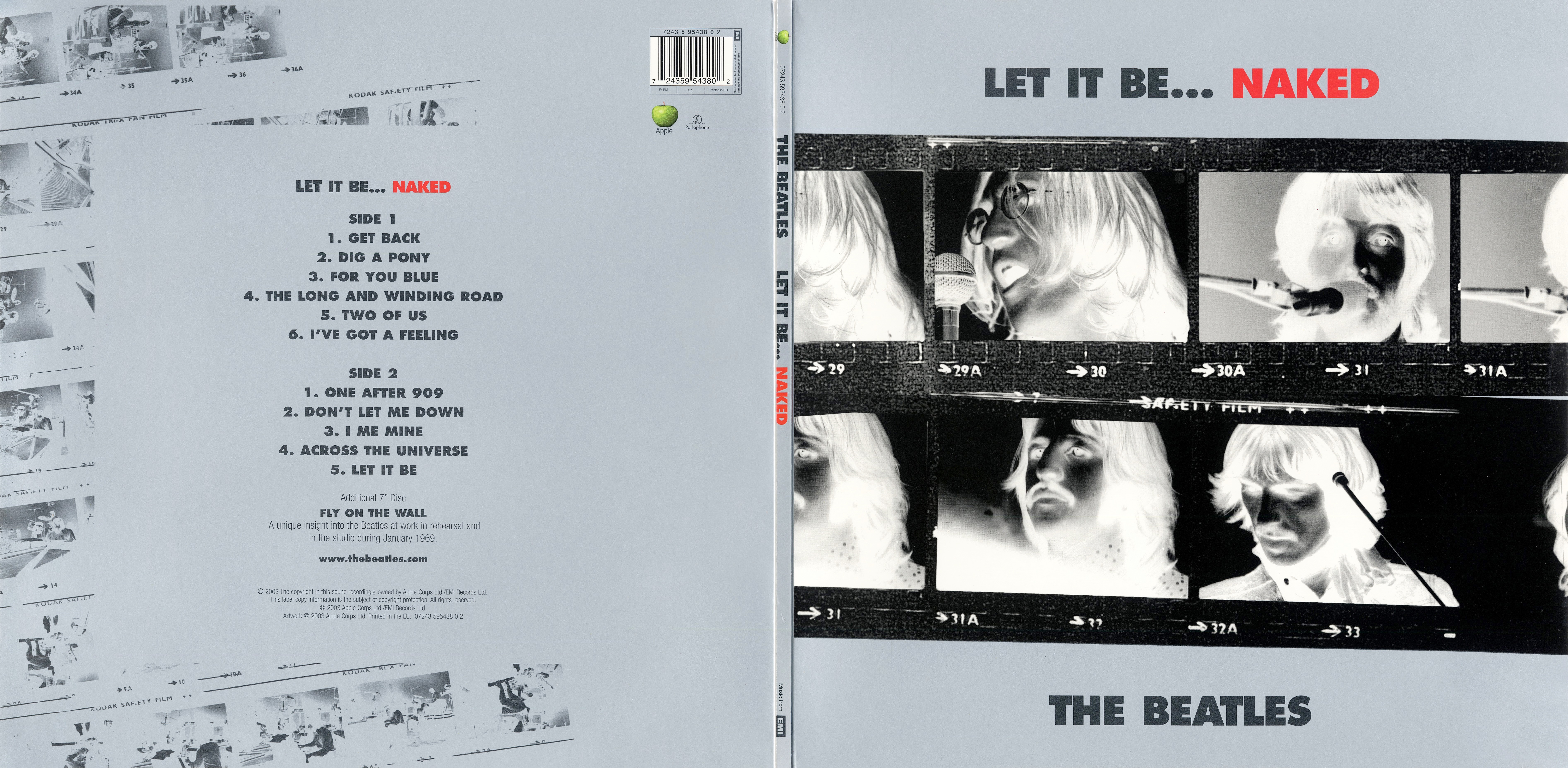
Unlaminated gatefold light grey glossy cover with Apple and Parlophone logos on the back side. The earliest gatefold sleeve has a misprint in the the writing credits on the back side. The words, ‘recordingis’ is written as one word. Later pressings have the corrected, ‘recording is’ as two words. Record housed in generic anti-static die-cut poly-lined dust inner sleeve without corners.
Earliest:Latest:

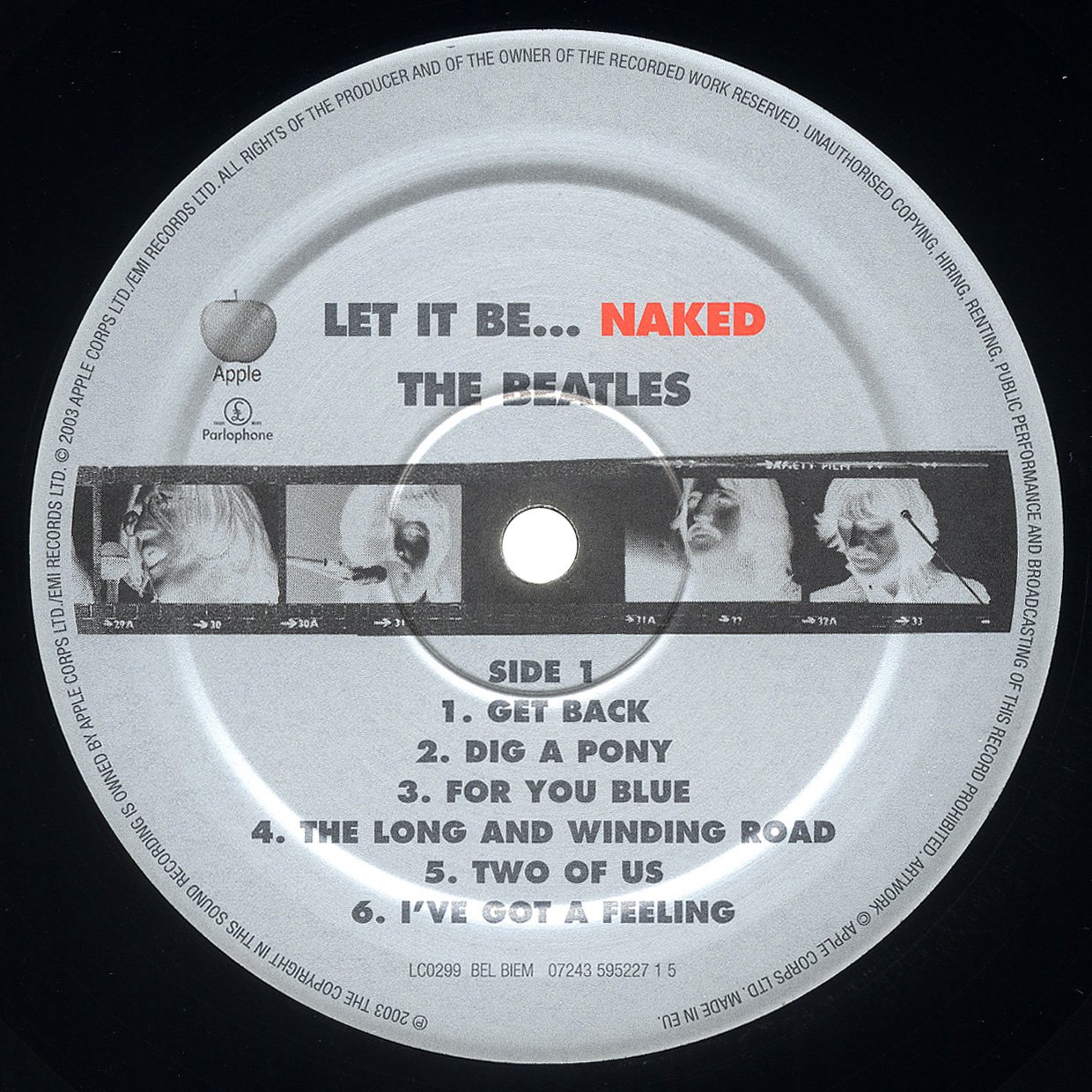
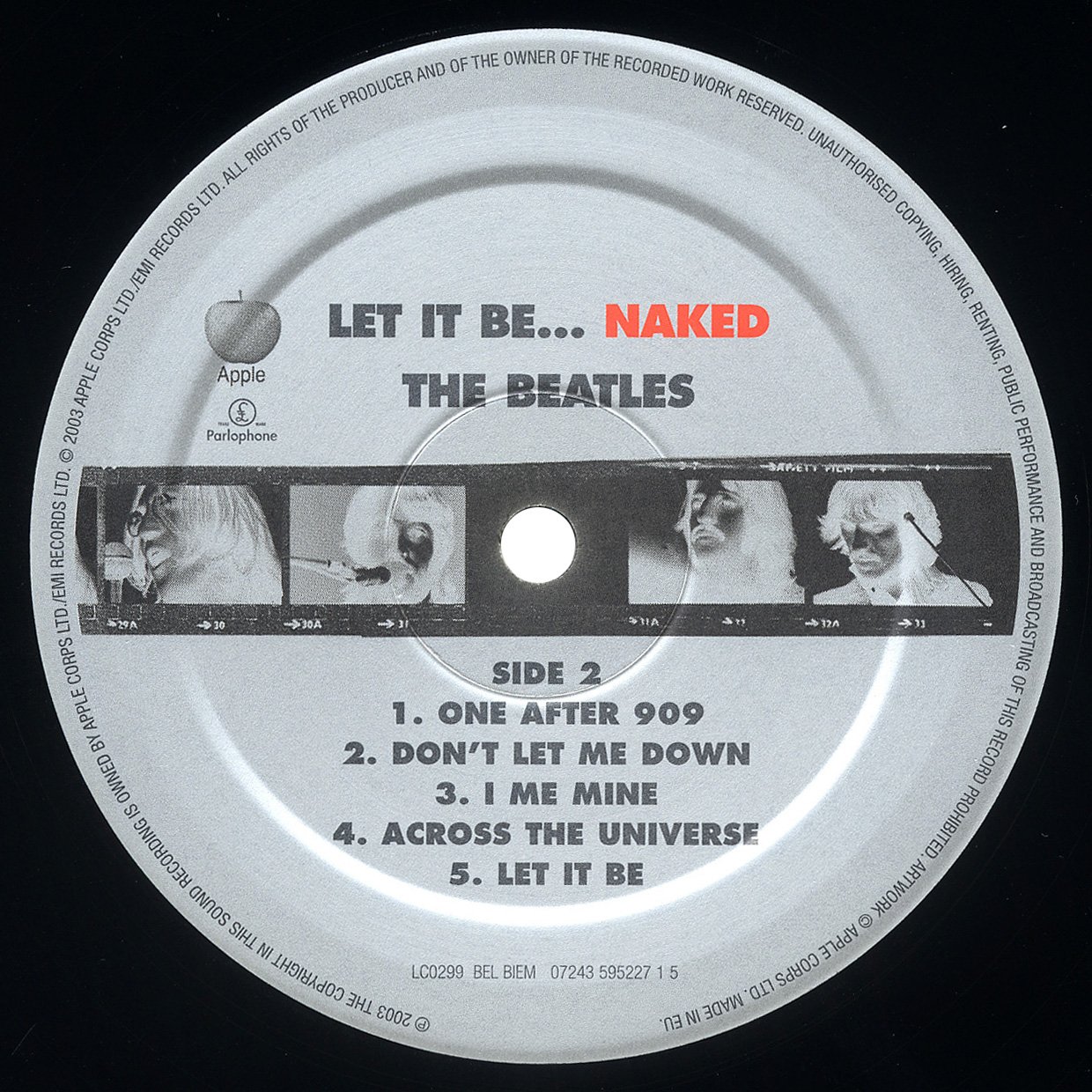
Light grey glossy labels with Apple and Parlophone logos. Matrix numbers scratched: Side 1: 5954380 1A1 SRz; Side 2: 5954380 1B1 SRz.
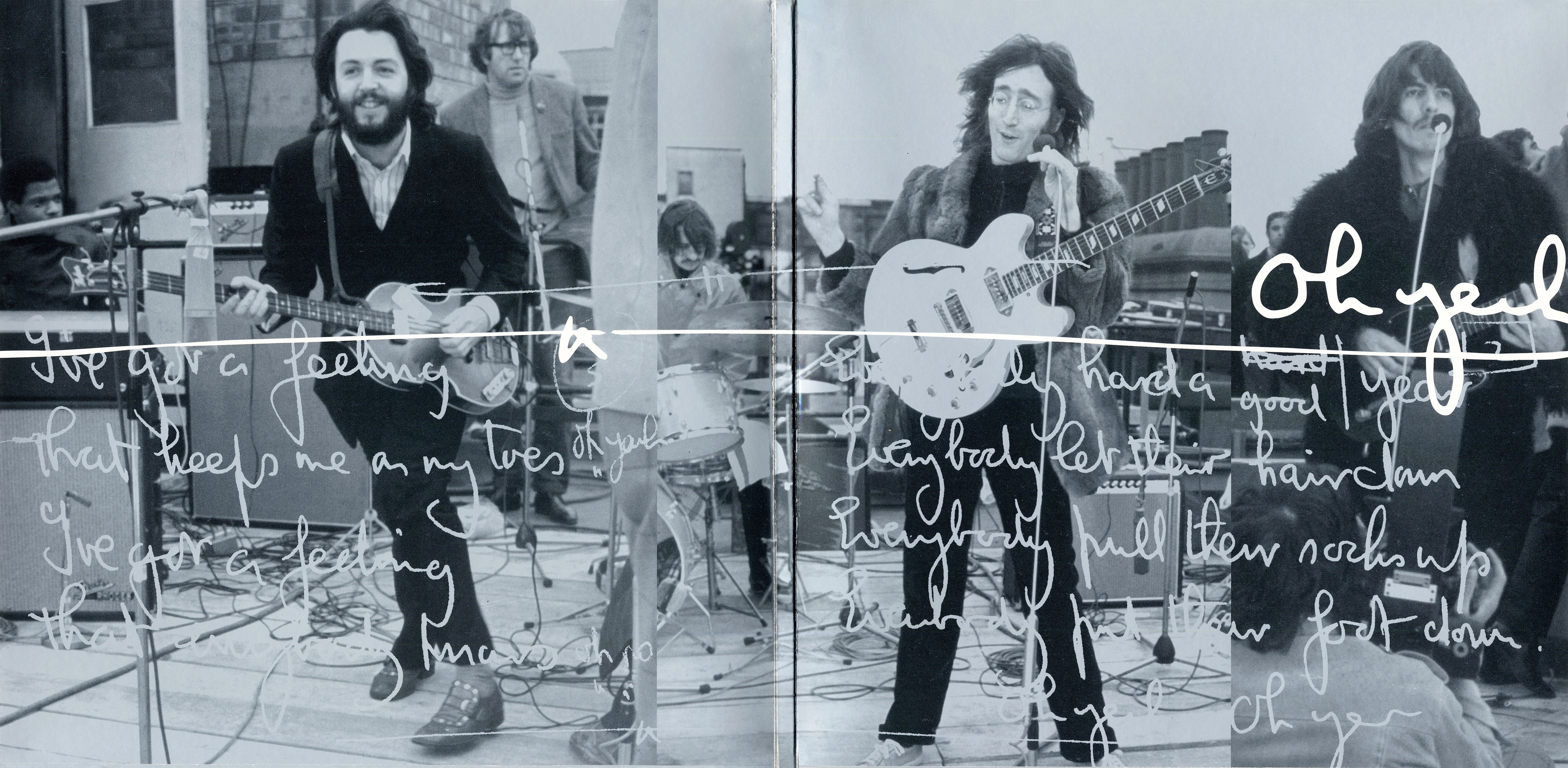
Booklet:
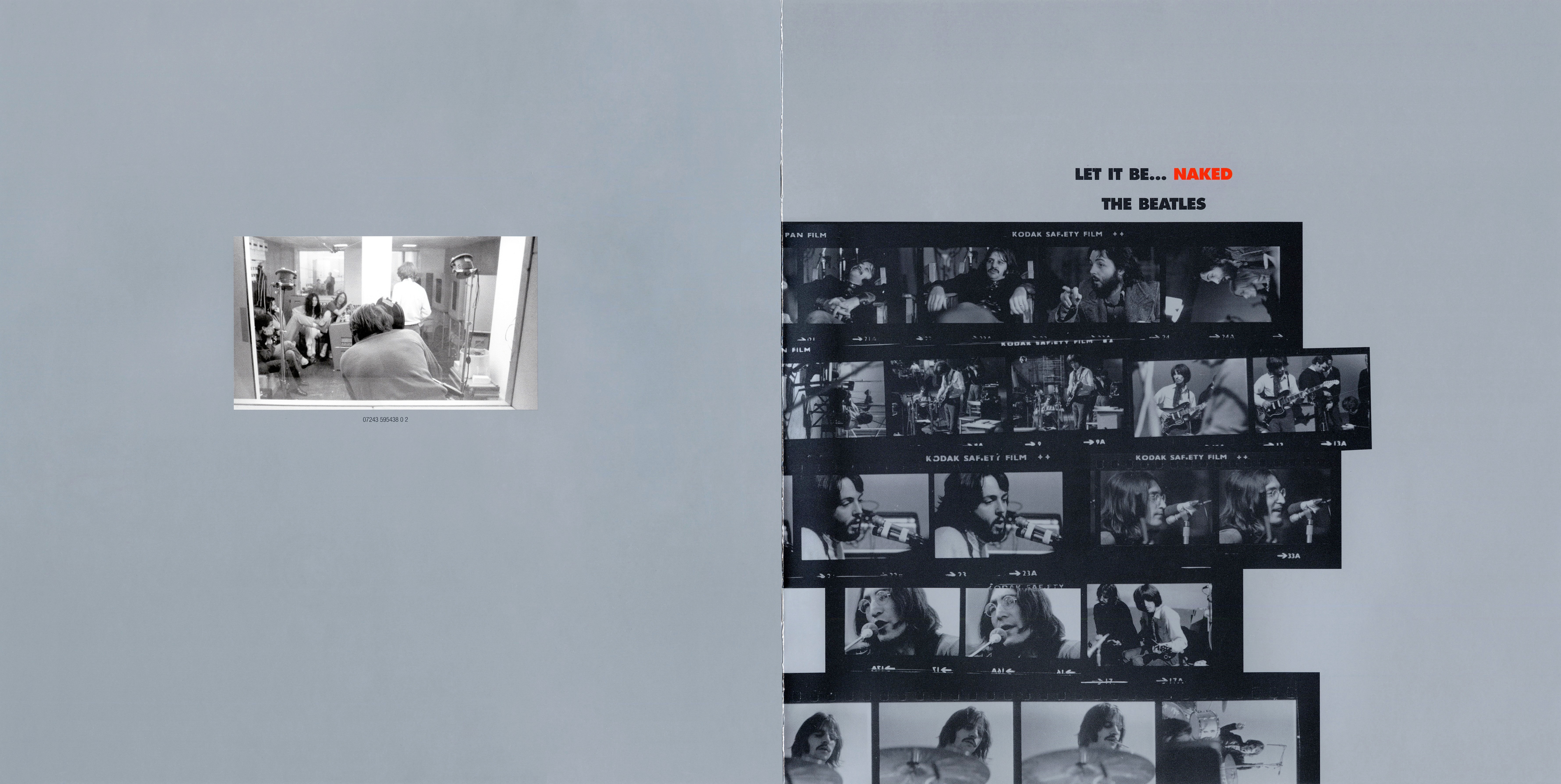
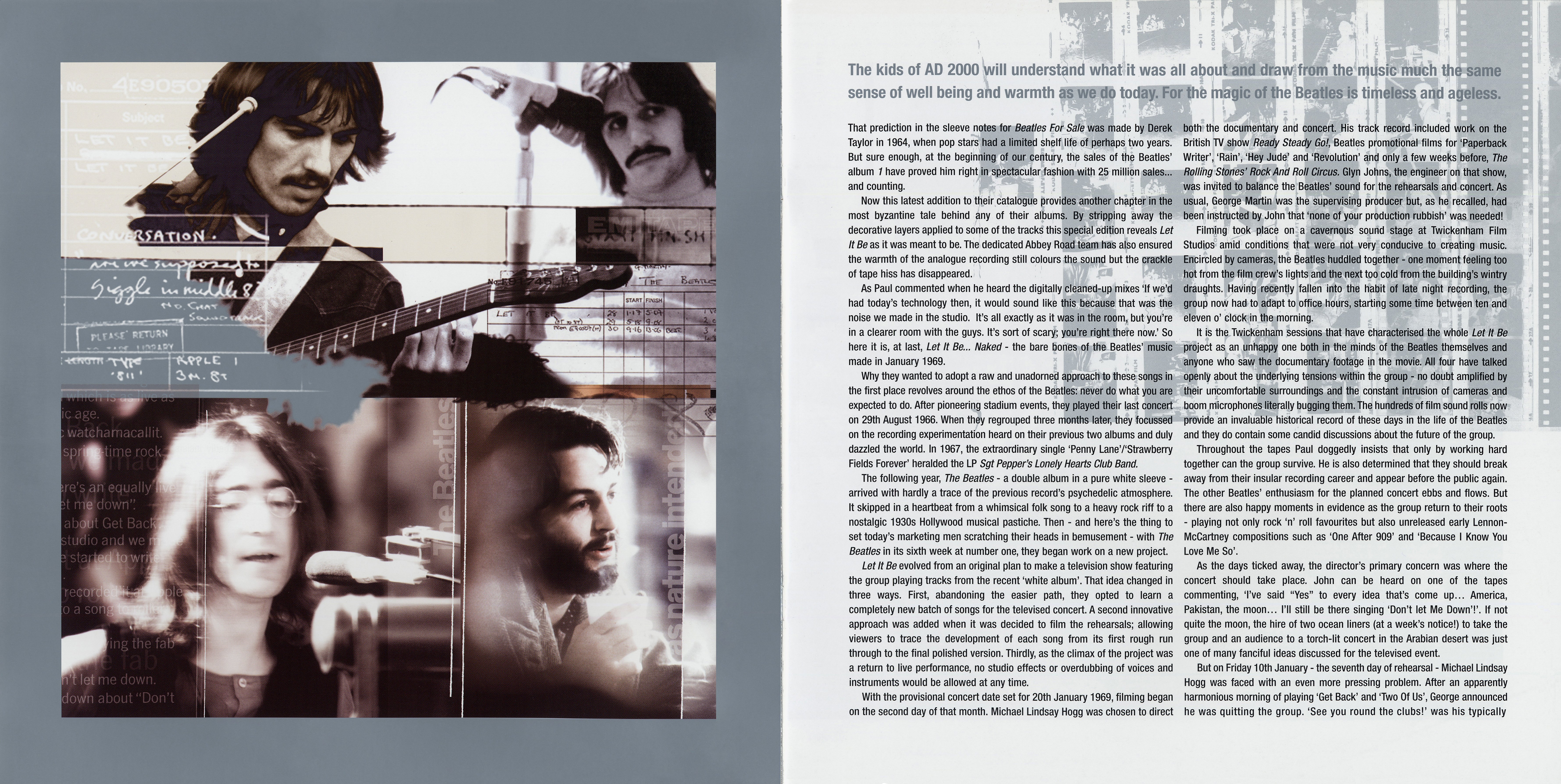
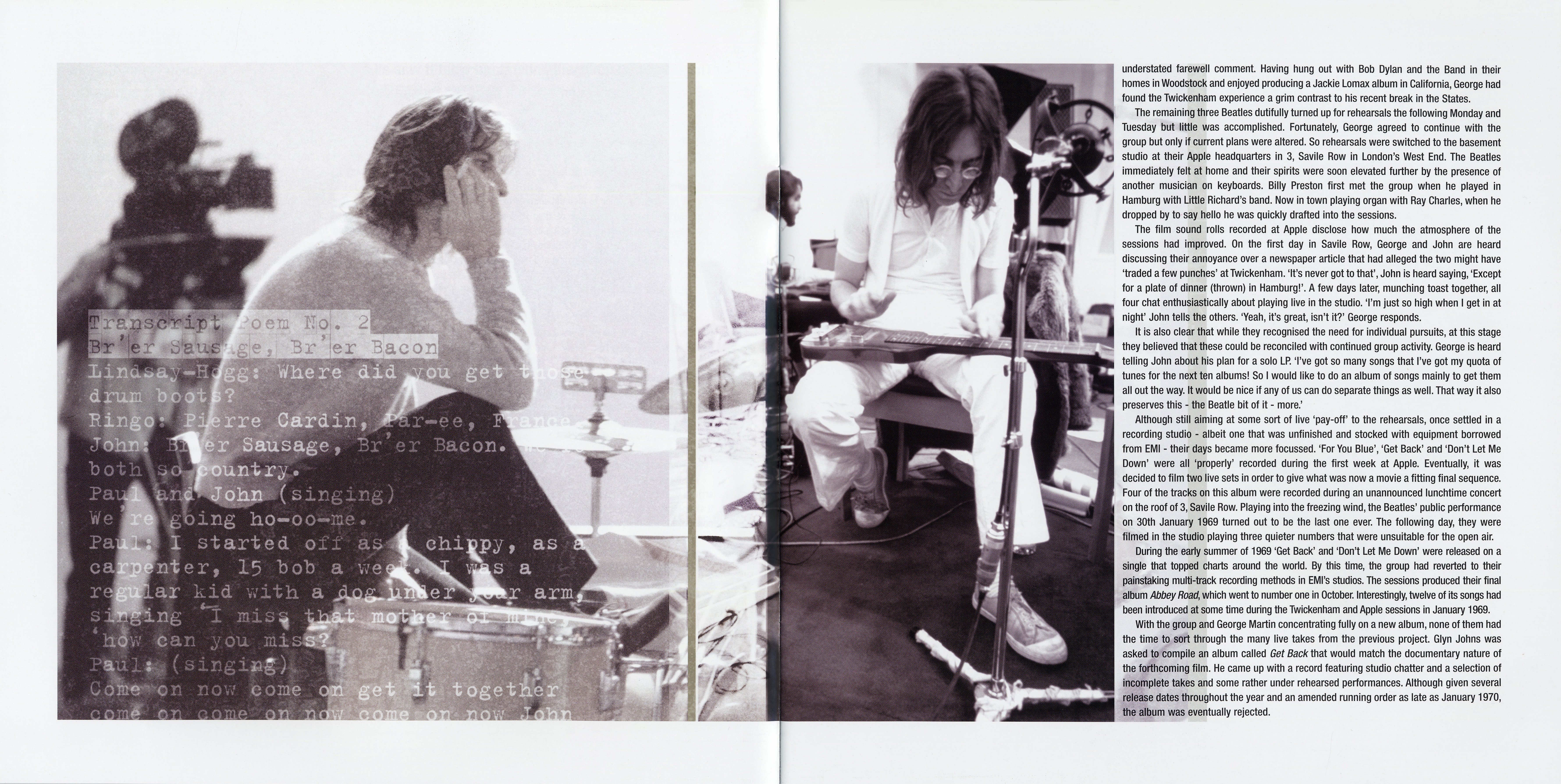
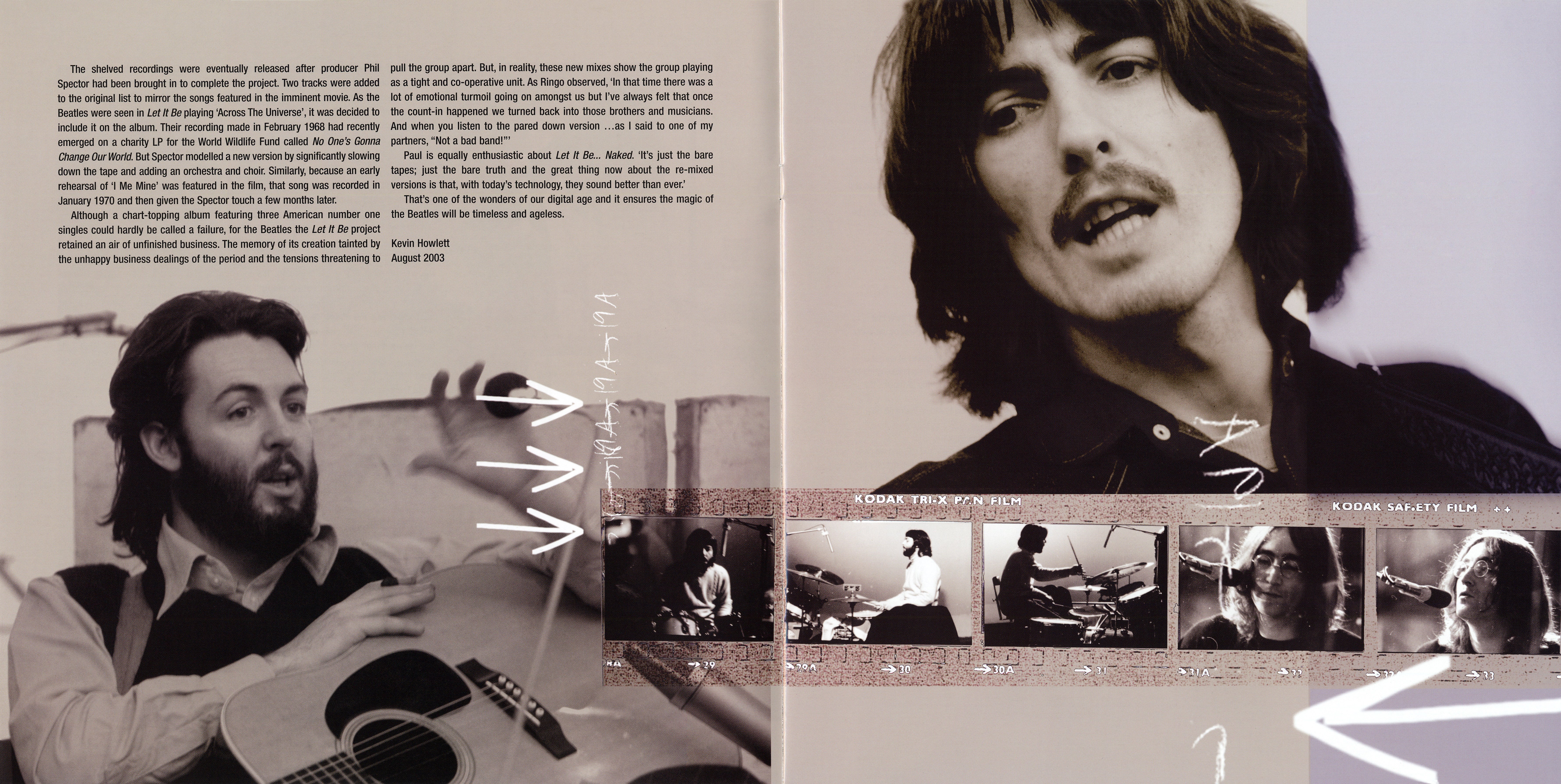
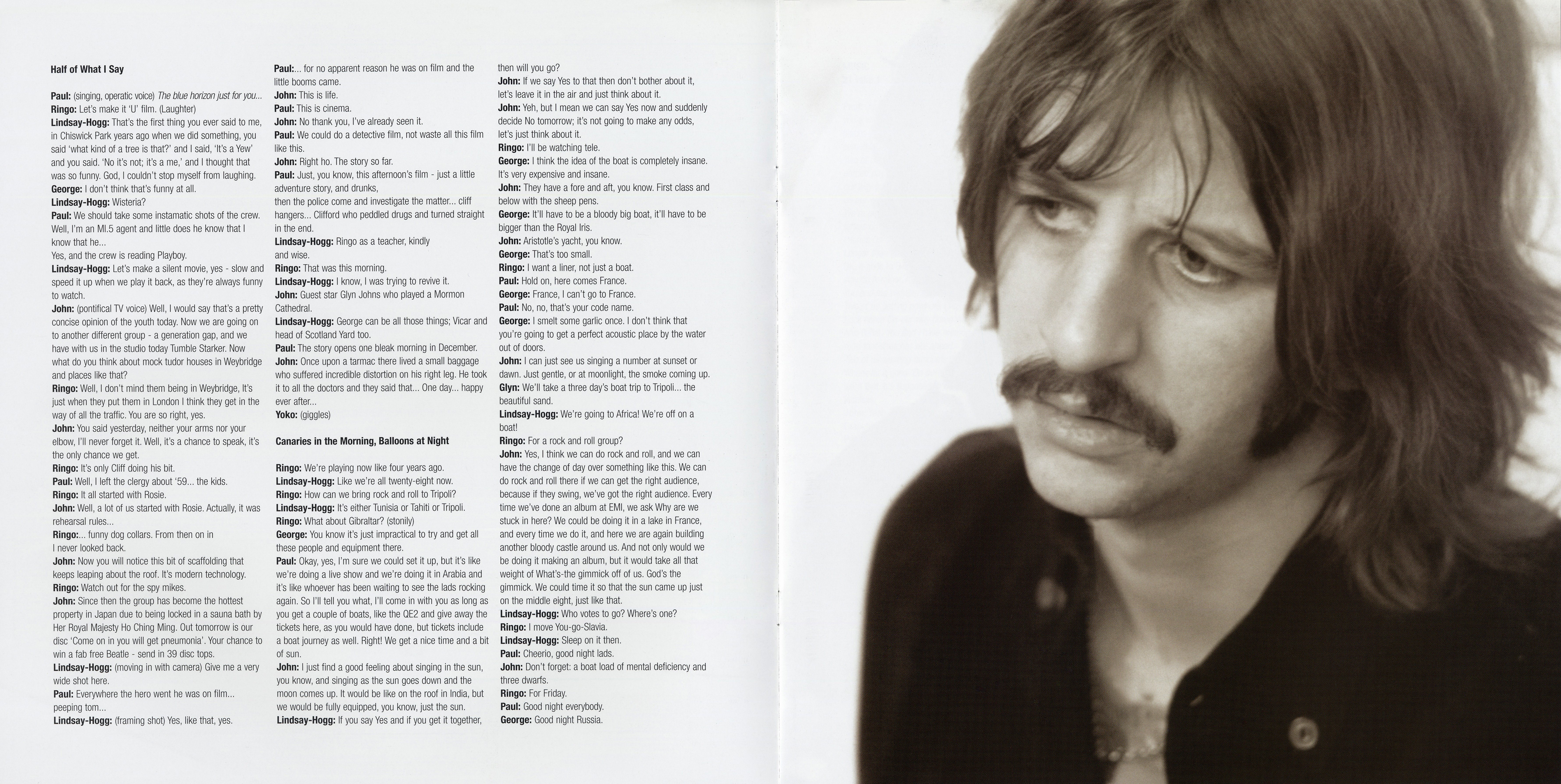

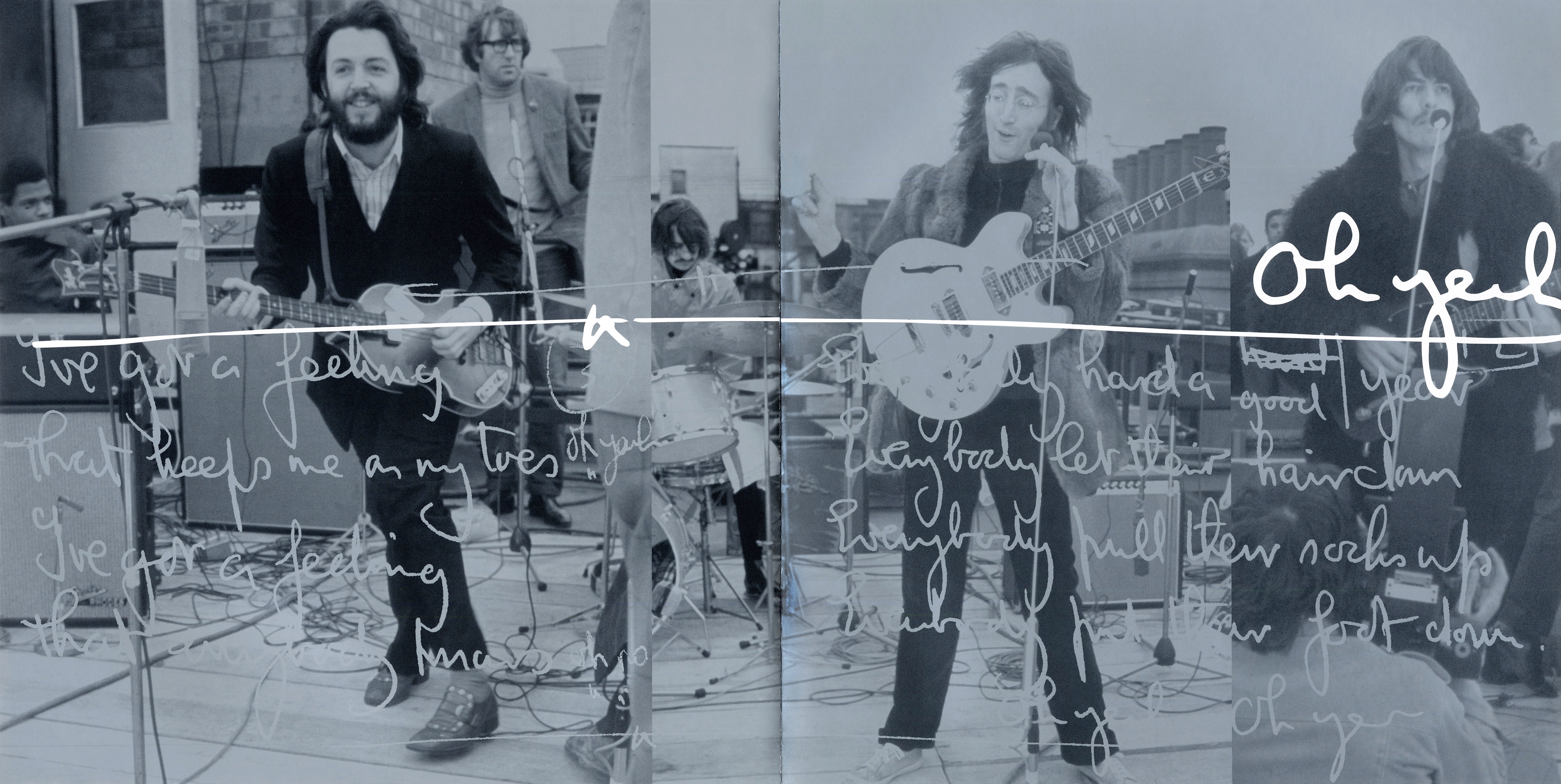
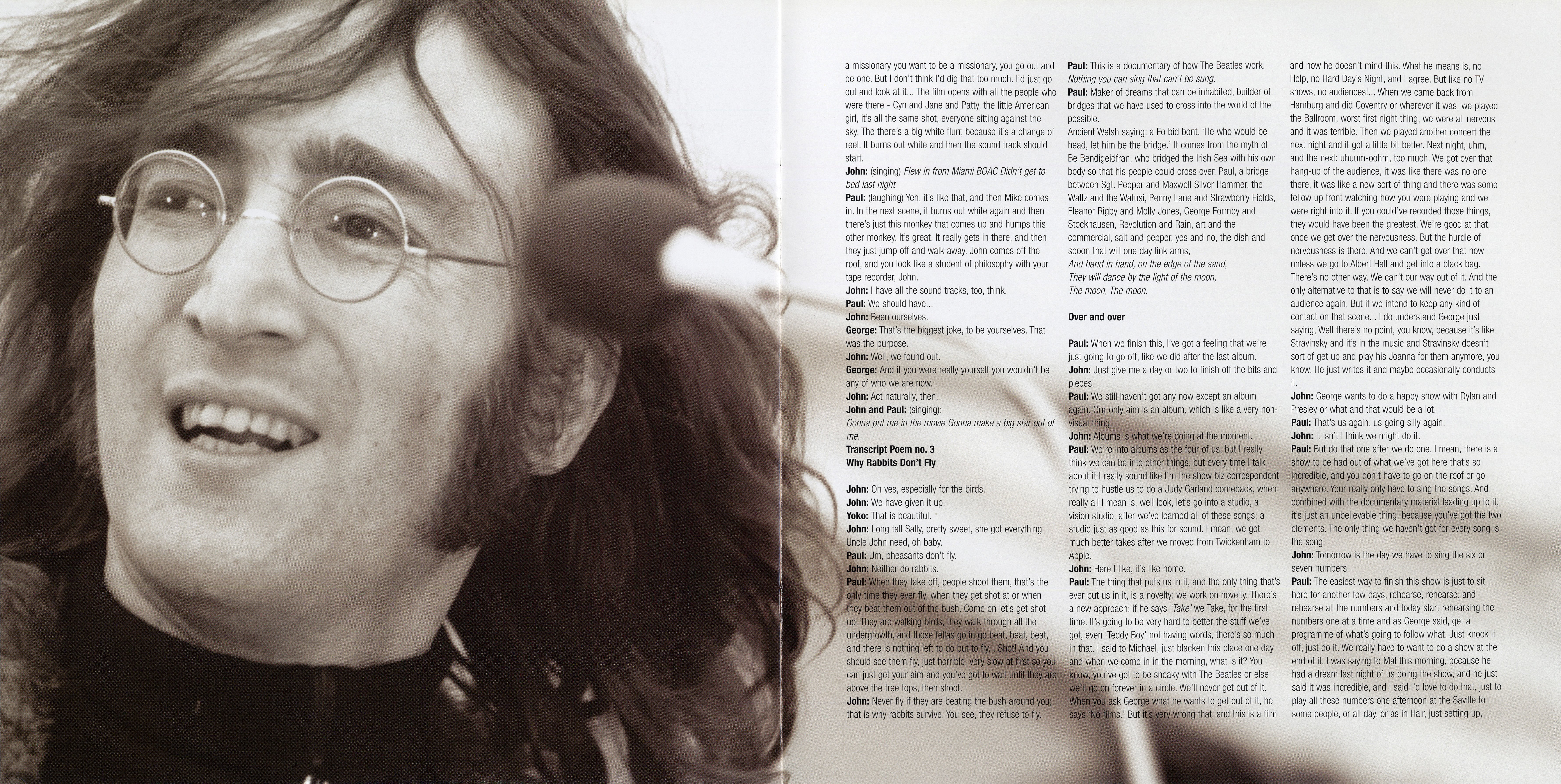
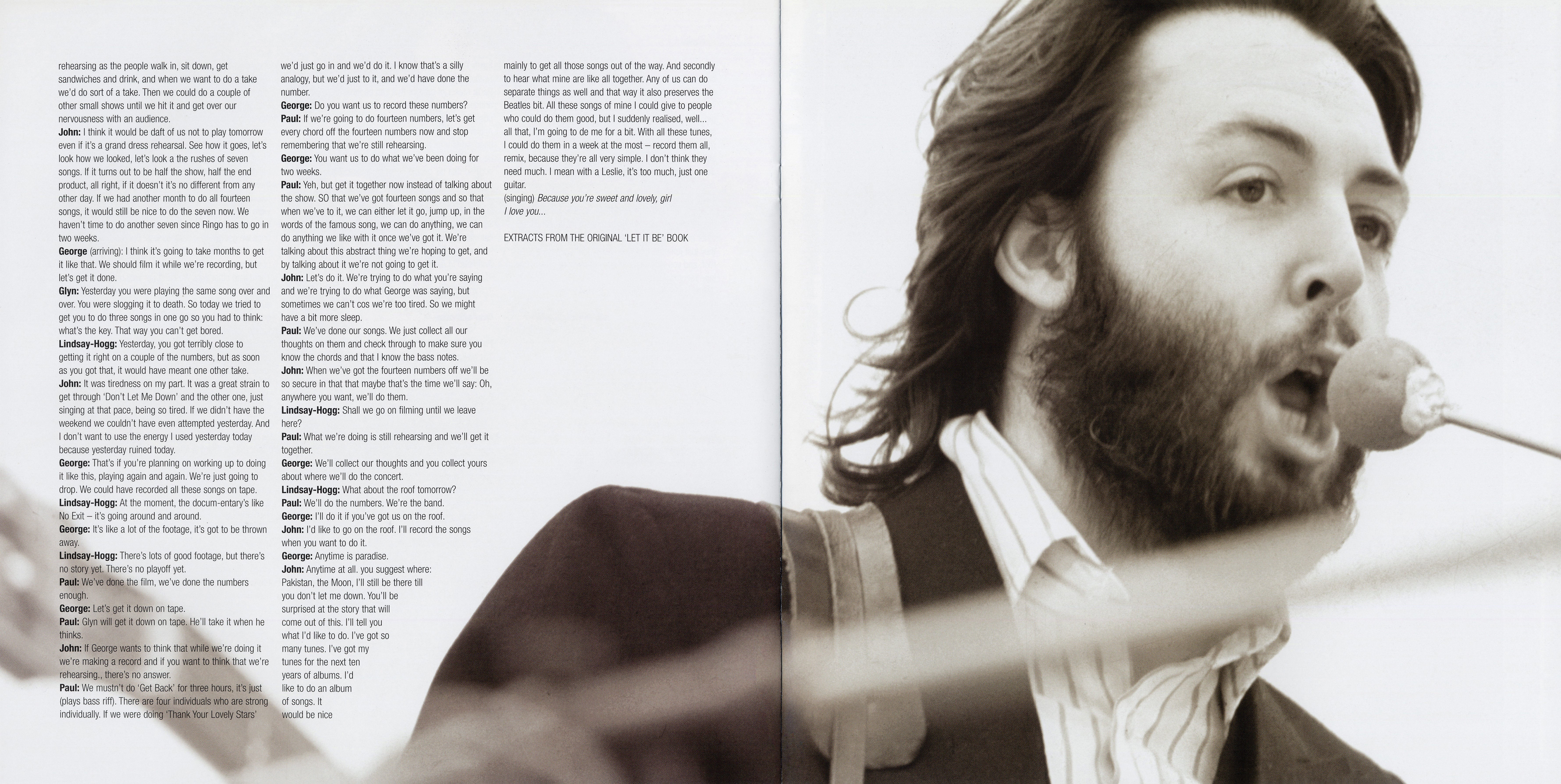
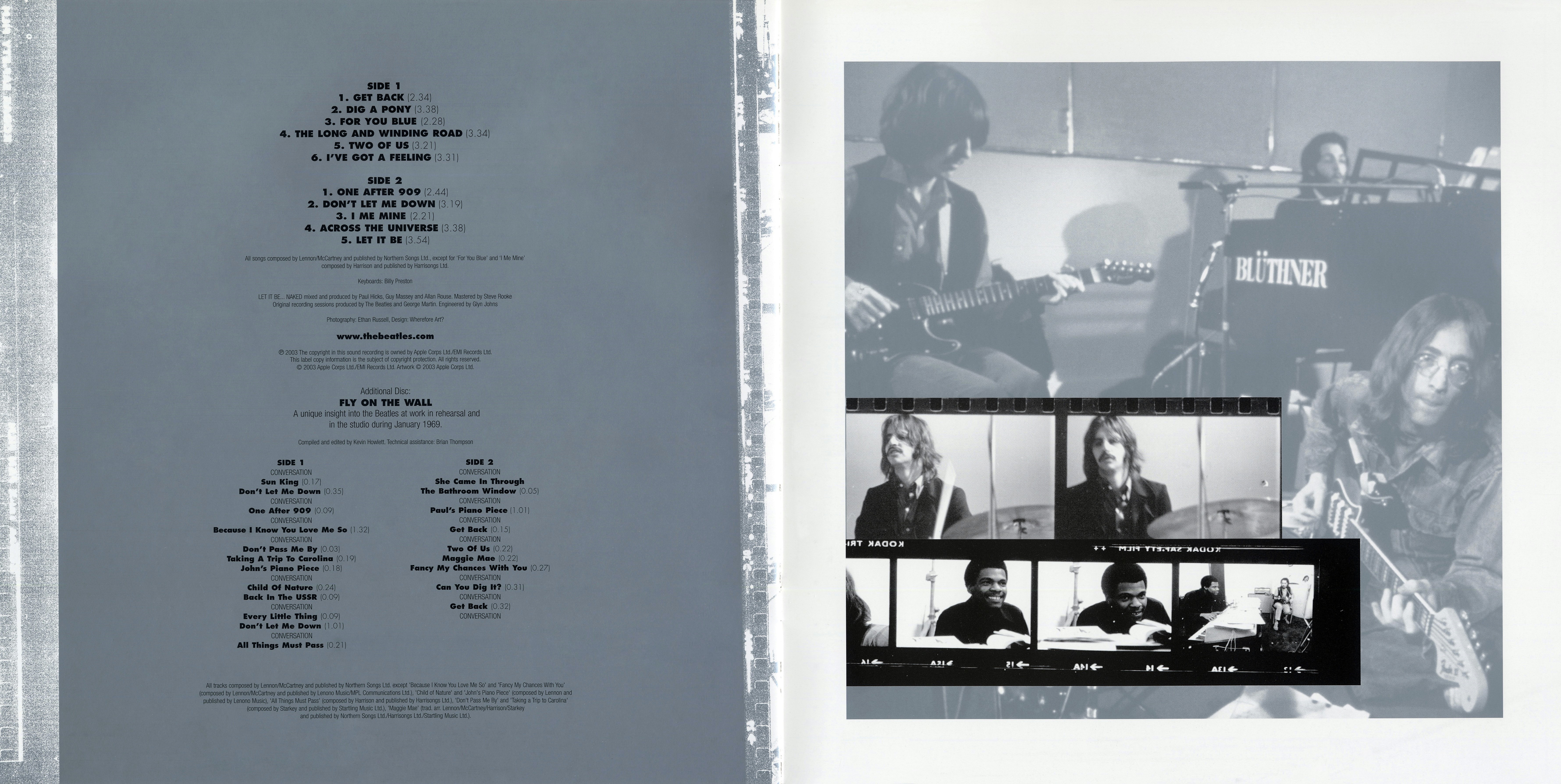
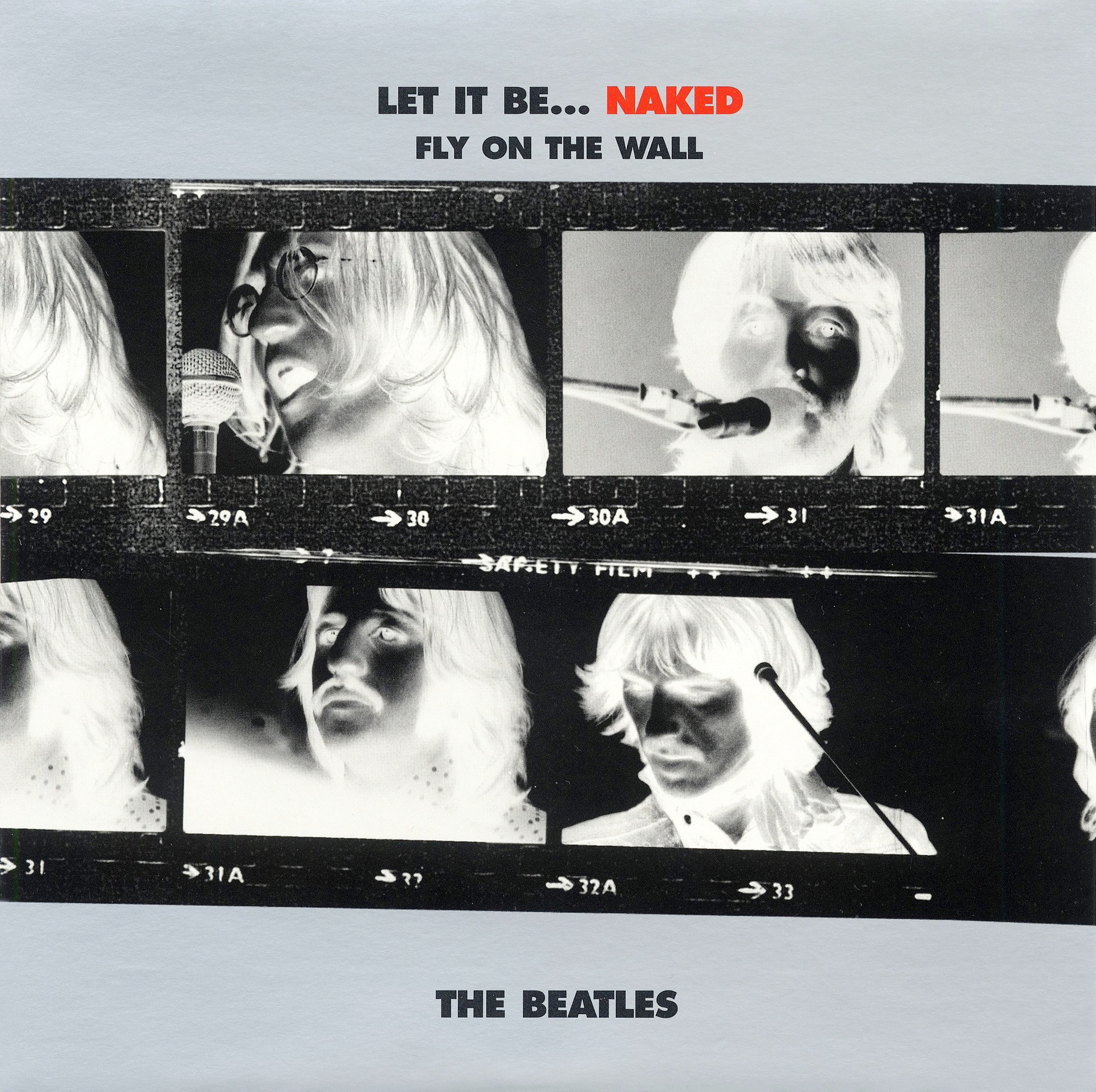
‘Fly On The Wall’ 7″ single. As part of the cleaning-up process, the brief jamming sequences and bits of humorous banter disappeared from the album, but this is more than compensated for by the ‘Fly On The Wall’ bonus single. 7″ sleeve has a misprint where credits are written. The words, ‘recordingis’ is written as one word.
Light grey glossy sleeve with die-cut on the back side.
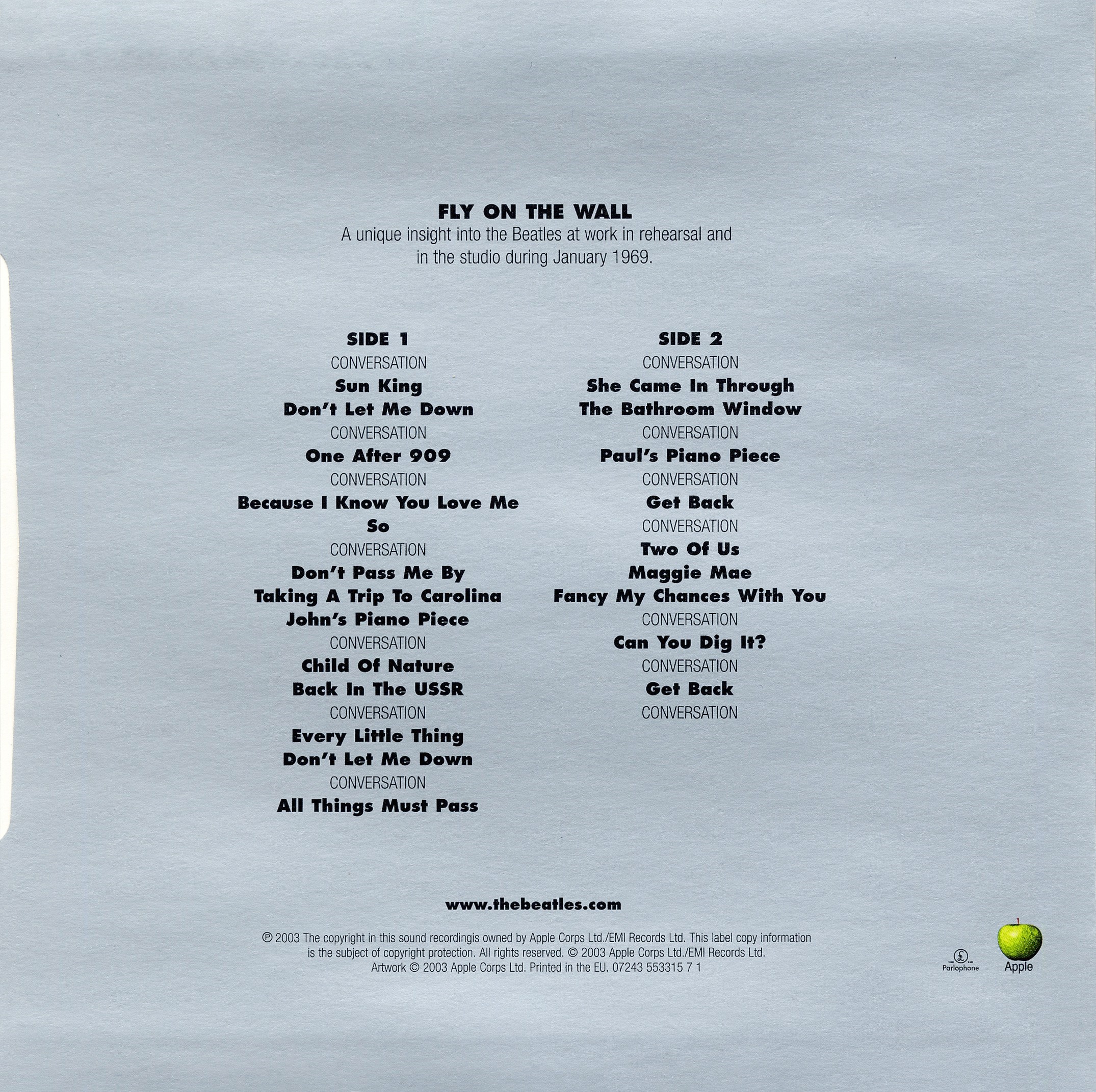
Light grey glossy labels. Matrix numbers scratched: Side 1: 5954380 1A1; Side 2: 5954380 1B1.
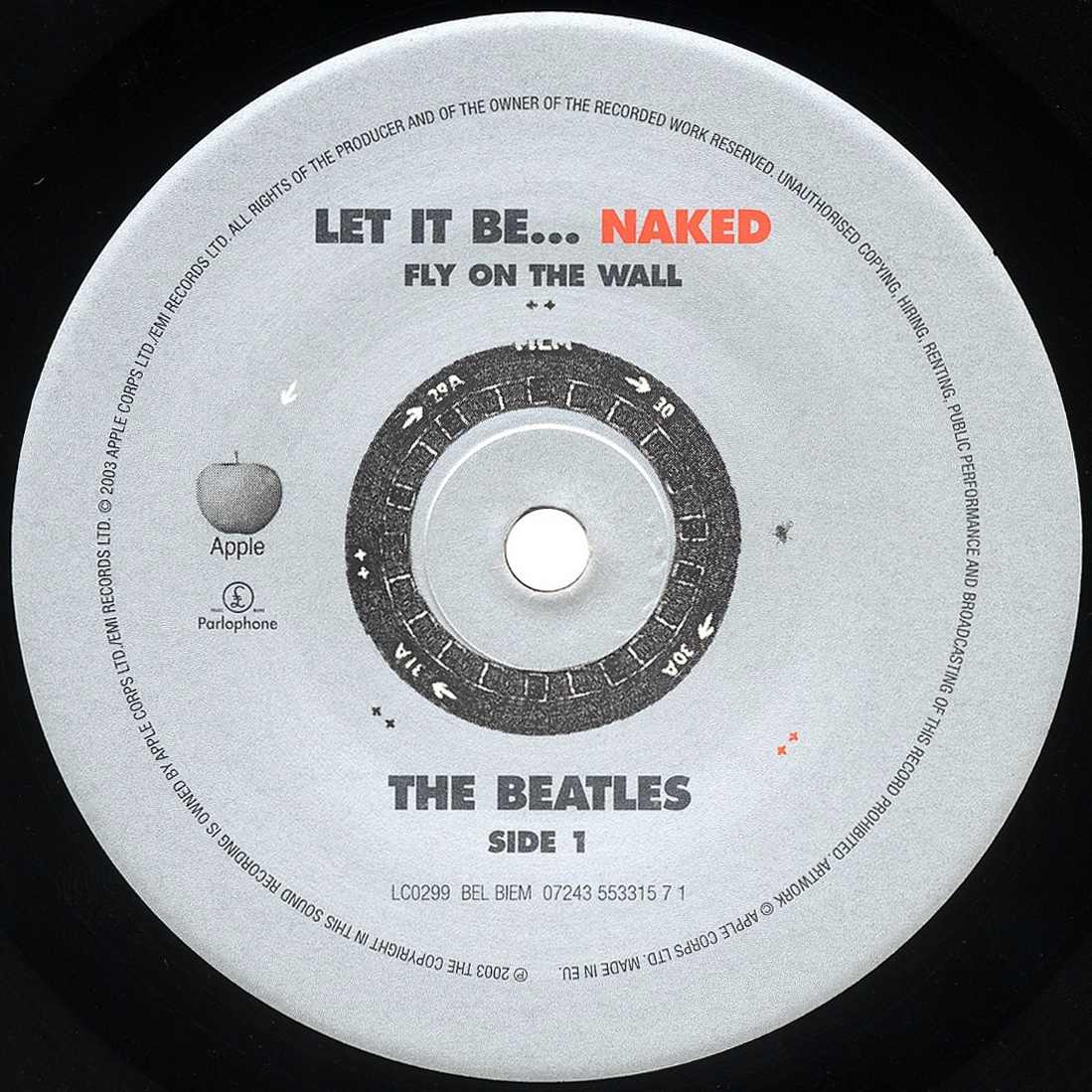
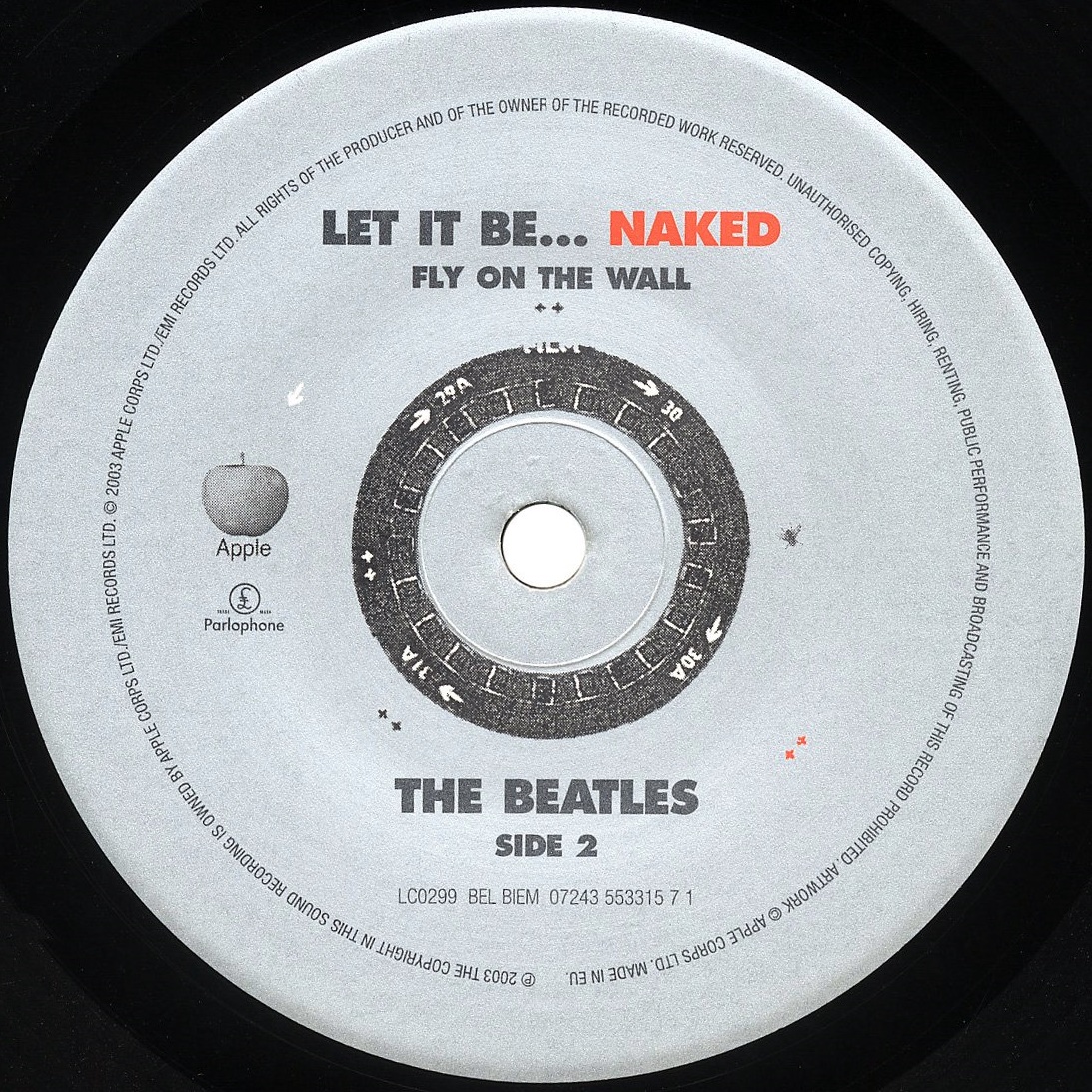
Second pressing, 2010s. The second edition has pronounced differences: polygraphydarker, less contrast, paper thinner, gatefold sleeve has a smaller size. Difference in color is particularly noticeable on the back of the sleeve. In addition, the cover of second edition has is smaller sizes in width and height.
Unlaminated gatefold dark grey glossy cover with Apple and Parlophone logos on the back side.
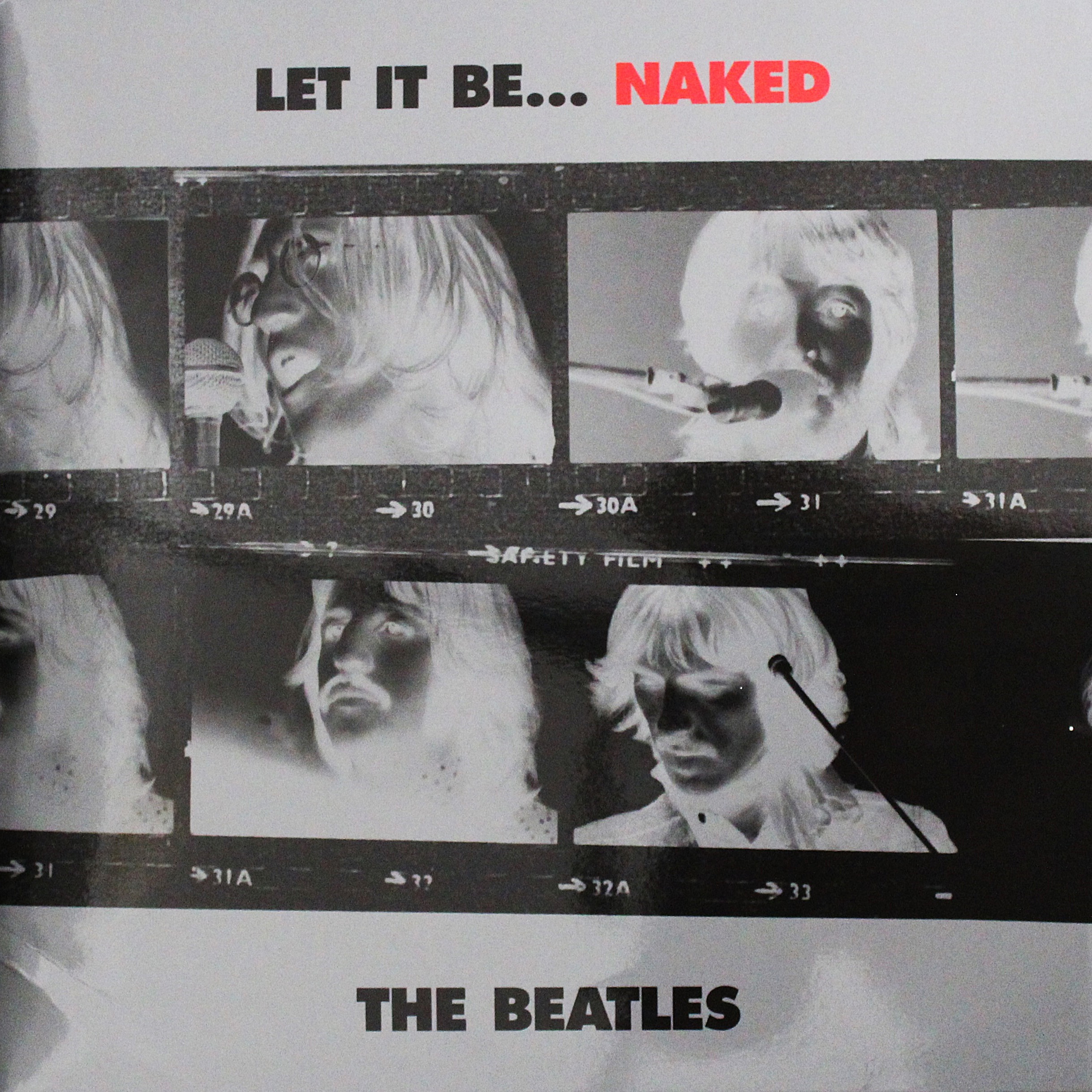
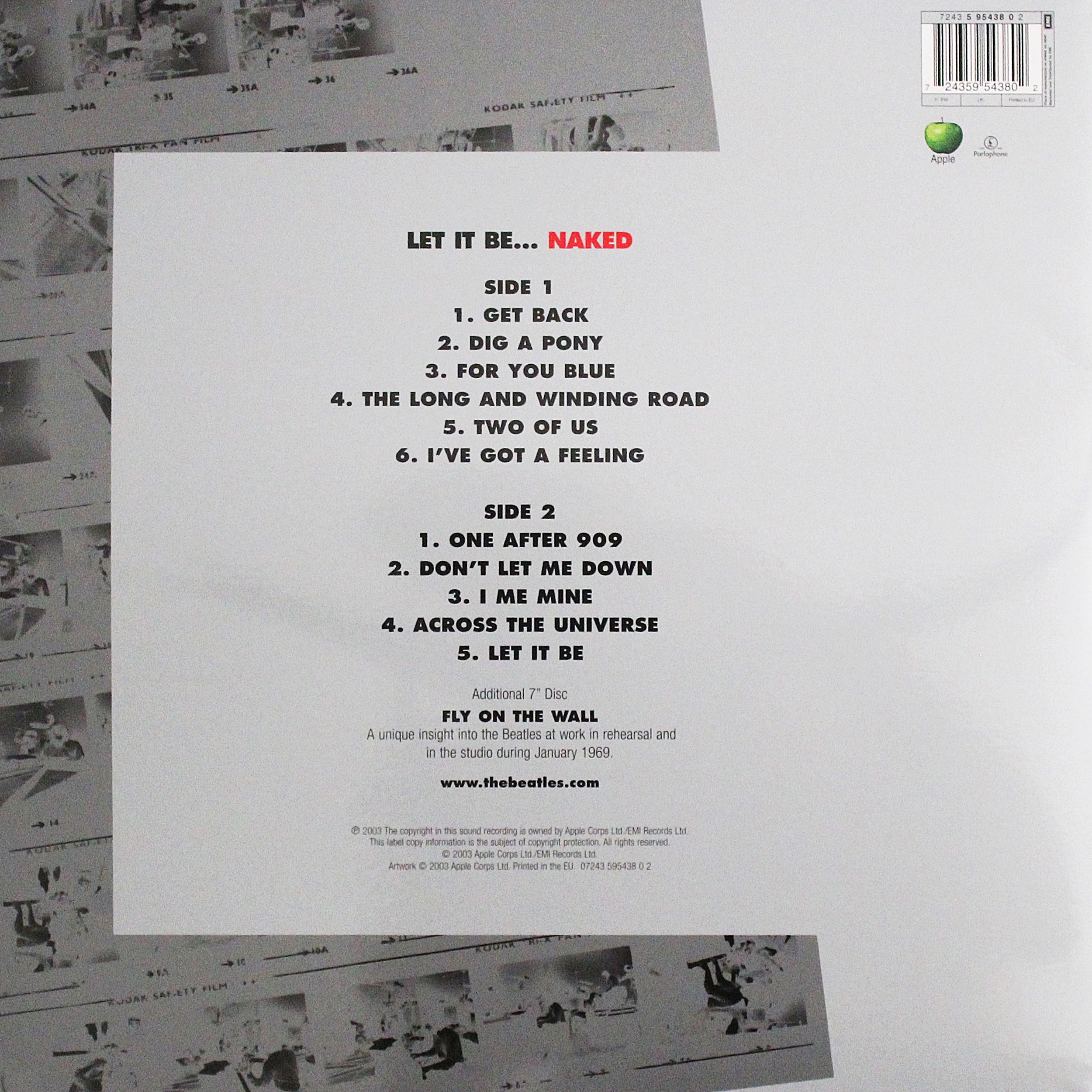
Compare sizes of sleeves: size of the first edition is 32 x 31.5 cm, wide spine – 10 mm, size of the second edition – 31 x 31 cm, wide spine – 6 mm.


Dark grey glossy labels with Apple and Parlophone logos. Matrix numbers scratched: Side 1: 5954380 1A1 SRz; Side 2: 5954380 1B1 SRz.
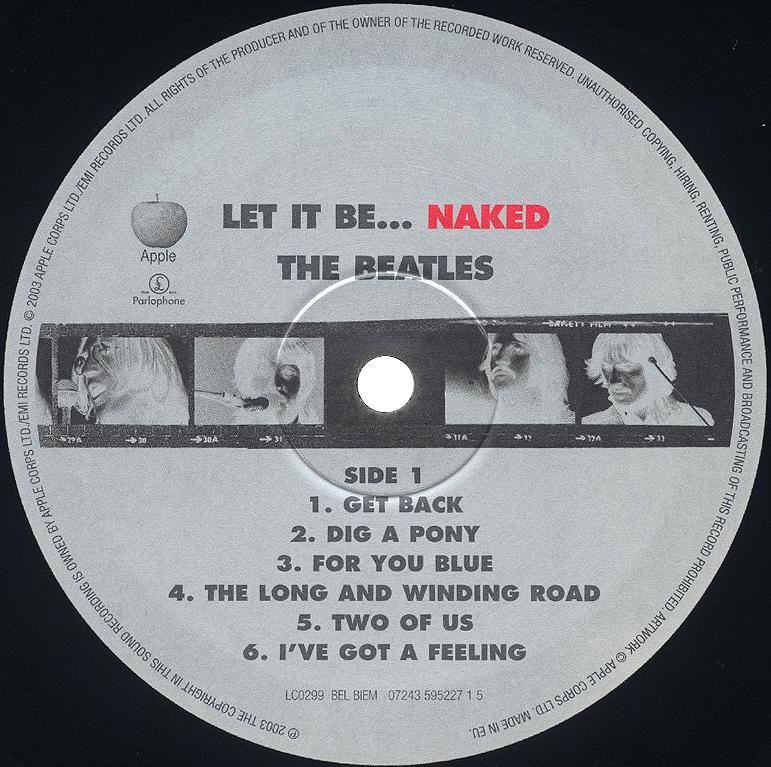
‘Fly On The Wall’ 7″ single. Dark grey glossy sleeve without die-cut on the back side. Dark grey glossy labels. Matrix numbers scratched (hard to see): Side 1: 5954380 1A1; Side 2: 5954380 1B1.

posted in 17. Beatles Compilations. E-mail the author
Courtesy of : http://thebeatles-collection.com/wordpress/2016/10/25/let-it-be-naked-apple-parlophone-72435954380/
January 09, 2021
Restoration of the Beatles 1 Video Collection - 5 Segments
Many people are unaware of the amount of effort spent on restoring the Beatles promotional videos. These can now be seen in the Beatles 1+ video project.
While this release dates back to October 15th, 2015, it is worth revisiting.
Restoration of The Beatles 1 Video Collection: Part 1/5
Restoration of The Beatles 1 Video Collection: Part 2/5
Restoration of The Beatles 1 Video Collection: Part 3/5
Restoration of The Beatles 1 Video Collection: Part 4/5
Restoration of The Beatles 1 Video Collection: Part 5/5
January 07, 2021
Sneak Peek – ‘The Beatles: Get Back’ Movie
In the vacuum of the year-long delay surrounding Peter Jackson’s film The Beatles: Get Back, the director has given us something of a holiday treat by releasing this terrific sneak peek teaser:
The sound, colour and clarity are fantastic, as is the mood of joy depicted.
Now, Jackson is at pains to say that this is neither a trailer nor a completed sequence from the film, but rather something to give us a flavour of what to expect.
It’ll therefore be interesting to see how the finished product comes up, because anyone with enough footage (and Jackson has more than 56 hours of it!) can edit together just the fun moments and make it look like everything with the band was hunky dory. We know this was not the case and that they were getting on each other’s nerves for quite a lot of the time as well.
However, this teaser is such fun to watch. It’s great to see The Beatles clowning around and enjoying themselves. We just hope there’s not too much history being revised.
From the web: “Acclaimed filmmaker Peter Jackson has released an exclusive sneak peek of his upcoming documentary The Beatles: Get Back for fans everywhere to enjoy. The 5-minute special look is available to fans worldwide on TheBeatles.com and streaming on Disney+.
Jackson said, “We wanted to give the fans of The Beatles all over the world a holiday treat, so we put together this five-minute sneak peek at our upcoming theatrical film The Beatles: Get Back. We hope it will bring a smile to everyone’s faces and some much-needed joy at this difficult time.”
The feature-length film is set to open in theatres on August 27, 2021.
Can’t wait!
Source: https://beatlesblogger.com/2020/12/22/sneak-peek-the-beatles-get-back-movie/
Source: https://beatlesblogger.com/2020/12/22/sneak-peek-the-beatles-get-back-movie/
January 04, 2021
Beatles Let It Be Extended Cut on Blu Ray
BLU-RAY/DVD DESCRIPTION AND REVIEW OF THIS VERSION
BY BEATLES EXPERT AND COLLECTOR MARK LACKEY
I have been a collector of Beatles music and films for over 40 years and recently acquired an interesting expanded version of the Let It Be documentary. As most Beatles fans are already aware, the Let It Be film chronicles The Beatles at both Twickenham and Apple studios during January 1969 discussing, rehearsing and recording their latest batch of songs. The film concludes with the band’s last live performance, an impromptu mini-concert on the rooftop of London’s Apple studio on Saville Row. The January 30, 1969 lunch-hour performance came as a complete surprise to downtown Londoners, some of whom complained about the noise until the police shut down the whole affair after about 45 minutes. By the time the film made it to the theaters in 1970, The Beatles had broken up. While the other Beatles movies have all been re-released on VHS, DVDs and Blu-Ray disks over the years, Let It Be has become out of print since the Beta, VHS and laserdisc releases (circa 1980). The surviving Beatles and Yoko Ono all agree that the film doesn’t put the band in a good light due to the tensions they were going through at the time. Indeed, many say that instead of a documentary on working together and making good music, it is an account of a band falling apart. For this reason Let It Be has had little support for an official DVD or Blu-Ray release over the last 40 years. Consequently, it has fallen by the wayside as far as inclusion in the official Beatles catalog of today. Many bootleggers have bridged the gap by creating substandard DVD and BluRay versions of Let It Be that are low-quality dubs from the surviving VHS or laserdisc releases.

Only now am I able to say that there is a version of the movie that goes beyond a simple tape-dub and actually rehabilitates the film altogether with frame-by-frame clean up of the dirt and scratches apparent on surviving copies, color correction and enhanced sound. The film has also been professionally extended to include new footage gleaned from various sources such as the original Nagra reels (some 90 hours of raw tape footage of The Beatles working together in January 1969), and excerpts from The Beatles Anthology series. The additional footage is incorporated well into the original film and extends the duration from 80 minutes to just under 2 hours. Aptly titled Let It Be - The Deluxe 35mm Extended Cut, this version of the film also includes the promo videos for both “The Ballad Of John and Yoko” and “Something.” Some Beatles historians may argue that these tunes were not recorded during January 1969, but later in the year, and therefore do not belong in the film. While this is true, the video for the former includes clips of The Beatles in January 1969 and the latter was composed and first rehearsed during these sessions as well, before being revisited and completed in the Abbey Road sessions. The film closes with Paul McCartney’s demo of the appropriately titled “Goodbye,” a song he wrote and gave to Welsh folk singer Mary Hopkin the previous year to release as one of the first Apple singles. Credits play over the animated video of the Abbey Road opener “Come Together” as a sign of things to come. Many fans regard the Let It Be film as a downer because the band wasn’t getting along at the time. We see Paul in a spat with George, we see John looking bored and we even hear instruments out of tune at times. My personal opinion is that there are good moments too. Some of the rehearsals are quite interesting to hear as embryonic and raw versions of “Let It Be,” “Two Of Us,” “I’ve Got A Feeling,” “Dig A Pony,” “The Long And Winding Road,” I Me Mine,” etc. Last but not least, the rooftop concert is absolutely fantastic. As Ringo himself has often stated, when The Beatles actually picked up their instruments to play together, all the bullshit went out the window and the results were good. As far as that “bullshit” is concerned, Peter Jackson’s upcoming remake of Let It Be will almost certainly be even more sugar-coated than the original version of the film. The added footage on this extended version of the film sheds much more light on those tensions surrounding the group. We hear what was said when George angrily quit the band and what the other Beatles said about Yoko behind John’s back. We also hear how the band agreed to play on the roof as a compromise to Paul’s original idea for a planned concert in an exotic location such as a Roman amphitheater in Tunisia. While not ALL of the additional material in the extended cut is in a negative light, you can look at it as a true and unadulterated version of the film that doesn’t take out the nasty stuff previously considered unsuitable for public consumption. For die-hard fans that want the whole truth, this is a must see and a must hear.

Mark Lackey
BEATLES ENTHUSIAST
mybeatlescollection.com
Also includes:
- Making of Let it Be
- Docudrama "Breaking The Band"
- Outakes and music video
- Digital Download of the "Get Back Sessions"
Source: https://www.ebid.net/us/for-sale/711841567255-the-beatles-let-it-be-film-blu-ray-hq-extended-cut-188914221.htm
BY BEATLES EXPERT AND COLLECTOR MARK LACKEY
I have been a collector of Beatles music and films for over 40 years and recently acquired an interesting expanded version of the Let It Be documentary. As most Beatles fans are already aware, the Let It Be film chronicles The Beatles at both Twickenham and Apple studios during January 1969 discussing, rehearsing and recording their latest batch of songs. The film concludes with the band’s last live performance, an impromptu mini-concert on the rooftop of London’s Apple studio on Saville Row. The January 30, 1969 lunch-hour performance came as a complete surprise to downtown Londoners, some of whom complained about the noise until the police shut down the whole affair after about 45 minutes. By the time the film made it to the theaters in 1970, The Beatles had broken up. While the other Beatles movies have all been re-released on VHS, DVDs and Blu-Ray disks over the years, Let It Be has become out of print since the Beta, VHS and laserdisc releases (circa 1980). The surviving Beatles and Yoko Ono all agree that the film doesn’t put the band in a good light due to the tensions they were going through at the time. Indeed, many say that instead of a documentary on working together and making good music, it is an account of a band falling apart. For this reason Let It Be has had little support for an official DVD or Blu-Ray release over the last 40 years. Consequently, it has fallen by the wayside as far as inclusion in the official Beatles catalog of today. Many bootleggers have bridged the gap by creating substandard DVD and BluRay versions of Let It Be that are low-quality dubs from the surviving VHS or laserdisc releases.

Only now am I able to say that there is a version of the movie that goes beyond a simple tape-dub and actually rehabilitates the film altogether with frame-by-frame clean up of the dirt and scratches apparent on surviving copies, color correction and enhanced sound. The film has also been professionally extended to include new footage gleaned from various sources such as the original Nagra reels (some 90 hours of raw tape footage of The Beatles working together in January 1969), and excerpts from The Beatles Anthology series. The additional footage is incorporated well into the original film and extends the duration from 80 minutes to just under 2 hours. Aptly titled Let It Be - The Deluxe 35mm Extended Cut, this version of the film also includes the promo videos for both “The Ballad Of John and Yoko” and “Something.” Some Beatles historians may argue that these tunes were not recorded during January 1969, but later in the year, and therefore do not belong in the film. While this is true, the video for the former includes clips of The Beatles in January 1969 and the latter was composed and first rehearsed during these sessions as well, before being revisited and completed in the Abbey Road sessions. The film closes with Paul McCartney’s demo of the appropriately titled “Goodbye,” a song he wrote and gave to Welsh folk singer Mary Hopkin the previous year to release as one of the first Apple singles. Credits play over the animated video of the Abbey Road opener “Come Together” as a sign of things to come. Many fans regard the Let It Be film as a downer because the band wasn’t getting along at the time. We see Paul in a spat with George, we see John looking bored and we even hear instruments out of tune at times. My personal opinion is that there are good moments too. Some of the rehearsals are quite interesting to hear as embryonic and raw versions of “Let It Be,” “Two Of Us,” “I’ve Got A Feeling,” “Dig A Pony,” “The Long And Winding Road,” I Me Mine,” etc. Last but not least, the rooftop concert is absolutely fantastic. As Ringo himself has often stated, when The Beatles actually picked up their instruments to play together, all the bullshit went out the window and the results were good. As far as that “bullshit” is concerned, Peter Jackson’s upcoming remake of Let It Be will almost certainly be even more sugar-coated than the original version of the film. The added footage on this extended version of the film sheds much more light on those tensions surrounding the group. We hear what was said when George angrily quit the band and what the other Beatles said about Yoko behind John’s back. We also hear how the band agreed to play on the roof as a compromise to Paul’s original idea for a planned concert in an exotic location such as a Roman amphitheater in Tunisia. While not ALL of the additional material in the extended cut is in a negative light, you can look at it as a true and unadulterated version of the film that doesn’t take out the nasty stuff previously considered unsuitable for public consumption. For die-hard fans that want the whole truth, this is a must see and a must hear.

Mark Lackey
BEATLES ENTHUSIAST
mybeatlescollection.com
Also includes:
- Making of Let it Be
- Docudrama "Breaking The Band"
- Outakes and music video
- Digital Download of the "Get Back Sessions"
Source: https://www.ebid.net/us/for-sale/711841567255-the-beatles-let-it-be-film-blu-ray-hq-extended-cut-188914221.htm
October 31, 2020
The Beatles announce Let It Be film reissue and new collaboration with Peter Jackson
The Beatles have announced a new film collaboration with director Peter Jackson, focusing on the January 1969 sessions for Let It Be.

The as-yet untitled film will be assembled from 55 hours of previously-unreleased film footage of The Beatles working on the Let It Be album in January 1969, at Twickenham Film Studios and their newly-built Apple Studios in Savile Row, London.
The announcement comes on the 50th anniversary of The Beatles' concert on the Apple rooftop, their final live appearance and the climax of the Let It Be film.
A restored version of the original Let It Be movie, directed by Michael Lindsay-Hogg, will be released after the new film.
Here's the official press release:
London – January 30, 2019 - Apple Corps Ltd. and WingNut Films Ltd. are proud to announce an exciting new collaboration between The Beatles and the acclaimed Academy Award winning director Sir Peter Jackson. The new film will be based around 55 hours of never-released footage of The Beatles in the studio, shot between January 2nd and January 31st, 1969. These studio sessions produced The Beatles’ Grammy Award winning album Let It Be, with its Academy Award winning title song. The album was eventually released 18 months later in May 1970, several months after the band had broken up.
The filming was originally intended for a planned TV special, but organically turned into something completely different, climaxing with The Beatles’ legendary performance on the roof of Apple's Savile Row London office — which took place exactly 50 years ago today.
Peter Jackson said, "The 55 hours of never-before-seen footage and 140 hours of audio made available to us, ensures this movie will be the ultimate ‘fly on the wall’ experience that Beatles fans have long dreamt about - it’s like a time machine transports us back to 1969, and we get to sit in the studio watching these four friends make great music together.”
Although The Beatles were filmed extensively during the 1960s - in concerts, interviews and movies - this is the only footage of any note that documents them at work in the studio.
The Let It Be album and movie, having been released in the months following The Beatles’ breakup, have often been viewed in the context of the struggle the band was going through at that time.
“I was relieved to discover the reality is very different to the myth,” continues Jackson, “After reviewing all the footage and audio that Michael Lindsay-Hogg shot 18 months before they broke up, it’s simply an amazing historical treasure-trove. Sure, there’s moments of drama - but none of the discord this project has long been associated with. Watching John, Paul, George, and Ringo work together, creating now-classic songs from scratch, is not only fascinating - it’s funny, uplifting and surprisingly intimate”.
"I’m thrilled and honoured to have been entrusted with this remarkable footage - making the movie will be a sheer joy.”
Jackson will be working with his They Shall Not Grow Old partners, Producer Clare Olssen and Editor Jabez Olssen. The footage will be restored by Park Road Post of Wellington, New Zealand, to a pristine standard, using techniques developed for the WW1 documentary film which has been nominated for a BAFTA for best documentary.
The untitled film is currently in production and the release date will be announced in due course. This film is being made with the full co-operation of Sir Paul McCartney, Sir Ringo Starr, Yoko Ono Lennon, and Olivia Harrison.
The Executive Producers are Ken Kamins for WingNut Films and Jeff Jones and Jonathan Clyde for Apple Corps.
Following the release of this new film, a restored version of the original Let It Be movie directed by Michael Lindsay-Hogg will also be made available.
Source: https://www.beatlesbible.com/2019/01/30/beatles-peter-jackson-let-it-be-film-announced/


The as-yet untitled film will be assembled from 55 hours of previously-unreleased film footage of The Beatles working on the Let It Be album in January 1969, at Twickenham Film Studios and their newly-built Apple Studios in Savile Row, London.
The announcement comes on the 50th anniversary of The Beatles' concert on the Apple rooftop, their final live appearance and the climax of the Let It Be film.
A restored version of the original Let It Be movie, directed by Michael Lindsay-Hogg, will be released after the new film.
Here's the official press release:
London – January 30, 2019 - Apple Corps Ltd. and WingNut Films Ltd. are proud to announce an exciting new collaboration between The Beatles and the acclaimed Academy Award winning director Sir Peter Jackson. The new film will be based around 55 hours of never-released footage of The Beatles in the studio, shot between January 2nd and January 31st, 1969. These studio sessions produced The Beatles’ Grammy Award winning album Let It Be, with its Academy Award winning title song. The album was eventually released 18 months later in May 1970, several months after the band had broken up.
The filming was originally intended for a planned TV special, but organically turned into something completely different, climaxing with The Beatles’ legendary performance on the roof of Apple's Savile Row London office — which took place exactly 50 years ago today.
Peter Jackson said, "The 55 hours of never-before-seen footage and 140 hours of audio made available to us, ensures this movie will be the ultimate ‘fly on the wall’ experience that Beatles fans have long dreamt about - it’s like a time machine transports us back to 1969, and we get to sit in the studio watching these four friends make great music together.”
Although The Beatles were filmed extensively during the 1960s - in concerts, interviews and movies - this is the only footage of any note that documents them at work in the studio.
The Let It Be album and movie, having been released in the months following The Beatles’ breakup, have often been viewed in the context of the struggle the band was going through at that time.
“I was relieved to discover the reality is very different to the myth,” continues Jackson, “After reviewing all the footage and audio that Michael Lindsay-Hogg shot 18 months before they broke up, it’s simply an amazing historical treasure-trove. Sure, there’s moments of drama - but none of the discord this project has long been associated with. Watching John, Paul, George, and Ringo work together, creating now-classic songs from scratch, is not only fascinating - it’s funny, uplifting and surprisingly intimate”.
"I’m thrilled and honoured to have been entrusted with this remarkable footage - making the movie will be a sheer joy.”
Jackson will be working with his They Shall Not Grow Old partners, Producer Clare Olssen and Editor Jabez Olssen. The footage will be restored by Park Road Post of Wellington, New Zealand, to a pristine standard, using techniques developed for the WW1 documentary film which has been nominated for a BAFTA for best documentary.
The untitled film is currently in production and the release date will be announced in due course. This film is being made with the full co-operation of Sir Paul McCartney, Sir Ringo Starr, Yoko Ono Lennon, and Olivia Harrison.
The Executive Producers are Ken Kamins for WingNut Films and Jeff Jones and Jonathan Clyde for Apple Corps.
Following the release of this new film, a restored version of the original Let It Be movie directed by Michael Lindsay-Hogg will also be made available.
Source: https://www.beatlesbible.com/2019/01/30/beatles-peter-jackson-let-it-be-film-announced/


Peter Jackson to make new Beatles documentary using unseen footage from ‘Let It Be’ sessions
Peter Jackson’s next project has been announced: a revised version of The Beatles documentary Let It Be.
The Lord of the Rings filmmaker will use 55 hours of in-studio footage initially filmed by director Michael Lindsay-Hogg for the original 1970 film.
Paul McCartney has previously hinted that a new version of Let It Be was being worked on, having been disappointed with the original’s downbeat take on the recording sessions – which took place just a year before the band broke up.
Jackson said in a statement of making the new film: “The 55 hours of never-before-seen footage and 140 hours of audio made available to us ensure this movie will be the ultimate ‘fly on the wall’ experience that Beatles fans have long dreamt about.

“It’s like a time machine transports us back to 1969, and we get to sit in the studio watching these four friends make great music together.”
For those fans intrigued by Lindsay-Hogg’s original film, Apple has confirmed that his version will be released “following the release of this new film”.
Jackson agreed with McCartney that the original does not represent what was actually happening in the studio at the time. “I was relieved to discover the reality is very different to the myth,” Jackson said.
“After reviewing all the footage and audio that Michael Lindsay-Hogg shot 18 months before they broke up, it’s simply an amazing historical treasure trove.
“Sure, there are moments of drama, but none of the discord this project has long been associated with. Watching John, Paul, George and Ringo work together, creating now-classic songs from scratch, is not only fascinating – it’s funny, uplifting and surprisingly intimate.
“I’m thrilled and honoured to have been entrusted with this remarkable footage. Making the movie will be a sheer joy.”
The news comes on the 50th anniversary of The Beatles’ concert atop the Apple Corps offices in London. While there’s no release date for Jackson’s film, sources tell Variety that the documentary could come out next year to mark the 50th anniversary of Let It Be.

Jackson recently released the documentary They Shall Not Grow Old, which featured restored footage of soldiers from the First World War. Jackson also recently co-produced the science-fiction film Mortal Engines, directed by Christian Rivers.
Source: https://www.independent.co.uk/arts-entertainment/films/news/peter-jackson-beatles-documentary-let-it-be-paul-mccartney-john-lennon-split-a8753981.html
The Lord of the Rings filmmaker will use 55 hours of in-studio footage initially filmed by director Michael Lindsay-Hogg for the original 1970 film.
Jackson said in a statement of making the new film: “The 55 hours of never-before-seen footage and 140 hours of audio made available to us ensure this movie will be the ultimate ‘fly on the wall’ experience that Beatles fans have long dreamt about.

“It’s like a time machine transports us back to 1969, and we get to sit in the studio watching these four friends make great music together.”
For those fans intrigued by Lindsay-Hogg’s original film, Apple has confirmed that his version will be released “following the release of this new film”.
Jackson agreed with McCartney that the original does not represent what was actually happening in the studio at the time. “I was relieved to discover the reality is very different to the myth,” Jackson said.
“After reviewing all the footage and audio that Michael Lindsay-Hogg shot 18 months before they broke up, it’s simply an amazing historical treasure trove.
“Sure, there are moments of drama, but none of the discord this project has long been associated with. Watching John, Paul, George and Ringo work together, creating now-classic songs from scratch, is not only fascinating – it’s funny, uplifting and surprisingly intimate.
“I’m thrilled and honoured to have been entrusted with this remarkable footage. Making the movie will be a sheer joy.”
The news comes on the 50th anniversary of The Beatles’ concert atop the Apple Corps offices in London. While there’s no release date for Jackson’s film, sources tell Variety that the documentary could come out next year to mark the 50th anniversary of Let It Be.

Jackson recently released the documentary They Shall Not Grow Old, which featured restored footage of soldiers from the First World War. Jackson also recently co-produced the science-fiction film Mortal Engines, directed by Christian Rivers.
Source: https://www.independent.co.uk/arts-entertainment/films/news/peter-jackson-beatles-documentary-let-it-be-paul-mccartney-john-lennon-split-a8753981.html
October 30, 2020
Peter Jackson’s The Beatles: Get Back set for cinema release in September 2020
The long-awaited Beatles documentary by The Lord Of The Rings director
Peter Jackson will receive a cinema release in the USA and Canada on 4
September 2020, with global release details to follow.
The Beatles: Get Back documents the recording of the group’s Let It Be album. It contains previously-unseen footage culled from 55 hours of material filmed by director Michael Lindsay Hogg in January 1969, plus 140 hours of audio from the sessions.
The new film’s music will be mixed by Giles Martin and Sam Okell at Abbey Road Studios, London.
Jackson’s film, which was announced in January 2019, will also include The Beatles’ entire concert on Apple’s rooftop on 30 January 1969. An edited version of the group’s final live appearance was included in the Let It Be film, released in May 1970.
A restored version of the Let It Be film will follow the release of The Beatles: Get Back. The original film was shot while The Beatles rehearsed and recorded at Twickenham Film Studios and the band’s own Apple Studios.

The Beatles at Twickenham Film Studios, January 1969 (photo: Linda McCartney)
The
worldwide distribution rights for the The Beatles: Get Back have been
acquired by The Walt Disney Studios. A new hardcover book, titled Get
Back, will also be published by Callaway Arts & Entertainment on 6
October 2020 in the USA, and 15 October in the UK.
Here’s the full press release:
The Beatles: Get Back documents the recording of the group’s Let It Be album. It contains previously-unseen footage culled from 55 hours of material filmed by director Michael Lindsay Hogg in January 1969, plus 140 hours of audio from the sessions.
The new film’s music will be mixed by Giles Martin and Sam Okell at Abbey Road Studios, London.
Jackson’s film, which was announced in January 2019, will also include The Beatles’ entire concert on Apple’s rooftop on 30 January 1969. An edited version of the group’s final live appearance was included in the Let It Be film, released in May 1970.
A restored version of the Let It Be film will follow the release of The Beatles: Get Back. The original film was shot while The Beatles rehearsed and recorded at Twickenham Film Studios and the band’s own Apple Studios.
The Beatles at Twickenham Film Studios, January 1969 (photo: Linda McCartney)
Here’s the full press release:
BURBANK, Calif. (March 11, 2020)—The Walt Disney Studios has acquired the worldwide distribution rights to acclaimed filmmaker Peter Jackson’s previously announced Beatles documentary. The film will showcase the warmth, camaraderie and humor of the making of the legendary band’s studio album, “Let It Be,” and their final live concert as a group, the iconic rooftop performance on London’s Savile Row. “The Beatles: Get Back” will be released by The Walt Disney Studios in the United States and Canada on September 4, 2020, with additional details and dates for the film’s global release to follow. The announcement was made earlier today by Robert A. Iger, Executive Chairman, The Walt Disney Company, at Disney’s annual meeting of shareholders.
“No band has had the kind of impact on the world that The Beatles have had, and ‘The Beatles: Get Back’ is a front-row seat to the inner workings of these genius creators at a seminal moment in music history, with spectacularly restored footage that looks like it was shot yesterday,” says Iger of the announcement. “I’m a huge fan myself, so I could not be happier that Disney is able to share Peter Jackson’s stunning documentary with global audiences in September.”
“The Beatles: Get Back,” presented by The Walt Disney Studios in association with Apple Corps Ltd. and WingNut Films Productions Ltd., is an exciting new collaboration between The Beatles, the most influential band of all time, and three-time Oscar®-winning filmmaker Peter Jackson (“The Lord of the Rings” trilogy). Compiled from over 55 hours of unseen footage, filmed by Michael Lindsay-Hogg in 1969, and 140 hours of mostly unheard audio recordings from the “Let It Be” album sessions, “The Beatles: Get Back” is directed by Jackson and produced by Jackson, Clare Olssen (“They Shall Not Grow Old”) and Jonathan Clyde, with Ken Kamins and Apple Corps’ Jeff Jones serving as executive producers.
The footage has been brilliantly restored by Park Road Post Production of Wellington, New Zealand, and is being edited by Jabez Olssen, who collaborated with Jackson on 2018’s “They Shall Not Grow Old,” the groundbreaking film which featured restored and colorized World War I archival footage. The music in the film will be mixed by Giles Martin and Sam Okell at Abbey Road Studios in London. With this pristine restoration behind it, “The Beatles: Get Back” will create a vivid, joyful and immersive experience for audiences.
Peter Jackson says, “Working on this project has been a joyous discovery. I’ve been privileged to be a fly on the wall while the greatest band of all time works, plays and creates masterpieces. I’m thrilled that Disney have stepped up as our distributor. There’s no one better to have our movie seen by the greatest number of people.”
Paul McCartney says, “I am really happy that Peter has delved into our archives to make a film that shows the truth about The Beatles recording together. The friendship and love between us comes over and reminds me of what a crazily beautiful time we had.”
Ringo Starr says, “I’m really looking forward to this film. Peter is great and it was so cool looking at all this footage. There was hours and hours of us just laughing and playing music, not at all like the version that came out. There was a lot of joy and I think Peter will show that. I think this version will be a lot more peace and loving, like we really were.”
“The Beatles: Get Back” is also being made with the enthusiastic support of Yoko Ono Lennon and Olivia Harrison.
Although the original “Let It Be” film, directed by Michael Lindsay-Hogg, and the accompanying album were filmed and recorded in January 1969, they were not released until May 1970, three weeks after The Beatles had officially broken up. The response to the film at the time by audiences and critics alike was strongly associated with that announcement. During the 15-month gap between the filming of “Let It Be” and its launch, The Beatles recorded and released their final studio album, “Abbey Road,” which came out in September 1969.
Shot on 16mm and blown up to 35mm, the 80-minute “Let It Be” movie was built around the three weeks of filming, including an edited version of the rooftop concert. The GRAMMY®-winning “Let It Be” album topped the charts in the U.S. and the U.K.
The new documentary brings to light much more of the band’s intimate recording sessions for “Let It Be” and their entire 42-minute performance on the rooftop of Apple’s Savile Row London office. While there is no shortage of material of The Beatles’ extensive touring earlier in their careers, “The Beatles: Get Back” features the only notable footage of the band at work in the studio, capturing John Lennon, Paul McCartney, George Harrison and Ringo Starr as they create their now-classic songs from scratch, laughing, bantering and playing to the camera.
Shot on January 30, 1969, The Beatles’ surprise rooftop concert marked the band’s first live performance in over two years and their final live set together. The footage captures interactions between the band members, reactions from fans and employees from nearby businesses, and comical attempts to stop the concert by two young London policemen responding to noise complaints.
A fully restored version of the original “Let It Be” film will be made available at a later date.
Source: https://www.beatlesbible.com/2020/03/11/peter-jackson-beatles-get-back-cinema-release-september-2020/
Subscribe to:
Posts (Atom)