This was such a ground breaking collection of Beatles complete BBC radio performances never before available. It deserves another look and listen. You can still find these CD sets on eBay and other marketplaces. Enjoy.
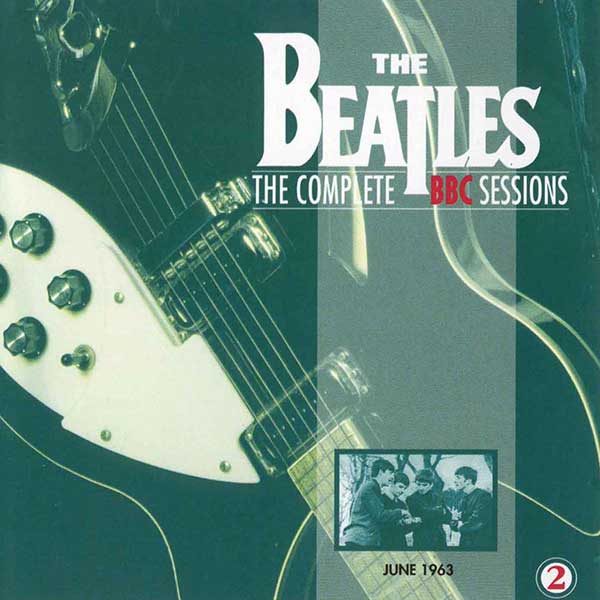
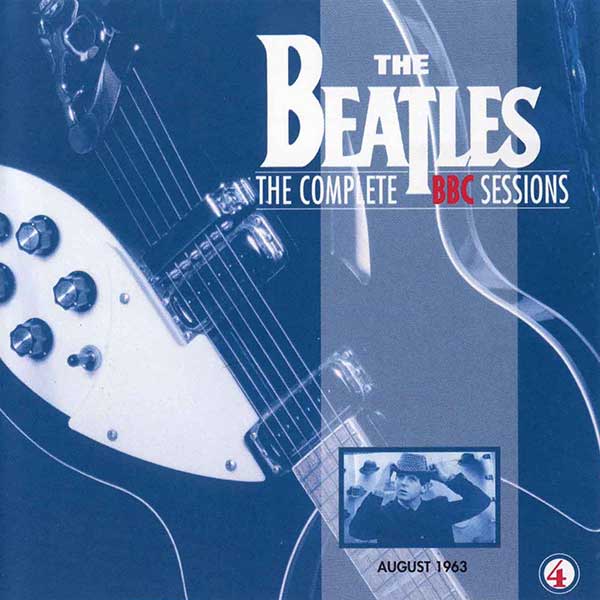
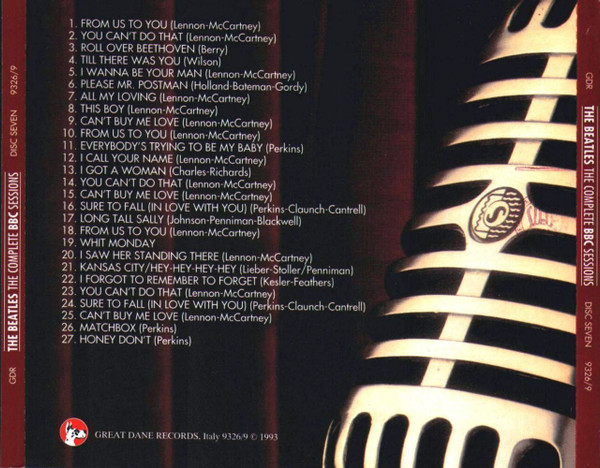
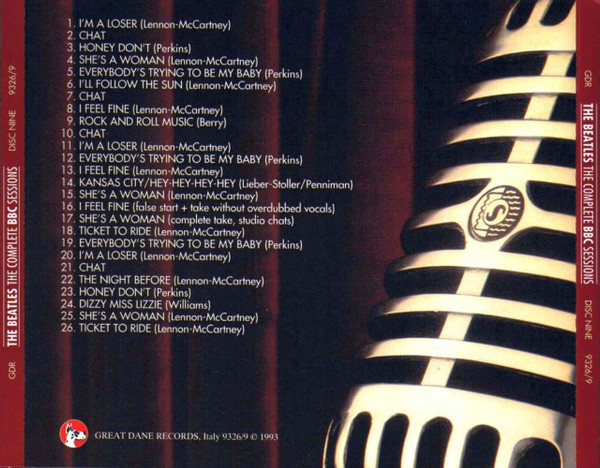
The Complete BBC Sessions is a bootleg 10 CD box set from Great Dane Records, Italy. Total running time is approximately 10 hrs. 16 min. It is comprised of all the available recordings (from private collectors) of The Beatles appearances on BBC radio from March '62 to June '65. (All of these recordings couldn't have been recorded off the air because a couple from '64 are clearly the working recording sessions.) There were a total of 52 known appearances (not counting interviews), of which this collection has 44 (complete and partial).
I have compiled a track listing of the 9 CDs plus the unavailable performances. Since the source is from the tapes of collectors, the sound quality ranges from very poor to excellent. I've made an attempt to grade each song: P (poor), G (good), VG (very good), E (excellent)
To keep my sanity, I didn't try to be that precise with the grading. I just used my intitial reaction to each song. So some would undoubtably rate some "G"s as "P"s, "VG"s as "E"s, and so on. I just wanted to give an idea of how much the sound quality varies. Of course this reflects just the sound not the performance (which IMO is excellent throughout).
I highly recommend this box set to anyone who wants all the BBC broadcasts (especially if one doesn't already have many BBC bootlegs). Others may find this overwhelming and repetitious. Some may want to seek out a good compilation. And (finally!) there is the new "Live at the BBC" from EMI.
One last note: I have heard that Great Dane is to release a 2 CD update to the box set this coming February. (old post)
The Complete BBC Sessions
Disc 1 (71:58)
Show Trk Song Qlty
1 Teenager's Turn NA Hello Little Girl (not broadcast)
(Here We Go) 1 Dream Baby P
r 3/7/62 a 3/8/62 2 Memphis P
3 Please Mr. Postman P
2 Here We Go 4 Ask Me Why P
r 6/11 a 6/15 5 Besame Mucho P
6 A Picture Of You P
3 Here We Go NA Sheila (not broadcast)
r 10/25 a 10/26 NA Love Me Do
NA A Taste Of Honey
NA P.S. I Love You
4 Talent Spot NA Love Me Do
r 11/27 a 12/4 NA P.S. I Love You
NA Twist And Shout
5 Here We Go NA Chains
r 1/16/63 a 1/25/63 NA Please Please Me
NA Ask Me Why
NA Three Cool Cats (not broadcast)
6 Saturday Club 7 Some Other Guy P
r 1/22 a 1/26 8 Keep Your Hands Off My Baby P
9 Beautiful Dreamer P
NA Love Me Do
NA Please Please Me
7 Talent Spot NA Please Please Me
r 1/22 a 1/29 NA Ask Me Why
NA Some Other Guy
8 Parade Of Pops NA Love Me Do
r 2/20 a 2/20 NA Please Please Me
9 Here We Go NA Misery
r 3/6 a 3/12 NA Do You Want To Know A Secret?
NA Please Please Me
NA I Saw Her Standing There
(not broadcast)
10 Saturday Club 10 I Saw Her Standing There P
r 3/16 a 3/16 11 Misery P
12 Too Much Monkey Business P
13 I'm Talking About You P
14 Please Please Me P
15 The Hippy Hippy Shake P
11 On The Scene NA Misery
r 3/21 a 3/28 NA Do You Want To Know A Secret?
NA Please Please Me
12 Easy Beat NA Please Please Me
r 4/3 a 4/7 NA Misery
16 From Me To You P
13 Swingin' Sound 17 Twist And Shout P
r 4/18 a 4/18 18 From Me To You P
14 Side By Side NA Side By Side Theme
r 4/1 a 4/22 NA I Saw Her Standing There
NA Do You Want To Know A Secret?
NA Baby It's You
NA Please Please Me
NA From Me To You
NA Misery
15 Side By Side 19 Side By Side Theme VG
r 4/1 a 5/13 20 Long Tall Sally VG
21 A Taste Of Honey VG
22 Chains VG
23 Thank You Girl VG
24 Boys VG
NA From Me To You
16 Saturday Club 25 I Saw Her Standing There G
r 5/21 a 5/25 26 Do You Want To Know A Secret? G
27 Boys G
28 Long Tall Sally G
29 From Me To You G
30 Money G
17 Steppin' Out 31 Please Please Me P
r 5/21 a 6/3 32 I Saw Her Standing There P
NA Roll Over Beethoven
NA Thank You Girl
NA From Me To You
NA Twist And Shout (not broadcast)
Disc 2 (77:55)
Show Trk Song Qlty
18 Pop Go The 1 Pop Go The Beatles
Beatles NA From Me To You
r 5/25/63 a 6/4/63 2 Everybody's Trying To Be My Baby G
3 Do You Want To Know A Secret? G
4 You Really Got A Hold On Me G
5 Misery P
6 The Hippy Hippy Shake P
7 Pop Go The Beatles G
19 Pop Go The Pop Go The Beatles+
Beatles 8 Too Much Monkey Business VG
r 6/1 a 6/11 9 I Got To Find My Baby VG
10 Young Blood VG
11 Baby It's You VG
12 Till There Was You VG
13 Love Me Do P
Pop Go The Beatles+
20 Pop Go The Pop Go The Beatles+
Beatles 14 A Shot Of Rythm And Blues G
r 6/1 a 6/18 15 Memphis P
16 A Taste Of Honey VG
17 Sure To Fall VG
18 Money VG
19 From Me To You P
Pop Go The Beatles+
21 Easy Beat 20 Some Other Guy G
r 6/19 a 6/23 21 A Taste Of Honey VG
22 Thank You Girl G
23 From Me To You G
22 Side By Side Side By Side Theme+
r 4/4 a 6/24 24 Too Much Monkey Business VG
NA Love Me Do
25 Boys G
26 I'll Be On Way VG
27 From Me To You G
23 Pop Go The Pop Go The Beatles+
Beatles 28 Anna G
r 6/17 a 6/25 29 I Saw Her Standing There G
30 Boys G
31 Chains G
32 P.S. I Love You G
33 Twist And Shout G
Pop Go The Beatles+
NA A Taste Of Honey (not broadcast)
Disc 3 (70:55)
Show Trk Song Qlty
24 Saturday Club 1 I Got To Find My Baby VG
r 6/24/63 a 6/29/63 2 Memphis VG
3 Money P
4 Till There Was You P
5 From Me To You G
6 Roll Over Beethoven G
25 The Beat Show NA From Me To You
r 7/3 a 7/4 7 A Taste Of Honey P
8 Twist And Shout P
26 Pop Go The Pop Go The Beatles+
Beatles 9 That's All Right (Mama) G
r 7/2 a 7/16 10 There's A Place G
11 Carol VG
12 Soldier Of Love VG
13 Lend Me Your Comb VG
14 Clarabella VG
Pop Go The Beatles+
NA Three Cool Cats (not broadcast)
NA Sweet Little Sixteen (not broadcast)
NA Ask Me Why (not broadcast)
27 Easy Beat 15 I Saw Her Standing There P
r 7/17 a 7/21 16 A Shot Of Rythm And Blues P
17 There's A Place P
18 Twist And Shout P
28 Pop Go The Pop Go The Beatles+
Beatles 19 Sweet Little Sixteen G
r 7/10 a 7/23 NA A Taste Of Honey
20 Nothin' Shakin' VG
21 Love Me Do P
22 Lonesome Tears In My Eyes VG
23 So How Come No One Loves Me VG
Pop Go The Beatles+
29 Pop Go The Pop Go The Beatles+
Beatles 24 Memphis VG
r 7/10 a 7/30 25 Do You Want To Know A Secret? G
26 Till There Was You VG
27 Matchbox G
28 Please Mr. Postman G
29 The Hippy Hippy Shake VG
Pop Go The Beatles+
Disc 4 (66:57)
Show Trk Song Qlty
30 Pop Go The Pop Go The Beatles+
Beatles 1 I'm Gonna Sit Right Down VG
r 7/16/63 a 8/8/63 And Cry Over You
2 Cry, Waiting, Hoping VG
3 Kansas City/Hey Hey Hey Hey G
4 To Know Her Is To Love Her VG
5 The Honeymoon Song VG
6 Twist And Shout G
Pop Go The Beatles+
31 Pop Go The Pop Go The Beatles+
Beatles 7 Long Tall Sally G
r 7/16 a 8/13 8 Please Please Me G
9 She Loves You VG
10 You Really Got A Hold On Me VG
11 I'll Get You VG
12 I Got A Woman VG
Pop Go The Beatles+
32 Pop Go The Pop Go The Beatles+
Beatles 13 She Loves You G
r 7/16 a 8/20 14 Words Of Love G
15 Glad All Over G
16 I Just Don't Understand G
17 Devil In Her Heart G
18 Slow Down P
Pop Go The Beatles+
33 Saturday Club 19 Long Tall Sally P
r 7/30 a 8/24 20 She Loves You P
21 Glad All Over P
NA Twist And Shout
NA You Really Got A Hold On Me
22 I'll Get You P
34 Pop Go The Pop Go The Beatles+
Beatles 23 Ooh! My Soul P
r 8/1 a 8/27 24 Don't Ever Change G
25 Twist And Shout G
NA She Loves You
26 Anna P
27 A Shot Of Rythm And Blues G
Pop Go The Beatles+
Disc 5 (71:13)
Show Trk Song Qlty
35 Pop Go The Pop Go The Beatles+
Beatles 1 From Me To You P
r 8/1/63 a 9/3/63 NA I'll Get You
2 Money P
3 There's A Place G
4 Honey Don't (John) G
5 Roll Over Beethoven G
Pop Go The Beatles+
NA Lucille (not broadcast)
NA Baby It's You (not broadcast)
36 Pop Go The Pop Go The Beatles+
Beatles 6 Too Much Monkey Business VG
r 9/3 a 9/10 7 Love Me Do G
8 She Loves You G
9 I'll Get You G
10 A Taste Of Honey VG
11 The Hippy Hippy Shake VG
Pop Go The Beatles+
37 Pop Go The Pop Go The Beatles+
Beatles 12 Chains VG
r 9/3 a 9/17 13 You Really Got A Hold On Me VG
14 Misery VG
15 Lucille VG
16 From Me To You VG
17 Boys VG
Pop Go The Beatles+
38 Pop Go The Pop Go The Beatles+
Beatles 18 She Loves You* G
r 9/3 a 9/24 19 Ask Me Why VG
20 Devil In My Heart G
* from 9/10 21 I Saw Her Standing There G
PGTB 22 Sure To Fall G
23 Twist And Shout G
Pop Go The Beatles+
39 Saturday Club 24 I Saw Her Standing There E
r 9/7 a 10/5 25 Memphis E
26 Happy Birthday Saturday Club E
26 I'll Get You E
27 She Loves You E
28 Lucille E
Disc 6 (72:41)
Show Trk Song Qlty
40 Easy Beat 1 I Saw Her Standing There G
r 10/16/63 a 10/20/63 2 Love Me Do G
3 Please Please Me G
4 From Me To You G
5 She Loves You G
41 Ken Dodd Show 6 She Loves You P
r 10/9 a 11/3
42 Saturday Club 7 All I Want For Christmas
r 12/17 a 12/21 NA All My Loving
8 This Boy G
9 I Want To Hold Your Hand G
10 Till There Was You VG
11 Roll Over Beethoven VG
*from 10/5 12 She Loves You* G
Sat Club 13 Crimble Medley G
43 From Us To You 14 From Us To You G
r 12/18 a 12/26 15 She Loves You G
16 All My Loving G
17 Roll Over Beethoven G
18 Till There Was You VG
19 Boys VG
20 Money G
21 I Saw Her Standing There G
22 Tie Me Kangaroo Down, Sport G
23 I Want To Hold Your Hand VG
24 From Us To You G
44 Saturday Club 25 All My Loving G
r 1/7 a 2/15 26 Money G
27 The Hippy Hippy Shake G
*From 12/21 28 I Want To Hold Your Hand* G
Sat Club 29 Roll Over Beethoven G
30 Johnny B. Goode G
31 I Wanna Be Your Man G
Disc 7 (65:35)
Show Trk Song Qlty
45 From Us To You 1 From Us To You G
r 2/28/64 a 3/30/64 2 You Can't Do That G
3 Roll Over Beethoven VG
4 Till There Was You VG
5 I Wanna Be Your Man G
6 Please Mr. Postman G
7 All My Loving VG
8 This Boy G
9 Can't Buy Me Love VG
10 From Us To You G
46 Saturday Club 11 Everybody's Trying To Be My Baby P
r 3/31 a 4/4 12 I Call Your Name P
13 I Got A Woman VG
14 You Can't Do That P
15 Can't Buy Me Love P
16 Sure To Fall VG
17 Long Tall Sally G
47 From Us To You 18 From Us To You G
r 5/1 a 5/18 19 Whit Monday To You G
20 I Saw Her Standing There G
21 Kansas City/Hey Hey Hey Hey P
22 I Forgot To Remember To Forget G
23 You Can't Do That P
24 Sure To Fall P
25 Can't Buy Me Love P
26 Matchbox P
27 Honey Don't (John) P
Disc 8 (51:20)
Show Trk Song Qlty
48 Top Gear 1 Top Gear Spot
r 7/14/64 a 7/16/64 2 Long Tall Sally E
3 Things We Said Today E
4 A Hard Day's Night E
5 And I Love Her E
6 I Should Have Known Better G
7 If I Fell P
8 You Can't Do That P
49 From Us To You 9 From Us To You P
r 7/17 a 8/3 10 Long Tall Sally G
11 If I Fell G
12 I'm Happy Just To Dance With You G
13 Things We Said Today G
14 I Should Have Know Better G
15 Boys G
16 Kansas City/Hey Hey Hey Hey G
17 A Hard Day's Night G
18 From Us To You P
49a From Us To You 19 From Us To You P
recording session 20 From Us To You P
7/17 21 I'm Happy Just To Dance With You P
22 I Should Have Known Better P
23 I Should Have Known Better P
Disc 9 (67:37)
Show Trk Song Qlty
50 Top Gear 1 I'm A Loser VG
r 11/17/64 a 11/26/64 2 (Chat)
3 Honey Don't E
4 She's A Woman E
5 Everybody's Trying To Be My Baby E
6 I'll Follow The Sun E
7 (Chat)
8 I Feel Fine E
51 Saturday Club 9 Rock And Roll Music G
r 11/25 a 12/26 10 (Chat)
11 I'm A Loser* VG
* same as 11/26 12 Everybody's Trying To Be My Baby* E
Top Gear 13 I Feel Fine* E
14 Kansas City/Hey Hey Hey Hey E
15 She's A Woman* E
51a Sat Club/Top Gear 16 I Feel Fine VG
recording session 17 She's A Woman E
52 Invite You To Take 18 Ticket To Ride (short) G
A Ticket To Ride 19 Everybody's Trying To Be My Baby G
r 5/20/65 a 6/7/65 20 I'm A loser G
21 (Chat)
22 The Night Before G
23 Honey Don't G
24 Dizzy Miss Lizzy E
25 She's A Woman G
26 Ticket To Ride (long) VG
How Apple Constructed Let It Be Naked- The Naked Truth About The Beatles' Let It BeNaked Jan 1, 2004 12:00 PM, By Matt Hurwitz – Mix Magazine
Ever wondered what The Beatles' Let It Be album would have sounded like had it been properly completed instead of released as a companion disc to their 1970 fly-on-the-wall motion picture of the same name? Such was the charge given to EMI's Abbey Road Studios by the group's Apple Corps Ltd. The result is the recently released Let It Be…Naked (Apple/Capitol-EMI).
After the tumultuous sessions for the 1968 album The Beatles (aka, The White Album), the Fabs regrouped at Twickenham Film Studios in London in January 1969 to make a TV special showing the group rehearsing and recording an album. The concept was a “warts and all” view of the band with no overdubs; everything was as live as possible. After those sessions broke down, the production moved to the basement studio of The Beatles' own Apple offices, where recording continued through the month. The sessions culminated in a historic live performance (The Beatles' last) on the office's rooftop on January 30 of the same year with their new temporary “fifth Beatle,” keyboardist Billy Preston (himself an Apple recording artist by the end of the sessions), who played on the studio recordings, as well.
Glyn Johns, who had recorded the sessions, was given the task of mixing and compiling the recordings into an LP (originally titled Get Back) in May of that year, though the group chose not to release it. Johns tried a second compilation in January 1970, though that version also failed to see the light of day. John Lennon, on new manager Allen Klein's advice, brought in legendary producer Phil Spector to revamp the album in March 1970, which he did, adding orchestration to three tracks and editing others. The result — with studio chatter and quips intact — was the May 1970 Apple release Let It Be, The Beatles' last original album (although , which came out in 1969, was actually recorded after Let It Be).
In February 2002, following a chance meeting of Paul McCartney and the film's original director, Michael Lindsay-Hogg, Abbey Road veteran Allan Rouse received a call from Apple's Neil Aspinall asking him to take a stab at remixing the album. Rouse had acted as project coordinator for a number of Beatles remix projects, among them The Beatles Anthology, Yellow Submarine Songtrack and Lennon's Imagine. While the task for those projects had always been to re-create the original mixes known to millions of fans using current technology, the charge for the Let It Be project was different.
“This was not an attempt to remaster an existing album,” Rouse says. “We were asked to make it sound the way the band had believed the finished album was going to sound.” This meant, for the most part, producing mixes that reflected only what the four bandmembers (or five, including Preston) could play live: no overdubbed guitars or vocals, and certainly no orchestras.
In addition, all of the between-song chatter, breakdowns, jokes and ditties — including “Maggie Mae” and the “Dig It” jam — were dropped. Says Rouse, “They just didn't really fit in with an album of 11 songs and neither did the dialog. Those little bits were fine for a soundtrack album, which Glyn's was, but they didn't fit comfortably with the concept of a straight album.”
Rouse tapped two young staff engineers, Paul Hicks and Guy Massey, for the job. Both had worked on prior Beatles projects (and had, coincidentally, started at the studio on the same day in 1994), including the 5.1 surround mixes for the recently released The Beatles Anthology DVD set.
The group took a team approach, making decisions democratically, each chipping in suggestions but deciding with one voice. During a two-week period, the three listened to all 30 reels of 1-inch 8-track session tapes, which had been recorded through a pair of borrowed 4-track consoles onto a 3M 8-track machine. As a reference, the producer/engineers also studied the released Spector album and both of Johns' versions. “We mainly listened to identify the takes they used,” says Rouse. They also noted where Spector had made any edits, deciding if there was a good reason to either keep or discard those edits. “As it turns out, Glyn and Phil had done most of the legwork. We ended up using the vast majority of their takes.”
But because the group's mission was to make the best possible album, they didn't limit themselves to what had been done previously. “Once we started, we would A/B against the Spector disc to see if what we were doing was an improvement,” says Massey.
Upon listening to the tapes in Rouse's room at the studio, they were transferred into Pro Tools 5.2 using a Prism Sound Dream ADA 8 A/D converter. And, as part of the improvement process, once the recordings were in the digital world, the engineers began researching which takes were the best performances, and, if more than one take of a song had strong attributes, trial edits were made to see what combination would make the best overall performance. “Once we had the building blocks in the digital domain,” says Massey, “we'd delve into a bit more detail. If there were fluffed lines or pops, etc., if there was another take without the errors, we'd try inserting that part from the other take.”
Adds Hicks, “Sometimes we did the tiniest little things. If something wasn't quite right — if there was a bend in a note or something — we did actually replace it with a slightly better one. Again, our main theme was to make it as strong as possible.”
The live rooftop recordings offered their own special challenges, given that the band was playing on a blustery winter day. Because the group was being filmed, the film crew had chosen an unobtrusive vocal microphone during the sessions, the Neumann KM84i, which features a small capsule on the end of an extension tube, with the mic's preamp located at the bottom near the floor. (The mic was commonly used for TV talk shows and awards programs.) The same mics were brought upstairs to the roof, where second engineer Alan Parsons simply tied clippings of pantyhose over the capsules to act as windscreens. “The wind noise was actually quite manageable,” says Hicks. “It was really only when they weren't singing that you could hear it.” For the inevitable hard consonants and mic pops, “We mainly handled that with a combination of filtering and EQ,” notes Hicks. A small amount of de-noising was done using an analog Behringer dynamic filter.
The following is a breakdown of what was done to each Let It Be…Naked track (in running order, along with the mix engineer's name in parentheses):
“Get Back” (Hicks): While Johns and Martin used a master recorded on January 28, 1969, for the aborted LP and released single, Spector had used a recording from the day before, and the same master is used on this album. Notably absent is the song's coda, which appeared on the single. “It turns out that the coda had been recorded as an edit piece four or five reels later,” explains Hicks. “Since it wasn't on the original session recording for the song, it wouldn't have represented what actually took place in the studio during that take, so it was decided to leave it off.”
“Dig a Pony” (Massey): Those who've heard bootlegs of Johns' mixes know the song originally featured an “All I Want Is You” intro and outro, which Spector removed for his LP. “The tuning is particularly bad in the beginning,” says Massey, prompting the decision to eliminate them in the new version, as well.
“For You Blue” (Hicks): Using the same master as Spector used, Hicks mainly focused on keeping the sounds bright and clear. What was interesting, he says, was learning about the unique sound McCartney got out of his piano. “It's a fuzzy, metallic sound, which he did by putting a piece of paper in the piano strings, causing them to vibrate against the paper when struck. You can hear on the session tape Paul's fiddling around, trying to get the right sound.” And because McCartney is playing piano, he does not play bass on the song. “The bass comes from the piano,” says Hicks, with McCartney playing a bass line on the keys. George Harrison's vocal, it turns out, was one of the few overdubs used. “We took out his live vocal, which was basically a guide vocal. It wasn't a complete take, really, and I don't think it was ever intended to be used.”
“The Long and Winding Road” (Hicks): Perhaps the greatest achievement on the album is the improvement to this track, easily accomplished by removing Spector's overblown orchestra. Actually, though, the master on Let It Be…Naked is not even the one used by Spector; it's the only take on the album that was changed in its entirety. The group returned to the Apple basement the day after their rooftop show to record three more songs, this one among them. Says Rouse, “Spector had used one take recorded five days earlier.” “This version, recorded on January 31, we felt was a stronger basic performance,” says Hicks. “There's also a slight lyric change,” adds Rouse, who suggests that, this being the later recording, it represents McCartney's final lyric choice.
As a listening experience, it's a first for Beatles fans to hear them play the song instead of an orchestra. The recording features McCartney on piano, Harrison playing lead guitar through a Leslie speaker, Lennon on a newly acquired Fender Bass VI and Ringo Starr keeping light time with his hi-hat.
“Two of Us” (Massey): The same master used by Spector, also from January 31, 1969, features Lennon and McCartney on acoustic guitars, Harrison on electric and Starr providing a simple bass drum/snare/tom beat. By the way, Starr's drums were typically recorded onto a single track, precluding mixing them into stereo. Small amounts of de-essing and rumble filtering were also performed.
“I've Got a Feeling” (Massey/Hicks): A rooftop recording, this song was edited by Massey before being mixed by his colleague. Massey used the best of each of two rooftop takes of the song, creating a version, Hicks says, with the most energy. And while Johns had opted for a studio recording of the song for his version of the album, there was no beating the live performances. Notes Hicks, “I don't know if it was just the fact that they were playing live and knew it or just because they were so cold, but there was just so much more energy in the live recordings.” Sonically, he notes, the live recordings — minus the wind and pops — are not much different from their studio counterparts, making a surprisingly good match when listening to the album.
“One After 909” (Hicks): Another rooftop performance, though, interestingly, the team did consider using a studio version. “We did research to see if there was another version,” says Hicks. “But it was just much slower, and it had a completely different feel. There was no contest, really. It's one of the more up-tempo numbers, so we went with the live one.” Hicks is proudest of his drum sound, bringing Starr out to the fore. “We found so many details we wanted to bring out, which we tried our best to do. Everything is a lot more focused.”
“Don't Let Me Down” (Hicks/Massey): Though not included on Spector's album, this song was a product of those sessions. A studio version from January 28, 1969, was released as the B-side to the “Get Back” single. This version, however, is an edit of the two rooftop versions. The Beatles recorded a second take because Lennon forgot the lyrics during the first take.
“I Me Mine” (Massey): This song was not originally recorded at Apple in January 1969, though Harrison is seen in the film playing it briefly at Twickenham. In January 1970, Harrison, McCartney and Starr recorded a studio version of the song, with Harrison playing acoustic guitar and singing a guide vocal, McCartney on bass and Starr on drums for the master take. Electric piano, electric guitar, lead vocal, backing vocals, organ and a second acoustic guitar were added as overdubs. The recording was a brief 1:34 in length, so before adding his orchestra, Spector lengthened it by repeating one of the verses, resulting in a 2:25 final master. The Naked team decided to leave in the overdubs — which made the recording complete as The Beatles had envisioned it — and Spector's edit. “We were originally going to do it unedited,” says Massey, “but if you listen to it at that length, it's just far too short.” Jokes Rouse, “That was our one concession to Mr. Spector.” Massey also built up the mix as the song progressed by adding elements of the mix as the song enters the second verse.
“Across the Universe” (Massey): Again, while no studio recordings of this song were made at Apple, Lennon is seen playing the song at Twickenham in the film. “Across the Universe” was actually recorded a year earlier, in February 1968, at the same Abbey Road sessions that produced “Lady Madonna” and “Hey Bulldog.” The basic track featured Lennon on acoustic guitar, his vocal and a tom-tom (all recorded onto one track), with Harrison playing a tamboura. At the time, George Martin had added background vocals and animal sound effects. Spector's version removed the latter two parts, as well as the tamboura, replacing them with an orchestra and a choir.
The new mix features Lennon's guitar and vocal, Starr's drums and the tamboura. “Again, because the concept was whatever the guys could play live onstage, we took everything else away,” says Rouse. The ending has been given a spiritual touch, with a building echo (via real Abbey Road tape delay) added.
“Let It Be” (Massey): another recording from January 31, 1969, the day after rooftop, with McCartney on piano, Lennon on Fender Bass VI, Harrison on lead guitar (through a Leslie), Starr on drums and Preston on organ. Three months later in April, Martin added a new electric guitar lead from Harrison, and in January 1970, added backing vocals from McCartney and Harrison, brass and cellos and yet another pass at a Harrison lead. Martin produced the single release of the song, issued in March 1970 (pre-Spector), featuring the April 1969 guitar solo. Upon Spector's arrival, the song was lengthened by repeating a chorus and issued featuring the January 1970 guitar lead.
The new version features the same master and uses a few edits from other takes, most notably the Harrison guitar solo that came from the take of the song that appears in the film. “We'd always thought that the guitar lead in the version in the film was just really soaring,” says Massey. “We edited it in, just as a trial take, and we all thought it sounded great.”
The album comes with a 22-minute companion “fly-on-the-wall” dialog/music disc put together by the BBC's Kevin Howlett and engineer Brian Thompson. Howlett listened to more than 80 hours of tapes, recorded in mono by the film crew during both the Twickenham and Apple sessions, discovering a number of previously unknown Lennon/McCartney tunes (which are included on the disc), as well as some other surprises. “I had expected to hear the kind of disagreements and arguing we've all heard about,” Howlett tells Mix. “Instead, I heard the bandmembers actually having a good time. By the end, they were, in fact, quite excited about what they were doing.”
Remixing an album by the greatest rock band of all time can be, well, daunting. “It's hard to make it as up-to-date as stuff nowadays, because it wasn't recorded these days,” says Massey. “From that point of view, it was a challenge to make it sound as punchy and as present as possible. But it's a good representation of what they were like then.”
Adds Hicks, “We all collectively felt that we wanted it to stand along all the other Beatles albums, and hopefully, we've achieved that.”
Let It Be . . . Naked
How much better, you could be forgiven for wondering, could Let It Be be? The answer, perhaps surprisingly, is "a bit". Let It Be, while obviously better than almost everything ever recorded by anyone else, was compromised by the fact that the Beatles were disintegrating as a unit during the recording sessions, the rancour most famously illustrated by John Lennon calling in Phil Spector behind Paul McCartney's back to rework "The Long and Winding Road". Let It Be... Naked, then, is the album as the Beatles would have heard it while they were making it.
2004 Side 1 1. Get Back 2. Dig A Pony 3. For You Blue 4. The Long And Winding Road 5. Two Of Us 6. I've Got A Feeling Side 2 7. One After 909 8. Don't Let Me Down 9. I Me Mine 10. Across The Universe 11. Let It Be
Let It Be (Original)
Recorded
in January 1969 at Twickenham Film Studios just outside London, Let It
Be was a miserable experience for all concerned. The Beatles were
constantly filmed while making the album in the process of falling
apart. They were so dispirited that, having recorded the tracks, none of
them could be bothered to do the necessary post-production work, which
was delegated first to producer George Martin, then to Glyn Johns, and
finally to Phil Spector. Their unlucky 13th, and last, album, Let It Be
was released on May 8, 1970, in the U.K., topping the chart two weeks
later. In America, with 3.7 million advance orders, it achieved the
highest initial sale of any album in history, and subsequently picked up
an Oscar as best Soundtrack of the Year.
George
Martin: We'd do take after take after take--and then John would be
asking whether Take 67 was better than Take 39. I'd say, "John, I
honestly don't know." "You're no f***ing good then, are you?" he'd say.
That was the general atmosphere.
John Lennon: It was a
dreadful, dreadful feeling in Twickenham Studios being filmed all the
time. You couldn't make music at 10 in the morning, or whatever it was,
with people filming you and colored lights.
Engineer
Glyn Johns edited the original session tapes into a a finished album
called Get Back. The Beatles could not agree on the final product and
the entire project was shelved for over a year until Allen Klein, the
Beatles' new manager, dusted it off.
Klein wasn't
happy with the quality of the tapes Johns had edited and hired Phil
Spector to produce a soundtrack album, giving him the formidable task of
sifting through hundreds of hours of studio and live tapes to produce
something marketable. Spector, who had never worked with the Beatles
before, added orchestrations and female choruses. The resulting record
was a disappointment to many Beatle fans and the Beatles themselves.
Still, Let It Be was a No. 1 record.
John Lennon: By
the time we got to 'Let It Be', we couldn't play the game anymore; we
couldn't do it anymore. It came to the point where it was no longer
creating magic, and the camera, being in the room with us, sort of made
us aware of that, that it was a phony situation ... "It was hell making
the film Let It Be. When it came out, a lot of people complained about
Yoko looking miserable in it. But even the biggest Beatle fan couldn't
have sat through those six weeks of misery. It was the most miserable
session on earth.
Paul McCartney: In fact, what
happened, when we got in there, we showed how a break-up of a group
works. We didn't realize that we were sort of breaking up as it was
happening.
George Harrison: As everybody knows, we
never had much privacy and, you know, this thing that was happening was
they were filming us rehearsing. There was a bit of a row going on
between Paul and I. You can see it, where he's saying, 'Well don't play
this', or something and I'm saying, 'Well, you know I'll play what you
want or I won't play if you don't want it, you know, just make up your
mind.' That kind of stuff was going on. And they were filming us,
recording us having a row, you know, it was like, terrible really. I
thought, 'I'm quite capable of being relatively happy on my own and I'm
not able to be happy in this situation, you know, I'm getting out of
here.'
Ringo Starr: I think everyone was getting a
little tired of us by then because we were taking a long time and there
were many discussions going on by then — many heated discussions."
By the end of 1970, the Beatles had sold over 500 million records.
1970
Side 1
1. Two of Us
2. Dig a Pony
3. Across the Universe
4. I Me Mine
5. Dig It
6. Let It Be
7. [Maggie Mae]
Side 2
1. I've Got a Feeling
2. One After 909
3. The Long and Winding Road
4. For You Blue
5. Get Back
The Beatles (The Original Studio Recordings) (also known as The Beatles: Stereo Box), is a box set compilation comprising all remastered recordings by English rock band the Beatles. The set was issued on 9 September 2009, along with the remastered mono recordings and companion The Beatles in Mono and The Beatles: Rock Band video game. The remastering project for both mo no and stereo versions was led by EMI senior studio engineers Allan Rouse and Guy Massey.[1] The Stereo Box also features a DVD which contains all the short films that are on the CDs in QuickTime format.
It is the second complete box set collection of original Beatles recordings after The Beatles Box Set (1988). Two earlier album collections, The Beatles Collection (1978) and The Collection (1982) did not contain all of the Beatles recordings. Although sales were counted as 1 unit for each box set sold in the mono and stereo format, total individual sales exceeded 30 million.
The Beatles (The Original Studio Recordings) received the Grammy Award for Best Historical Album at the 53rd Grammys.[2] The box set was issued on vinyl in 2012.
Album listing
The sixteen-disc collection contains the remastered stereo versions of every album in the Beatles catalogue. The first four albums (Please Please Me, With the Beatles, A Hard Day's Night and Beatles for Sale) made their CD debut in stereo, though most songs from those albums have previously appeared on CD in stereo on various compilations. Both Help! and Rubber Soul use the remixes prepared by George Martin for the original 1987 CD releases (the original 1965 stereo mixes were released on The Beatles in Mono). Magical Mystery Tour is presented in the sequence and artwork of its original North American Capitol Records album release, as opposed to the UK six-song EP.
All CDs replicate their original album labels as first released, from the various Parlophone Records variations, to the Capitol Records label (for Magical Mystery Tour) and the UK Apple Records side A label from Yellow Submarine through Let It Be, and with the side A & side B Apple labels for discs one & two respectively for The Beatles. For Past Masters, disc one uses a mid-1960s Parlophone label design and disc two uses the (side A) Apple label design. Each of the albums except Past Masters includes a mini-documentary, mainly drawing from The Beatles Anthology (with a few animated 3D scenarios made up of original photos thrown in), about the album in QuickTime format. The Beatles and Past Masters are two-disc sets.
Please Please Me (1963) With the Beatles (1963) A Hard Day's Night (1964) Beatles for Sale (1964) Help! (1965) Rubber Soul (1965) Revolver (1966) Sgt. Pepper's Lonely Hearts Club Band (1967) Magical Mystery Tour (1967) The Beatles (1968) Yellow Submarine (1969) Abbey Road (1969) Let It Be (1970) Past Masters (1988)
Missing stereo session tapes
No stereo mixes exist for the 1963 single "She Loves You" and its flipside "I'll Get You" or the 1962 single "Love Me Do" and its flipside "P.S. I Love You". It was the practice at Abbey Road Studios prior to early 1963 to wipe and re-use master tapes once they had been mixed down to mono for single release.[3] For this reason there will never be true stereo mixes of "Love Me Do" or "P.S. I Love You". Although the practice had stopped by the time of the release of the "She Loves You" single, and although it is possible that the master tapes were in EMI's possession in January 1964, when the German language version was recorded, it is commonly believed that those tapes were either stolen or destroyed.[4] Competent-sounding stereo versions of "She Loves You" have been created unofficially using the backing track from "Sie Liebt Dich", but the engineers who prepared the remasters elected not to do this. Every release of these four songs has been in mono (or simulated stereo) and they appear in mono on the stereo version of Past Masters and Please Please Me. This is also the case for the single version of "Love Me Do" with Ringo on drums but at some point (fairly early on) even the mixed down mono tape of this version of the song was lost. Some authors have expressed the opinion that the original version of "Love Me Do" was intentionally destroyed in order to alleviate possible confusion between it and the more common version of the song.[5] Since 1980, new transfers sourced from reasonably clean 45rpm mono singles from private collectors have been used as the master for this version of the song.[6][7]
Two other songs in The Beatles' catalogue which also appear in mono on the stereo CDs are "Only a Northern Song" and "You Know My Name (Look Up the Number)". Neither of these songs received stereo mixes at the time they were recorded, although other songs that were similarly not mixed into stereo during The Beatles' recording lifetime were not excluded from the set: the stereo mixes of "Strawberry Fields Forever," "Penny Lane," and "Baby, You're a Rich Man" all made in 1971, the stereo mix of "Yes It Is" that was given a very limited UK release in 1986 on a mail order cassette promotion that Apple and The Beatles did not authorize[8] and was commercially released in 1988 on Past Masters; and the 2000 edit of "Day Tripper" from 1. "Only a Northern Song" was first mixed into stereo and 5.1 surround for the Yellow Submarine Songtrack album in 1999 and a differently-edited stereo mix of "You Know My Name (Look Up the Number)" appeared on Anthology 2 in 1996. "You Know My Name (Look Up the Number)" is the only track left in The Beatles' catalogue of which the original edit has never received a stereo mix despite the multi-tracks being available.
Bonus features
Included in the set is a DVD called The Mini Documentaries compiling all the short documentaries released on the individual albums in QuickTime format. The DVD features narration from all four Beatles as well as George Martin as the opening on each of the individual albums. Each documentary contains rare footage and previously unheard dialogue. There are sound excerpts from various songs, accompanied by still photos, clips of television appearances, footage from inside recording sessions, film footage from their final photo session, and material from the five Beatles films A Hard Day's Night, Help!, Magical Mystery Tour, Yellow Submarine, and Let It Be. The DVD has a red Apple label (similar to that on the original US Let It Be LP). This DVD is exclusive to the Stereo set, and is not included in the Mono version. Limited edition USB flash drive Apple-shaped USB flash drive
On 7 December 2009, The Beatles (The Original Studio Recordings) was also released as a limited edition of 30,000 apple-shaped USB flash drives. This event marks the first appearance for the Beatles catalogue in a high-resolution digital format being encoded in 44.1 kHz/24-bit FLAC format. CD-standard is 44.1 kHz/16-bit. The 16 GB flash drive also includes 320 kbps MP3 copies of the albums, a specially designed Flash interface, and all the visual elements from the boxed set — the mini-documentary films, original UK album art, rare photos and expanded liner notes.[9]
Although it received positive reviews from critics and users, many complaints were received [10] that the "stem" on the USB flash drive is very fragile that it can break off when attempting to remove the USB drive out of the apple-shaped holder, making the USB drive difficult to remove. Vinyl
On 12 November 2012, the set was released on 180-gram vinyl, specially prepared for vinyl, with a 252-page book included. Also included are the inserts which were included in the original LPs such as the cardboard cutout sheet included in Sgt. Pepper plus the photos and poster included in The Beatles.[11] Chart performance Professional ratingsReview scores Source Rating AllMusic 5/5 stars[12] The Austin Chronicle 4/5 stars[13] Entertainment Weekly A[14] Pitchfork Media 10/10[16] Rolling Stone 5/5 stars[15] Spectrum Culture 5/5 stars[17]
On the United States Billboard Top 200 albums chart the set debuted at number 15. On the Japanese Oricon weekly album charts, it debuted at number 6, selling over 35,000 copies in its first week.[18] The set was certified triple platinum by the RIAA in April 2010. The set was also certified Diamond in Canada in March 2010.[19]
In Germany, the box set reached number 37.[20]
---------------------
Remastering The Beatles
Guy Massey, Paul Hicks & Steve Rooke https://www.soundonsound.com/techniques/remastering-beatles, 10-2009
Remastering projects don't come much bigger than this: a team of engineers spent four years in Abbey Road creating the definitive Beatles collection.
"Today's stuff has no dynamics at all,” says mastering engineer Steve Rooke. "It's really squashed, and if the Beatles were recording today I'm sure they'd be squashing their music. But we've all lived with the sound and the dynamics we've got. We didn't want to destroy that at all, but it's got to appeal to today's CD‑buying public.”
The remastering team readjust to daylight after their four‑year incarceration in Abbey Road Studios. From left (back): Simon Gibson, Sean Magee, Allan Rouse; (front) Guy Massey, Paul Hicks, Sam Okell and Steve Rooke.
The question of whether or not to apply limiting was just one of many dilemmas that faced the Abbey Road team — headed by Allan Rouse, and including Rooke and engineers Guy Massey, Paul Hicks, Sean Magee and Sam Okell — who worked for four years to create the definitive digital versions of the world's most important pop music catalogue. "We know it's going to be put under the microscope,” admits Guy Massey, "but you can't think about it in those terms, because you'd never get anything done. You'd be like 'The people who talk about this sort of thing, are they going to like this? Maybe we shouldn't do it.'”
Faced with, on one hand, the demands of purists, and on the other, the expectations of modern listeners, the team chose to take two directions at once. For collectors and audiophiles, they created a box set comprising all the original mono versions of the Beatles' albums (less Abbey Road, which was not issued in mono, and Yellow Submarine, where the original mono was a straight fold‑down from the stereo), which for the most part was as faithful as possible to the source. Simultaneously, they reworked the stereo catalogue for release in a second box set, and also as individual albums — again treating the material with respect, but not shying away from the application of modern technology, if it was felt that fidelity could be improved.
Here, There And Everywhere
So why the need for remastering in the first place? Well, for one thing, the existing Beatles catalogue on CD was incomplete. When the albums were first made available digitally, George Martin took the decision to use the mono versions of the first four albums, and the stereo versions of the rest — even though, as Guy says, "The mono was always The Mix. On Pepper they spent three weeks mixing that, and the stereo was done in three days.”
Steve Rooke's mastering room at Abbey Road.
"I found it quite fascinating,” says Paul Hicks, "because I wasn't that familiar with all the monos, and it is interesting listening to how different the crossfade is from 'Sergeant Pepper Reprise' to 'A Day In The Life' — that's very different from the mono to the stereo versions — and on 'Lucy In The Sky', the mono's got loads of phasing all the way through the verse vocals that the stereo doesn't. It's fascinating, what is now considered to be the masters and what in the '60s was considered to be the masters, and the differences.”
The Beatles' masters were originally recorded using the EMI 'British Tape Recorder' (top); after extensive tests, a Studer machine (bottom) was chosen for the digital transfers.
The Beatles' masters were originally recorded using the EMI 'British Tape Recorder' (top); after extensive tests, a Studer machine (bottom) was chosen for the digital transfers.What's more, as Paul explains, "When the CDs were released in the '80s, George Martin decided he wanted to remix Help! and Rubber Soul. So basically, the CDs that everyone knows of those two albums are actually new mixes that were done in the '80s by Geoff Emerick and George Martin.” (The original stereo mixes of these two albums are included in the mono box set.)
There's also the issue of audio quality. The catalogue was first digitised in 1986, and although it was done well by the standards of the time, the improvement in digital audio since then has been vast. "People slag off the original CDs, and I definitely think what we've got is a step up, but I don't think they sound awful,” says Guy Massey. He believes that the '80s team did apply some digital noise‑reduction, to the original CDs' detriment, but credits the improvement in sound above all to the new transfer from the original tapes: "We always had the original CDs in a [Pro Tools] Session and I'd always refer to that. Immediately, they were better.”
Studer tape machine was used to remaster The Beatles recordings.
"I think one thing people will notice is more low end and more top end, and the majority of it was what we got out of the tape,” adds Paul.
From Me To You
The transfer process was certainly treated with the utmost care. "We had a good few weeks of basically checking things like the tape machines,” says Paul. "Obviously, somewhere like Abbey Road has got a lot of different test tapes from over the years. The main thing was we didn't rush this! We experimented with different machines. We tried some with valve preamps and things, but we didn't let any of that bias us. We ended up going with the Studer A80 — we just used our ears.”
One machine that never entered into the equation was EMI's own 'British Tape Recorder', which would have recorded the masters in the first place. "They have some in storage in Hayes somewhere, but they're not in working order,” says Guy. "They would have been pretty hard to get back into the scratch they would have been in in the late '60s.”
Because of their importance, the analogue masters had been scrupulously maintained and archived. "All the Beatles tapes are in fantastic order, the multitracks as well as the quarter‑inches,” enthuses Paul. "Guy and I have been doing Beatles stuff for about 15 years, on and off, and we've never baked a Beatles tape. The formula on that EMI tape was just fantastic. The only thing we did find, which we had to be incredibly careful with when we were transferring it — and especially with the monos, which hadn't been played in 40 years — was that a lot of the glue had dried up on the edits. So on the first wind‑back you had to be incredibly careful, because a lot of the edits just split apart when winding. We had to get the gloves on!”
"For the transfer and archiving part of the process, we did it song by song,” continues Guy. "So if the tapes had come apart when we were spooling back, we'd replace all those [splices] — same length, we'd measure them all and make sure it was all pukka — and then song by song we'd transfer them. We'd transfer the first one, go back, clean the whole tape path again. Beginning of each week, we'd de‑mag the heads. We had a speed reader on the capstan all the time so we knew it was running at the right speed.”
"We'd line up and then we'd always play through, manually checking the azimuth,” says Paul. "It was amazing just by tweaking that, if nothing else, how much more top end you could potentially get. That was a significant part of the transfer process.”
George Harrison puts his feet up during a long mixing session at Abbey Road; Ringo Starr looks on.
Fixing A Hole
The digital files were recorded in Pro Tools at 24‑bit, 192kHz through a Prism A‑D converter. "The Pro Tools system was treated as a tape machine,” says Paul.
Guy takes up the story: "There was a listening period once we'd transferred an album and were happy with the transfers. We would have detailed lyric sheets and timing sheets, and between us all, we'd identify areas that we thought we would want to remove — clicks, de‑popping, if we could do it. We've got the luxury of going back to the multitracks and saying 'Is that an electrical noise? Yes it is, let's take it out.' In 'Kansas City' [from Beatles For Sale], the stereo version, there's quite a big drop-out that's very noticeable. We used Retouch in the CEDAR world to fix issues like that. And then we'd cut those fixed portions into the master file, so it wasn't a complete process we were doing there. On some tracks there were quite a few little edits we had to do.”
De‑noising, meanwhile, was confined to gaps and fades. "Until there's a de‑noising system that works properly and doesn't take the air and all that stuff that de‑noising takes off, we didn't want to use it,” insists Guy. "We'd use it in gaps. If there's no programme, just tape hiss, we would use it very subtly. It's less than one percent of the whole thing.”
The amount of restoration that could be done was, of course, limited by the fact that they were working only with the master recordings — even though, in some cases, it would theoretically have been possible to go back to the multitracks for a cleaner fix. "If there's some low‑end stuff under a vocal wind pop, or something, we wouldn't be able to achieve as great a reduction as if the vocal was by itself in the right‑hand channel,” admits Guy. "People have asked us whether we could slot in a bit [from the multitrack], but it was like 'No, we're dealing with the master mixes. That's what they did then. That's what we're presenting.'”
"This is a remaster project,” agrees Paul. "It's basically taking what George Martin, Norman Smith and Geoff Emerick considered to be the masters and making them sound as good as possible.”
Even then, the very idea of issuing the earliest Beatles albums in stereo blurs the boundary between remix and remaster. These were recorded on two‑track, but mono dominated the market at the time. "The stereos are theoretically multitracks, because it was the predecessor of the four‑tracks,” explains Paul. "You've got the band on the left and the vocals on the other side. The purpose of them being done like that was so they could then balance the mono in more detail.”
In theory, then, it would have been possible to re‑balance the vocals against the instruments, but as Guy explains, they were careful to preserve the levels as they made it to the mono originals. "Obviously, if we decided that we'd like a little bit more guitar within the balance that they'd had for the band, if that then increased the left channel a fair amount we'd rebalance the vocal to that; or similarly, if we wanted to EQ a bit of vocal out, if that upset the balance in any way we'd do a bit of jiggery‑pokery in that sense, but we didn't remix it. If we upset the balance in any way because we were EQ'ing quite narrowly, we'd always mono it and make sure we hadn't destroyed the balance.”
Getting Better
After the transfers and restoration were complete, the actual mastering began, with Guy and Steve tackling the bulk of the work on the stereo albums, while Paul and Abbey Road's Sean Magee handled the mono set. Steve Rooke takes up the story: "Guy and Paul came up to my room, we had a listen through to what was now the cleaned‑up master version, and decided how we were going to tackle each track. We took each track in turn and tried to get the best out of it sound‑wise. We were always careful not to go too far, because we were dealing with the Beatles, and everyone knows the Beatles sound, but we wanted to give the public the best possible sound we could. So we were trying to get as much separation between the instruments, as much clarity as possible. If we could put a bit more bass line or kick drum in and give it a bit more punch, we would do. So we listened to each track in turn, once we were happy with the sound, we'd put it onto my workstation. It took about a day to do 14 tracks, something like that.”
The fruits of the project are collected in two box sets. The Beatles In Mono is a faithful reproduction of all the original mono mixes, while the stereo set has been remastered with modern tastes in mind. Apart from surgical tweaks, which were done using a Prism digital EQ, equalisation was done using an almost period‑correct piece of Abbey Road history: "We came through an original EMI TG desk, which dates back to about 1972,” explains Steve Rooke. "We went through that, and once it was all in the workstation we would then compile it in the running order we wanted, gap it, and whatever, limit it and then capture it to CD.”
"A lot of the stuff we transferred flat and left, because there's no point fixing stuff that's perfect,” adds Guy. "A hundred of the tracks, maybe, we did tiny amounts of EQ'ing if we felt something was lacking in the mix. A lot of it was very subtle.”
What, then, of the controversial limiting applied to the stereo albums, which yielded a level increase of 3‑4dB? "On this we used a Junger D01, which we felt suited the sound we were after,” says Steve. "We've got several limters in the room. They've all got different sound and different effects, but this seemed to be the flattest, if you like. We didn't want the limiter to change any of the sound we'd got, and used it very discreetly.”
Remastering The Beatles
"When we did the limiting, we would then level‑correct that with the original capture and listen for any artifacts, make sure there was no pumping or anything odd happening,” explains Guy. "We purely used that as a level gain stage, as it were. So the loudest song's loudest part would be limiting a little bit, but the rest of it would just be level correction.”
Extensive reference was made not only to the original CDs, but also to the vinyl albums — which, in some cases, represent the definitive versions as far as listeners are concerned. These had been cut at Abbey Road, meaning that the team had access to the original cutting notes as well as the resulting discs. "It's very interesting to see what was done,” says Guy. "Quite often, not that much. They had to filter quite a bit of the low end off to get it on and cut a loud vinyl, and then obviously add top towards the centre [to compensate for so‑called 'diameter loss'].”
Yet another debate in which purism and modern tastes clash is over the question of gaps between songs. "In the '60s, there was a set rule that when they were banding an album together, it was six seconds per song, which obviously is incredibly long by today's standards,” says Paul. "So on the monos we did decide to keep it exactly as it was, but on the stereos we got a bit more creative.”
"Even on the '80s CDs we felt some of them were a bit long,” says Guy. "Some of them were maybe a bit short. So we did them on a more musical basis.”
The remasters were revised several times as a result of further listening, before test CDs were sent to the band's Apple HQ for approval. Such was the surviving Beatles' faith in the team that they had allowed the project to run to completion with no intervention at all. "Basically, Apple told us to get on with it!” says Paul. "We did it, and when we were happy we sent discs out to Apple, which went out to the shareholders — ie. Paul [McCartney] and Ringo [Starr], Yoko [Ono] and Olivia [Harrison].”
"And the phone didn't ring,” says Guy, with obvious relief. He pauses for a second. "Yet!”
===============
De‑mixing The Beatles: Rock Band
Few were surprised that the Apple Corporation had decided to revamp the Beatles catalogue for the iTunes age, but the announcement of a special Beatles‑branded edition of the Rock Band video game raised plenty of eyebrows. "Dani Harrison, George's son, was a fan of the game,” says Paul Hicks. "I think he got to know one of the members of the team who make Rock Band, and one thing led to another, and it ended up going to Apple, and everyone thought it would be a good idea to do it. I think more and more people are realising that it's a legitimate outlet for music.”
You can play as any of the four Beatles, and the playing principle requires that their individual instruments be streamed on separate tracks — something of a challenge when, in many cases, they were all recorded to one! Paul worked with Giles Martin to prepare the music for the game. "A lot of people have said, 'Do you just put the stereo mixes in?' Well, no, because if you stop playing the guitar, the guitar has to stop playing. If you stop playing the drums, the drums have to stop playing.
"There's guitar, drums, bass, vocals and, on this game, backing vocals as well, and there's a backing track which is everything else, so maybe strings or something. We did push the boundaries with that sometimes — if there isn't a guitar for three‑quarters of a song, we'd put a string element in or a piano element in, so at least the guitar can still be playing something.
"We start with the multitrack. We basically mix it, we get happy with the sound of it — we've still got the plates and everything here — you make it sound like the mix and then you have to 'de‑mix' it. Every era has its own challenge. When you get to the end [ie. the Abbey Road album] it's a little easier because everything went to 8‑track. Again, Giles and I went through a lot of thought processes, and we ended up utilising Simon [Gibson] here with his Retouch system. With a lot of the processes we'd been fiddling round with on the remasters, it was like 'Maybe we can push it further and try some advanced filtering.' And a lot of the time we'd get it back and Giles and I would look at each other and be like 'Bloody hell, that's brilliant.' We'd be taking the bass line out and this and that — it's one of those things that you don't know until you try it — but obviously, if you just filter the low end out, you're going to be getting rid of the kick drums and stuff, which we weren't comfortable doing. We knew there would be limitations, because a lot of the time you've got drums, bass and guitar all on one track, so you have to look at it as an advanced bottom/middle/top instance.
"Once we were happy with that, it would go off to Harmonix‑MTV Games. They would encode it and we would get it back and play it, and Giles and I would sit down and think 'Maybe for the sake of the game...' We did a few little tweaks, like 'You can't quite hear that guitar.' And for some of the live ones we brought things in a tiny bit.”
Review: Beatles Mono and Stereo Remasters Box Sets
SO, HOW DO THEY SOUND? THE HOWS AND WHYS OF THE 2009 REMASTERED MONO AND STEREO BEATLES CATALOG,James N. Perlman
Introduction
On September 9, 2009, EMI/Capitol released the entire Beatles
catalog, both stereo and mono, in a remastered CD format. The primary
purpose of this essay is to discuss the remasters largely in terms of
their sound. Listening occurred on what would be considered an
audiophile system with Quad 988's and a Rel sub-bass as the speaker
system. The conclusion I reach, after listening to both the mono and
stereo remasters, is that, overall, the mono remasters are the better,
truer, releases, not only in terms of content, but as also in terms of
pleasure, and trueness, of the listening experience. [The mono mixes
were the ones the Beatles and George Martin worked toward through The Beatles (The White Album).]
Universal Observations About the Sound of All of the Remasters
Before I address the primary subject of this article I want to
address the first question many people ask when it comes to these
remasters: Why remasters instead of remixes and remasters, as has been
done with other catalogs from other musicians and groups from this era?
When we think about the process of getting Beatles material into
commerce, it seem pretty logical that remasters are probably the way it
had to be in order to get these albums out. Sometimes we forget that in
order for this enterprise, or most any Beatles enterprise, to get off
the ground Paul, Ringo, Yoko and the Harrison estate have to come to an
agreement. It is one thing to start a new project, like Love,
and do a remix. It is quite another thing to start down the path of a
remix of the core, legendary, catalog. A deal breaker could be just as
simple as someone complaining that in a proposed remix someone else had
been mixed louder than in the originals. That would end the discussion.
For this reason, we will always be "stuck" with remasterings, or
re-issues on advanced formats, rather than any form of remix. It is
also the reason why EMI really didn't involve any of the Beatles in this
project. Instead, when the project was finished, EMI presented the
finished products to the Paul, Ringo, Yoko and Olivia Harrison and they
were simply asked for a thumbs up or down. (Stereophile, October, 2009, Vol. 32, No. 10, p. 117)
Once it is realized a remix just couldn't be in the cards (thereby really improving the sound, as we heard in Love and Let It Be Naked),
the remastering team was confronted with the original master tapes.
Now, another problem crops up: the quality of the sound of the original
recordings. Most people understand that from a technical perspective,
at best, these were only OK recordings for the time. No one claims
these were great recordings [save perhaps for Abbey Road and possibly The Beatles (The White Album)].
The reasons the bulk of the catalog can't be considered "great"
recordings are because of the technical limitations at Abbey Road
Studios I discuss later in the individual review of the album A Hard Day's Night.
The reality of the matter is the Beatles mono recordings do not even
compare favorably with earlier American mono recordings, such as Buddy
Holly or, going back even further, Little Willie John. Similarly,
overall, British stereo recordings from this era tend to lag behind
American stereo recordings. Consequently, the remastering team was
confronted with two very significant inhibitors in terms of making these
re-issues sound great: 1) they couldn't re-mix the albums and 2) the
actual sonic quality of the source material. The aforementioned Stereophile
article also provides additional technical information regarding the
remastering process that is pertinent to my conclusions about how these
remasters sound:
Tape Recorder used: Studer 80.
Compression/limiting: Yes on the Stereos but "gingerly"
according to Allen Rouse. Specifically, according to Rouse, the average
level of the mixes was raised 3-4 dB "to make better use of the CD's
dynamic window." Stereophile, November, 2009, Vol. 32, No. 11,
p. 3. Limiting was not performed on the monos. When asked why limiting
was used on the stereo remasters, Rouse replied: "When everybody stops
limiting, then I guess that's probably the best thing that can happen,
but everybody wants theirs louder... Everybody had phasing; it was a
fashion, and then eventually people grow up and work out how far and how
much you should use these things." Rouse stated they did not want to
compromise the dynamics. But, as the graphic below seem to indicate,
dynamics were affected.
Pro Tools: Yes at 24 bits/192 via Prism A/D converter.
Point No. 2 from the Stereophile article provides a launching point for one reason I find the mono remasters more satisfying than the stereo remasters.
If one takes a very simply oscilloscope, found in any
commercially available CD burning software, it is clear very little was
done to the mono remasters, just as Rouse stated. Here is a graphic of
the song "A Hard Day's Night" taken from the 1987 mono re-issue:
Now let's look at the same track from the 2009 mono re-issue:
There is slightly less headroom in the 2009 remaster, and the
track starts with a tad more gain. But, if anything, the 2009 mono
actually shows a bit more definition in the dynamics without any
clipping. On paper, this appears to be a good thing and a good job.
Regrettably the same cannot be said for the stereo remasters. As
written above, compression/limiting was used on the stereo remasters.
Compression changes the sound and wave form. It can make things sound
uniformly, or more uniformly, loud. It can make a recording fatiguing
and/or harsh. Dynamics at the peak of sound are almost always affected.
Read more about compression...; Read more about the "loudness war"...
Again, the use of a simple oscilloscope reveals how this manifest
itself in the 2009 stereo remasters. First, here's a graphic of "A Day
In The Life" from the 1987 CD:
Now here's a graphic of the same song from the 2009 remaster:
Now look very closely at the graphs. In a few spots you can
actually see where the tops of the volume are cut off by the compression
in the 2009 stereo. One place is at the end of the song before the
final piano chord. Notice how on the top channel the piano chord is as
loud as the preceding orchestration as it reached its peak. Yet, in the
1987 graphic, you can see how the end of the orchestration is actually
louder than the piano chord. Any question of regarding the relative
actual loudness of the orchestration versus the piano chord is resolved
by looking at the graphic of the 2009 mono:
Our ears can play tricks on us. Oscilloscope, not so much.
Let's be clear about this: perhaps the most important moment in the
entire Beatles catalog has been altered.
Another place is about 1/2 of the way into the song on the top
channel. A third revealing part of the two graphics is near the
beginning, after the crowd noise from "Pepper's Reprise" dies down.
Look at the relative bloom in sound, on both channels, when the 2009
graphic is compared with the 1987 graphic. While this bloom is most
apparent at the beginning of the song, it continues on throughout. This
bloom is separate from the fact the song starts out with slightly
greater initial gain in the 2009 remaster. A further example of this
bloom can be found by comparing the decay of the piano chord in the 1987
and 2009 graphics. Again, notice the bloom in the 2009 remaster. A
final revealing portion is the funky "Answer me never" found at the end
of the LP. All these artifacts are functions of the compression applied
to the stereo remasters.
Hence, there should be no mistake about this, the stereo
remasters have changed the music. One can argue whether this results in
a better sound, but most would argue it doesn't. What cannot be
contended is that this is the "same" music from the standpoint of
dynamics of the recordings. These graphics, and you can find many, many
other examples in the 2009 remasters if you look, explains to me why,
overall, I find the stereo remasters lacking. I can hear the artifacts
that are prevalent in a compressed recording. This affects the
"musicality" of the recording. And, at the end of the day, what counts
most to me is the "musicality" of the recording.
All this provides objective evidence for the conclusion the
stereo remasters are lacking. But there is an addition reason the
monos, overall, sound better. This reason flows from the actual
recording process. It has been said, many times: the Beatles and George
Martin spent most of the time working on the mono mixes. While
emphasis has been placed on the notion the monos are the definitive
mixes in terms of content, and in a purist sense they are, there is
another, less obvious reason, the monos sound more musical. This reason
has to do with the actual recording process. Remember, each track
recorded (track used in the context of this and the following paragraph
means track on a tape, not the full song; as in track on an album), that
was later used in both the mono and stereo mixes, was designed to fit
in with the overall sound of the mono mix of each song. Thus, at the
end of the mix of the monos what exists is the full musical puzzle; with
all the pieces in their proper place relative to the other. This
results in the intended musical puzzle fully assembled.
When George Martin went to do the stereo mixes, he took many of
the individual tracks, pieces of the puzzle, that were designed to fit
into the final full mono puzzle, and separated them from the whole.
Consequently, while, in almost every instance, these separate pieces of
the puzzle sound clearer and more distinct in the stereo mixes (and this
has its advantages when one actually wants to examine individual piece
of the puzzle; say a Paul bass line or a John's harmony), many times the
individual pieces of the puzzle sound out of context or thin or harsh,
etc. in the stereo mix. This may not have sounded so wrong to many of
us, particularly to those of us living in the United States, as all we
really knew were the stereo mixes. But now, as many of us are hearing
this complete catalog of music in the mono format for the first time, we
can now actually hear the full musical puzzle as it was intended, with
all the pieces of the musical puzzle properly assembled. For this
reason, it really shouldn't come as much of a surprise that many are
coming to the same conclusion: the monos, overall, sound more musical
and, overall, provide the more satisfying listening experience.
The reason for this is simple, the monos sound more musical because the
intent behind each track was that it be used to assemble a mono mix, not
a stereo mix. Sure, the vast majority of these same individual tracks
were later used for the stereo mixes. And sure, they will sound
individually clearer (Because they are, in varying degrees, separated
from the sound as a whole.). But this doesn't change the controlling
point, that from a production perspective, a musicality perspective, it
obviously makes a world of difference that these tracks were recorded to
fit in a mono mix not a stereo mix.
While there are many songs from which to choose to illustrate
this point, let's examine one song, "Can't Buy Me Love," brought to my
attention by Steve Brauner and K. Giorlando. In the '09 mono Ringo's
drums drive the song. Ringo's drums give the song its energy. The
volume is right up there with Paul's lead vocal. However, when you go
to both the '09 stereo mix and a mid-70's vinyl stereo mix, where
Ringo's drums come out of one speaker, they are muted and, consequently,
there is a loss of energy to both of these stereo mixes. I think it is
fair to conclude that when it came to the stereo mixes, George Martin,
for production/sonic reasons, had to dial back the drums when he put
them on one side of the mix. Still, the musicality and, arguably, the
pleasure of the song is compromised by what Martin, no doubt, had to do
in order to create a stereo mix. Obviously, there are any number of
songs in this catalog where the same sort of analysis could be made.
All this said, I acknowledge that musicality is only part of the
calculus, albeit a very large part. Clarity, tonality, dynamics, the
ability to hear separate sounds, all play a role in creating the full
listening experience. Thus, as will become evident in the individual
reviews that follow, the heightened clarity of a stereo mix can overtake
the mono mix, when the musicality is not compromised, or not, overall,
compromised significantly (A Hard Day's Night, Beatles For Sale) or when the material cries out for stereo and the stereo mixes musicality isn't significantly harmed (Magical Mystery Tour) as opposed to when the musicality is significantly harmed by the nature of the stereo mix (Sgt. Pepper's Lonely Hearts Club Band). There are even instances where the compression applied provides a benefit. This is most prominent in the pre-Rubber Soul
stereo remasters where the compression adds a bit of needed body to the
tracks. This compression is somewhat similar to what Capitol did with
the early releases here in the United States when Capitol enhanced the
tracks with reverb and the like.
Still, in the end, I cannot come to the conclusion the stereo
remasters are the definitive/best available stereo renderings. Instead,
my recommendation is that people interested in the best stereo
experience should stick with, or go to, either early EMI pressings or
the Mobile Fidelity pressings. There are also some early 21st Century
Japanese pressings, released at the same time as Let It Be Naked, which sound quite nice and quiet. As for the mono remasters, as I only have one Beatles mono on vinyl, Sgt. Pepper's, in a Japanese mid-1980's pressing, the only thing I can say is the two sound very, very, similar. As Pepper's
seems to be the most challenging recording in the Beatles's catalog,
this augers well for a conclusion the entire remastered mono project
will compare favorably with mono vinyl pressings. Now that my general
impressions of the sound quality of the stereo and mono remasters is
complete, attention can be placed on the individual albums.
The Individual Albums
Please Please Me
The sound on the mono is just amazing. You can really hear the
fullness of the echo as John sings Anna. The vocals just soar. Ringo
was just so good, even at this early stage and so was Paul. They
supported and framed the songs so perfectly. While the mono is the
winner, the stereo has things to recommend. There is a bit more
clarity, but this comes at the expense of fullness. If one is not
bothered by the left right separation found in this, and With The Beatles, the stereos provide a complementary listening experience. With The Beatles: As with Please Please Me,
the mono sounds so, so, nice. The stereo is perhaps not quite as good
PPM, but the same overall comments above about the stereo PPM apply.
A Hard Day's Night
Because of the way HDN was initially rolled out here in the states, soundtrack not the EMI version, I think HDN
is a bit of an overlooked album by the group. The album seems better
and more enjoyable in stereo as you do get the clarity, without some of
the negative sonic artifacts I find troubling on Pepper's, etc. I
think the reason is that they now had four tracks so George Martin
could do proper stereo mixes and still have a mostly fresh
first-generation sound. Remember, there were only two track available
for Please Please Me. However, when they got to Rubber Soul and Revolver,
four tracks weren't enough, which required, in some instances, numerous
dubs of the four tracks to another four track tape, merging the four
tracks to one track, thereby opening up three new tracks. While this
degraded the sound somewhat it also made it difficult to back-track and
do the after-thought stereo mixes, which is why we have the atrocious
"stereo" of Rubber Soul and Revolver. Consequently, the
reason the monos of these albums provide the better listening experience
has mostly to do with technical limitations. While the mixes on A Hard Day's Night
are stereo mixes, they carry George Martin's idiosyncratic, but really
right, decision to put the vocals in the center, the rhythm section to
the left and the other instruments to the right. I always have loved
how Martin took care to isolate the brilliant work of Ringo and Paul so
many times instead of just following the convention of placing the drums
in the center. This is why one of Martin's memoirs is entitled: All You Need Is Ears.
All this said, if you really want to hear HDN in stereo,
and it isn't too expensive, try to find an early EMI vinyl pressing
(anything from the mid-'70's back.). But for the vast majority of
listeners, the remastered HDN and Beatles For Sale too, will provide
immense pleasure.
Beatles For Sale
Comments, preference and reasons for preference similar to A Hard Day's Night.
Help
Thank God we have three different versions to compare to make life
ever so easy. First, mono is the definitive mix, that's a plus. As a
minus, while it sounds richer, it is also a bit cluttered compared with
the stereo mixes. As for the stereo mixes, the remaster of George
Martin's '87 remix does show some limiting in this new incarnation. A
bit a hard to dial in the right volume. Sounds fuller, but that's the
limiting. I am not sure I care for this version too much. As for the
`65 stereo version, that comes on the same disc as the mono version, as
this album is somewhat acoustic, the absence of the limiting that was
done to the new stereo remix/remaster is a plus. The delicacy is there
in "I Need You." Overall, the "old" stereo is prettier than the "new"
stereo. One can argue over whether the "new" stereo or the ""old"
stereo is better, I come down on the side of the "old" stereo, I like
pretty. But as you get both the mono and the "old" stereo on the single
mono disc, the cheapskate in me screams if you had a pistol to your
head and only had to purchase one version of Help, it would be the "mono" disc.
Rubber Soul
Mono over stereo, if for no other reason than the left/right channel mix that plagued Please, Please Me, With The Beatles and is most egregious in Revolver.
Revolver
There is a section of "I Want To Tell You" where Ringo is so muscular
and explosive in the mono that is missing in stereo and this is before
we get to the issue of the left/right "stereo" of the stereo mix. Plus,
there is just this overall richness of sound to the mono that is
missing in the stereo. That said, it is a bit cooler to hear "Tomorrow
Never Knows" in stereo. But, overall, mono, particularly considering
there are parts of Revolver in stereo that sound a bit harsh.
Sgt. Pepper's Lonely Hearts Club Band
The things you have heard are correct about the mono mix, the clarity
and control over the notes, instruments and vocals are all there.
Overall, it just sounds better, fuller and richer than the stereo 2009
CD, plus it is what the boys intended. Oddly, the thing that was most
breathtaking was "She's Leaving Home;" just a full, gorgeous, sound. In
stereo, it just sounds relatively wrong; thin compared with the mono.
That said, because "Day In The Life" is such a mind-f the stereo is the
definitive version of this song.
As I live in Chicago, and have access to one of the country's
remaining great stereo stores, that also boast three incredibly
knowledgeable owners and an original Sgt. Pepper's British stereo
pressing, following posting this review I went over there to compare
the original vinyl with the two new CD re-issues. We listened to the
reference system, Naim Audio electronic and Quad speakers. There was
total agreement on what we heard. First, Pepper's mono CD had better tonal balance than Pepper's stereo CD. Pepper's
stereo CD had better clarity than the mono, but this was defeated by
the harshness of the sound (more on harshness shortly). Thus, overall,
between the two CD's we preferred the mono CD. All that said, the
original stereo British vinyl pressing crushed both. It had both tonal
correctness, coloration and stereo effect.
Now as to the harshness issue, please be mindful that I have
listened to these discs on two audiophile systems. Something like
harshness is likely to be more prevalent the higher up you get in the
stereo food chain. Thus, someone who doesn't have an audiophile system
may not experience the harshness at all, but it is really there. This
may render some of the stereo CDs more listenable for these people than
they were for me, at least when it comes to Pepper's.
Magical Mystery Tour
While Pepper's sounded better in Mono, MMT sounds better in stereo, and remember good vinyl will be better in stereo.
The Beatles (The White Album)
Both versions have their merits, you need both. If you can only go
for one, it's the stereo. But remember, good vinyl will be better in
stereo.
Abbey Road
The defining moment of these re-issues, and why it took four years, may be found on AR's
"I Want You (She's So Heavy)." Because they couldn't take the tape hiss
out without compromising the sound, they didn't. But when it came to
John's final "yeah" which was over saturated and clipped previously,
they were able to take the clipping out, and for the first time, you can
hear all of John's vocal. With all that said, remember, good vinyl will
be better, and the flat-out best sounding CD is the unauthorized
Japanese issue available from 1983-1985 (Sony CP35-3016) which is quite pricey due to its unavailability and high-quality. For more information on this issue see these two helpful links: MopTop.orgReview on Ebay
Let It Be
For this title I decided to compare three versions of LIB, an original 1970 EMI vinyl, this remastered CD and LIB Naked. Following this comparison, it turns out that LIB is one of the more interesting remaster releases. First, LIB Naked
has it all. It is true to the original vision of the Beatles for this
music. It has clarity, correct dynamics and musicality. One of the
places you can hear this best is in the title track and the differences
between the Martin and Spector mixes. Martin got the church-like nature
of the song. Consequently, you get more organ and the choir-boy
harmonies of John and George, which Spector dubbed over with horns,
strings and over the top solos by George. And I'm with Sir Paul
concerning the damage done by Phil to "The Long And Winding Road." As
for the 1970 LIB vinyl, it has its problems from a sonic
standpoint, particularly as it is a Phil Spector production. This
brings us to this remastered CD. It trumps the 1970 standard vinyl in
clarity but not LIB Naked. The real surprise is that the
compression added to this remaster actually makes this a more Phil
Spectoresque production than the original. And, surprisingly, I like
it, at least compared with the 1970 vinyl. Still, Naked is what you want.
Past Masters (Mono and Stereo)
As these are songs from the entire range of recording techniques used
in the years of the Beatles's career, for the most part, the general
advantages and disadvantages of the mono and stereo recordings discussed
above apply. The one thing to add is that the mono tracks from Yellow
Submarine are wonderful; another reason, if another reason is actually
needed, to purchase the mono box set. In fact, the Mono Past Masters
would have been the knock-out winner between the two if they had added a
stereo "Let It Be" and "The Ballad Of John and Yoko." After all, the
"stereo" Past Masters is actually a mixture of stereo and mono.
Conclusion
Somewhere along the line, during the weeks following the release of
these remasters, I started to draw an analogy between these remasters
and the Sistine Chapel. Like the Sistine Chapel, we have works of great,
timeless, art. And, like the Sistine Chapel, necessary restoration
work has been done to a work of art. When it comes to the mono
remasters, the work done by Allen Rouse, and his team, was largely akin
to removing all the soot and dirt that had accumulated on top of
Michelangelo's masterworks, thereby restoring the original work to much
of its initial beauty. This is the true goal of a restoration,
preservation, project. But when it comes to the stereo remasters, what
Rouse's team did was exactly what later "artists" did to the Sistine Chapel:
They colored over it to, in part, make it more fashionable for the time
in an "attempt to enliven the appearance of the work." Rouse admits
this in the Stereophile article mentioned above. But I contend
altering a masterwork to align it with fashion, or to enliven it, is
something that should never be done when the goal is to preserve
timeless art for history. Eventually, as was the case with the Sistine
Chapel, the layers added to the 2009 stereo remasters will be removed.
We'll get the stereo mixes in a more natural state. Will this reveal
the inherent faults in the stereo mixes? Sure. But these inherent
faults cannot be changed. I think the true purpose, or value, of the
stereo mixes is, primarily, to have a stereo mix to complement the mono
mix. Mixes that, many times, will reveal more detail than the monos and
provide a different perspective to this wonderful music. Having the
stereo mixes in their original state is what is required for this role
and for history.
Much has been made about the remastered Beatles catalog, and for good reason: it rocks! I could go into glossy detail about the sound — how the mids are smoother, the bass is punchier, the highs crispier, less noise, more EQ, greater dynamics, you feel like you were there, blah, blah, blah. A lot of people who scoop up the 2009 Remasters will only be vaguely aware of what went into the audio refinements applied to these precious recordings. Even then, will it even matter? The promotional campaign snarls ’em in, the packaging and extra goodies and exclusivity catches their eye, the whole Beatles phenomenon is reborn again, and it’s nearly impossible not to get caught up in the mania. The fact that these shiny pieces of plastic, spread out over a dying format, sound so terrific is a bonus.
As for what’s become available, the choices are quite fetching. Audiophiles purists, self-described completists, Beatlologists, and borderline anal-retentive types who have been screaming about superior mono mixes over what’s out and additional mono mixes of what’s not out, have finally gotten their wish. The Beatles In Mono box set features 10 albums in their original monaural mixes, plus a couple of discs worth of miscellaneous songs, including four from Yellow Submarine, also mixed in mono (think the Past Masters discs from 1987).
This is the first time mono mixes of Help!, Rubber Soul, Revolver, Sgt. Pepper’s Lonely Hearts Club Band, Magical Mystery Tour, and The Beatles have been released on CD. The original 1965 stereo mixes of Help! and Rubber Soul also make their debut on CD, following the mono mixes on their respective discs.
For the rest of us (and I count myself among them) where the stereo mixes are every bit as cool and coveted as the mono mixes, there’s some decision-making. You can get the 14-CD box set or choose any of the 14 titles individually. The individual discs are enhanced with QuickTime mini documentaries about the making of each album. Unless you get the box set, which has a DVD packed with all the mini documentaries, you’ll have to watch the video on your computer.
The individual discs are housed in colorful digipaks — eco-friendly packaging with its own advantages and disadvantages. It really comes down to whether you want to stare endlessly at the cover art or extract the CD from a tight-fitting pocket inviting future abrasion. The box set, by contrast, does a better job protecting the CD. Any shortcomings are more than compensated for with the liner notes and groves of new, unseen photos. The aesthetics politely put aside, let’s have a listen.
Remastering the Beatles catalog was an extensive and time-consuming process. It involved teams of recording, mastering and restoration engineers. After a series of tests, the original analog master tapes were transferred to digital with a Pro Tools workstation via an analog-to-digital converter. One song was transferred at a time, and tape heads were cleaned afterwards, but work on the actual audio was minimized to preserve “the original integrity of the songs.” Digital technology was employed to reduce noise sparingly, yet effectively, as well as to pump up the EQ and overall dynamics.
Logic would dictate one start from the beginning, but logic is overrated, especially these days, so instead, I went backwards and unwrapped Abbey Road. First released on Friday, September 26, 1969, Abbey Road would document the Beatles’ last stand in the studio. There is no question they went out on top by recording a tight and cohesive album. George Harrison contributed “Something” and “Here Comes The Sun,” arguably his two greatest songs. Both register incredibly big and bright on the remaster. To clearly hear the Moog synthesizer and guitar through the Leslie on “Because” and ‘Maxwell’s Silver Hammer” is a godsend. After an A/B comparison of the famed medley, I’m ready to sell off my 87 model and let the remaster guide the way.
Next up was the big daddy, The Beatles widely known as The White Album. The packaging of the remaster doesn’t quite match that of the 30th anniversary limited edition, which was far more true to the original LP. The tunes, however, are another story. Eric Clapton’s ax cries out a lead on “While My Guitar Gently Weeps,” and Paul McCartney’s bass is thumping everywhere like nobody’s business. It’s even impressive on “Martha My Dear.” The orchestration, the brass, the acoustic guitars — all given a face-lift. The syncopation and snorting may be frightening on “Piggies,” but the guitars on “Yer Blues” and “Helter Skelter” have never been more gutturally realized. So I peruse lyrics and recording notes in the booklet, pull out the mini Richard Hamilton collage (remembering my original full-size poster fell apart from over-folding) for a gaze, and think about Christmas 1968 when my parents gave me a new stereo and a fresh copy of The Beatles.
The booklet that comes with the Magical Mystery Tour remaster is reproduced from the original EP and subsequent Capitol LP. Like the 1987 CD, The songs replicate the Capitol version, which contained six songs from the Magical Mystery Tour TV show, and five additional tracks, including “Strawberry Fields Forever” and “Penny Lane.” All it took was one spin through the instrumental “Flying,” and a couple of clicks over to “I Am The Walrus,” and I knew this was a keeper.
The film and songs on Yellow Submarine fell somewhere between the period of The Beatles and Magical Mystery Tour; the soundtrack album wouldn’t appear until early 1969. Out of all the remasters, this may be the most expendable. The title track is on Revolver and “All You Need Is Love” is on Magical Mystery Tour. Which leaves four Beatles tracks and the film’s score, composed and orchestrated by George Martin. Harrison’s “Only A Northern Song” and “It’s All Too Much,” along with Lennon-McCartney’s “All Together Now” and “Hey Bulldog,” are good enough to make this record an essential piece of the puzzle.
Spending time with Rubber Soul and Revolver, one truly gets a sense of how the Beatles were developing as recording artists. Certainly, Help! is surging with growth — the title track and “You’ve Got Hide Your Love Away” are two of John Lennon’s most eloquent songs. That momentum would carry over to Rubber Soul where Lennon pulled away the blinds on “Norwegian Wood,” exorcised his demons on “Nowhere Man” and took a step back on “In My Life.”
The subtleties and nuances come alive on these two CDs. The sitar dances and leaps on “Norwegian Wood” but becomes more integral on the next album. Revolver would be the initial step away from the normal range of songs and sounds, utilizing a menagerie of ideas, effects, percussion devices and loops to spectacular effect. McCartney worked it on a few different fronts — going long with more sophisticated material like “Eleanor Rigby” and “For No One,” while turning out light-hearted fare such as “Good Day Sunshine” and “Got To Get You Into My Life” that sparkle with optimistic charm. Lennon was more intent on instilling a hallucinogenic spin via “She Said She Said,” “Doctor Robert” and “Tomorrow Never Knows.” Sequenced and stitched together, these songs gloriously parade a polish unmatched by even today’s high recording standards.
Following this progression, Sgt. Pepper’s Lonely Hearts Club Band is perched on top of the heap. This is the record that abandoned the organic glimmer of Revolver, but faithfully pushed the Beatles to grandiose heights of grandeur — clearly in need of addressing and direction at the dawn of 1967 and the Summer of Love. The fake band, as conceived by Paul McCartney, stayed at home while the craziness ensued. But the music rose to the challenge.
“Lucy In The Sky With Diamonds” and “Being For The Benefit Of Mr. Kite!” once again found Lennon pushing the bounds of imagination. “Within You Without You” whetted Harrison’s appetite for Indian music to a startling beautiful degree. For their one of their most ambitious statements, Lennon and McCartney married two pieces of music to create the epic “A Day In The Life.” To hear this one in all its pristine glory is truly a highlight of all the remasters.
Coming three years later, Let It Be fell short of the lofty expectations set forth by the likes of Revolver and Sgt. Pepper. In light of George Martin’s absence, Phil Spector’s unruly occupation and 2003’s Let It Be…Naked, the Let It Be remaster may be less desirable than other titles. If you can get through “The Long And Winding The Road,” however, the rest of the album includes some of the Beatles’ best bits on record. “Two Of Us” is still one of the great underrated collaborations between Lennon and McCartney. Spector’s embellishments aside, he managed to add a nice touch of strings to “Across The Universe” that reverberated swiftly in my headphones. The remastered CD’s mini documentary and historical notes also offer some keens insights into the Fabs’ dissolution.
There will undoubtedly be dissension among Beatle hardcores with regard to the mono mixes and stereo mixes. The new stereo mixes of Please Please Me, With The Beatles, A Hard Day’s Night and Beatles For Sale may be the line in the sand, but for the casual fan with a passing interest in the songs that put the group on the map, any one of these may do the trick. Here in the States, those first few albums were much different in appearance and content. Once the hardcores jump into the fray, it’s as if the Capitol versions never existed (unless you have an early copy of Yesterday And Today). On play back, you can definitely pick up on the differences between the 1987 monos and the stereo remasters. Which means, you can keep the old versions, upgrade to the stereo versions, and buy the mono box set for another perspective.
The double CD Past Masters combines the previous two Past Masters releases from 1987. The 32 songs are mostly miscellaneous A and B sides, none-album tracks that either fell between the cracks, missed soundtrack slots or simply didn’t fit anywhere else. Stacking hits like “She Loves You,” “I Want To Hold You Hand,” “Hey Jude” and “Revolution” with oddities like “Kom Gi Mir Deine Hand” (“I Want To Hold Your Hand” in German), “The Ballad Of John And Yoko” and “You Know My Name (Look Up The Number),” Past Masters is a template for everything right and just about the Beatles and their place in history.
Future mongers and format naysayers may have their opinions on fanciful CD packages like the 2009 Remasters in the age of the digital download. Indeed, as numbers increase for the convenience and impersonality that come with the iTunes lifestyle, remastering CD collections like this could become an obsolete practice. Can one sonically asphyxiated by the low fidelity of an MP3 ever learn to love the superior sound and accouterments associated with the CD? Perhaps the Beatles’ 2009 Remasters can show the way…~ Shawn Perry
The Beatles in Mono is a boxed set compilation comprising the remastered monaural recordings by the Beatles. The set was released on compact disc on 9 September 2009, the same day the remastered stereo recordings and companion The Beatles (The Original Studio Recordings) were also released, along with The Beatles: Rock Band video game. The remastering project for both mono and stereo versions was led by EMI senior studio engineers Allan Rouse and Guy Massey.[8] The release date of 09/09/09 is related to the significance to John Lennon of the number nine.
The boxed set was released on 180-gram heavyweight vinyl on 8 September 2014, mastered directly from the original analog tapes and not the digital masters used for the CD release.[9]
Intention
The Beatles in Mono was released to reflect the fact that most of the Beatles' catalogue was originally mixed and released in the monophonic format. Stereo recordings were a fairly new concept for pop music in the 1960s and did not become standard until late in that decade. This explains why the Beatles' initial album releases were mixed for mono. By the late sixties, however, stereo recording for pop music was becoming more popular and, thus, the new standard. Therefore, the last few Beatles albums—Yellow Submarine, Abbey Road, and Let It Be—were mixed and released only in stereo. Many feel that the mono mixes reflect the true intention of the band. For example, in the case of Sgt. Pepper's Lonely Hearts Club Band, all the mono mixes were done together with the Beatles themselves, throughout the recording of the album, whereas the stereo mixes were done in only six days by Abbey Road personnel George Martin, Geoff Emerick and Richard Lush after the album had been finished, with none of the Beatles attending.[10] George Harrison commented:
At that time [...] the console was about this big with four faders on it. And there was one speaker right in the middle [...] and that was it. When they invented stereo, I remember thinking 'Why? What do you want two speakers for?', because it ruined the sound from our point of view. You know, we had everything coming out of one speaker; now it had to come out of two speakers. It sounded like ... very ... naked.[11]
Besides Harrison, John Lennon did not like the stereo mix of "Revolution" used on the 1967-1970 compilation album. When interviewed in 1974, Lennon said:
The fast version was destroyed. It was a Heavy Record, but the stereo mix made it into a piece of ice-cream.[12]
Limited edition
Amazon.com advertised the set as a limited edition item in the United States, and less than a month prior to the set's release announced the site had sold out of units.[13][14] Less than two weeks before 9 September, many other online retailers announced the selling out of units from their inventories, including the Canadian Amazon.ca site.[15]
EMI announced on 3 September that more mono boxed sets were to be pressed due to high demand from online pre-orders.[16] It is still to remain a "limited edition", but since it has already been certified platinum by the RIAA, it was not limited to 10,000 copies as originally stated. As of July 2018, the CD set is still readily available; however, the vinyl box set is out of print. Individual mono albums on vinyl still available are: Rubber Soul, Revolver, The Beatles, and Mono Masters, a 3-LP set of singles.
Five years after the initial CD release, mono editions of each of the albums are available individually in the vinyl format, though the mono editions for CD are still only available in the box set. All of the American albums can be had on CD individually in mono paired with the original stereo mixes; this is the only other way to acquire the mono mixes on CD. Disc listing
This section needs additional citations for verification. Please help improve this article by adding citations to reliable sources. Unsourced material may be challenged and removed. (May 2010) (Learn how and when to remove this template message)
The thirteen-disc (fourteen on LP) collection contains the remastered mono versions of every Beatles album released in true mono. The original 1965 stereo mixes of Help! and Rubber Soul are included on the CD version as bonuses on their respective albums. (In 1986 both albums had been remixed by George Martin for their CD release in 1987.) The box contains a new two-disc compilation album titled Mono Masters, which compiles all the mono mixes of singles, B-sides and EP tracks that did not originally appear on any of the UK albums or Magical Mystery Tour.
Please Please Me (1963) With the Beatles (1963) A Hard Day's Night (1964) Beatles for Sale (1964) Help! (1965) Rubber Soul (1965) Revolver (1966) Sgt. Pepper's Lonely Hearts Club Band (1967) Magical Mystery Tour (1967) The Beatles (1968) Mono Masters (1962–1970)
The albums Yellow Submarine, Abbey Road and Let It Be are not included in this set, as no true mono mixes of these albums were issued. The same holds true for the songs "The Ballad of John and Yoko", "Old Brown Shoe" and the single mix of "Let It Be", which were also omitted. A mono version of the Yellow Submarine album was released in the UK, but it was simply a fold-down (two stereo channels combined into one channel) from the stereo mix, not a unique, separate mono mix. Abbey Road and Let It Be were issued in the UK in mono on reel-to-reel tape and on LP in Brazil and other countries, but again, only as fold-downs from the respective stereo versions.
The previously unavailable true mono mixes of the four new Beatles songs released on the Yellow Submarine album ("Only a Northern Song", "All Together Now", "Hey Bulldog" and "It's All Too Much"), originally intended for a separate, but ultimately scrapped mono EP which would have also included a mono mix of "Across the Universe", are included on the Mono Masters compilation.
Also omitted from this set, but included in the stereo box set, is a DVD containing the mini-documentaries included with the stereo remasters of the different albums.
The "White Album" was originally released in mono and stereo in the UK and several other countries, but in the United States, it was only released in stereo. However, the mono mixes of "Don't Pass Me By" and "Helter Skelter" had been previously issued in the US in 1980 on the Capitol Records Rarities compilation album.
All CDs replicate their original album labels as first released, from the various Parlophone Records label variations, to the Capitol Records label (for Magical Mystery Tour) and the UK Apple Records side A and B labels for discs 1 and 2 respectively for The Beatles. For Mono Masters, disc 1 uses a mid-1960s Parlophone label design and disc 2 uses the unsliced Apple label design. All vinyl labels use the Apple label design.
The CD set also includes a 44-page booklet which includes an essay on the important role that the mono mixes played in the Beatles' recording career, notes on every track featured in Mono Masters, and a track-by-track listing of the recordings. The vinyl set includes a 108-page book which also includes many rare photographs of the Beatles in Abbey Road Studio, fascinating EMI archive documents and evocative articles sourced from 1960s publications. Chart performance
The set debuted at number 40 on Billboard's Top 200 chart and the magazine reported that 12,000 copies were sold in its first week of release.[17][18] In Japan, it debuted at number 10, selling over 20,000 copies in its first week on the Oricon album charts.[19] The set was certified platinum by the Recording Industry Association of America in April 2010.[20]