January 19, 2016

Updated Beatles Bootleg Summary - from wiki


This is a more detailed listing of the major Beatles Bootleg releases. Source link appears at the end.

The Beatles bootleg recordings, From Wikipedia, the free encyclopedia

The Beatles' bootleg recordings are performances by The Beatles that have attained some level of public circulation without being available as a legal release. The term most often refers to audio recordings, but also includes video performances. From the earliest Beatles bootlegs in the late 1960s, the group has been one of the most bootlegged rock artists.[1]

Bootleg recordings arise from a multitude of sources, including broadcast performances, recordings of live shows, test discs, privately distributed copies of demos, and covertly copied studio session tapes. The largest single source of Beatles bootleg material is the set of Nagra audio tapes from the 1969 filming of the Get Back/Let It Be rehearsal and recording sessions. P
Historical overview

The first popular Beatles bootleg was Kum Back, available around September 1969 in a plain white sleeve with no mention of a record company; the vinyl bootleg was based on anacetate of one of the early rough mixes by Glyn Johns of the Get Back album (which would later become Let It Be).[2] John Lennon may have been the unintentional source for one of theGet Back bootlegs; Lennon said: "They say it came from an acetate that I gave to someone who then went and broadcast it as being an advance pressing or something."[3]

Other notable bootlegs to appear in the early 1970s were Yellow Matter Custard, containing 14 BBC Radio performances from 1963,[4] and Sweet Apple Trax, a double album of songs and jams from the Get Back rehearsal sessions.[5] In 1978, a copy of The Beatles' Decca audition tape was bought by bootleggers, who released the songs over a series of 45 rpm singles.[5] Bootleggers of this era often copied and repackaged each others' releases, so popular titles often appeared from more than one bootleg label. The biggest labels for Beatles material in the 1970s were Kornyfone (TAKRL), ContraBand, Trademark of Quality, and Wizardo.[6]

EMI had planned to release an album of alternate takes and previously unreleased songs by The Beatles in 1985 called Sessions, but The Beatles objected after it had been compiled; by the end of the year, bootleg copies were widely available.[7] During the cataloging and review of the EMI archives in the early 1980s in preparation for the Sessions album and a multimedia show given at Abbey Road Studios, it is suspected that high quality copies of some of the material were surreptitiously made.[5] This may have been the source for the Ultra Rare Trax CD series from Swingin' Pig that started appearing in 1988, which provided takes never previously bootlegged in clarity that rivaled official releases.[8]

The late 1980s also saw the emergence of Yellow Dog, a label specializing in Beatles studio outtakes, who released the CD series Unsurpassed Masters in quality similar to Ultra Rare Trax; Yellow Dog, like Swingin' Pig's parent company Perfect Beat, was registered in Luxembourg, which had the most liberal copyright laws among EU countries.[9] Yellow Dog releasedUnsurpassed Demos in 1991, featuring 22 songs from the 1968 Kinfauns (Esher) demos, only some of which had been previously made public during the radio series The Lost Lennon Tapes that debuted in 1988.[7]

In 1993, a nine-CD box set of The Beatles' BBC radio performances was released in Italy by Great Dane. The official Live at the BBC and Anthology releases in 1994–1996 covered much of the highlights of previously bootlegged material, in sound quality that most bootlegs could not match. However, new bootlegs continued to appear, with bootleggers including the word "anthology" in the title of many of their collections. Starting in 1999, Silent Sea issued a series of CD-Rs, featuring recompiled studio outtakes with commercial-quality packaging and liner notes.[10] In 2000, the Vigotone label followed up their earlier eight-CD package of Get Back session recordings with a seventeen-CD collection called Thirty Days.[11] In the early 2000s, the DVD format enhanced the availability of Beatles bootleg videos, covering filmed concerts, TV appearances, promotional films, and even rare clips and outtakes.[12]

The availability of high-speed Internet has transformed the bootlegging industry. The Purple Chick label has assembled and digitally fine-tuned many comprehensive themed packages, including individual studio album sessions, the Get Back sessions, and the BBC performances, all distributed free through various fan trading sites online.[13][14] Author Richie Unterberger noted that it is "now theoretically possible to assemble a complete collection of the circulating unreleased Beatles recordings without ever buying a bootleg."[12]

Commonly bootlegged material

Several books have been devoted to comprehensively documenting Beatles bootlegs; the following is a list of some of the most common or notable bootlegged recordings by The Beatles.

The Quarrymen/Silver Beetles era (1957–1960)


Other than the commercially released songs with Tony Sheridan issued on In the Beginning (Circa 1960), only three recordings made by the group prior to 1962 have become public.[15]

The Quarrymen show, 6 July 1957. The Quarrymen played a show for the Woolton fête at St Peter's Parish Church, notable as the day that Paul McCartney was first introduced to Lennon by a mutual friend, Ivan Vaughan. In 1994, Bob Molyneux, a retired policeman, rediscovered a reel-to-reel tape he had made of the show while experimenting with a Grundigportable tape recorder. The tape contained a poor quality recording of the Quarrymen performances of Lonnie Donegan's "Puttin' On the Style" and Elvis Presley's "Baby, Let's Play House". A thirty-second excerpt of "Putting On the Style" was released to promote the tape's auction at Sotheby's later that year; the tape was bought by EMI for £78,500, becoming the most expensive recording ever sold at auction. EMI decided the recording was not of sufficient quality to include in Anthology. After extensive audio restoration, excerpts from both songs were included in the BBC radio documentary The Day John Met Paul, broadcast on 26 June 2007.
The Quarrymen acetate, 1958. In mid-1958, The Quarrymen paid to record themselves at Phillips' Sound Recording Services in Liverpool, performing "That'll Be the Day" and "In Spite of All the Danger". These were included on Anthology 1, although the latter song was edited.[15]

Home rehearsals, 1960. More than one hour of the band's home rehearsals from 1960 have appeared on bootlegs, although the recording's date and location are uncertain. McCartney once said that it was taped at his home in April 1960;[16] the recording may also originate from two separate sessions a few months apart.[17] Three of the songs were included on Anthology 1. The recording also featured early versions of songs that The Beatles would later record in the studio ("Matchbox", "One After 909", "I'll Follow the Sun"). Other songs included "Well, Darling", "Hello Little Girl", "That's When Your Heartaches Begin", "Wild Cat", "I'll Always Be in Love with You", "Some Days", "Hallelujah I Love Her So", "The World Is Waiting for the Sunrise", "You Must Write Every Day", "Movin' and Groovin'", and "Ramrod".

Decca audition (1962)

Main article: The Decca audition
The Beatles performed fifteen songs that were recorded at their audition for Decca Records on 1 January 1962 (three Lennon/McCartney compositions and twelve cover versions). Five of the songs were included on Anthology 1.

Fourteen of the fifteen tracks appeared on a series of coloured vinyl singles with picture sleeves, released in 1978 on the Deccagone label through Strawberry Fields Forever, Joe Pope'sfanzine. The following year, all fifteen tracks appeared on the Circuit Records bootleg album The Decca Tapes.
Due to the questionable copyright status of these performances (recorded prior to the group's EMI contract), the Decca audition was commercially distributed in various configurations starting in 1981; some of these "grey market" albums omitted the three Lennon/McCartney songs.[18] By the late 1980s, legal action by The Beatles had halted commercial availability of the albums.[19] In addition to continued inclusion on bootlegs, a small U.S. record label issued the songs on CD through mail order in 2007 as The Lost Decca Sessions, which it described as legal and licensed.

Cavern Club rehearsals (1962)

Sometime between August and December 1962, The Beatles recorded themselves rehearsing at The Cavern Club, performing "I Saw Her Standing There", "One After 909" (two versions), and "Catswalk" (two versions).[20]

Star-Club performances (1962)

Main article: Live! at the Star-Club in Hamburg, Germany; 1962
As The Beatles were concluding their final two-week Hamburg engagement in late December 1962, portions of their performances were taped by Star-Club stage manager Adrian Barber; the tapes ended up with Ted "Kingsize" Taylor, the leader of another band playing at the club.[21] Eventually Taylor sold the tapes, which formed the basis of the double album Live! at the Star-Club in Hamburg, Germany; 1962, released in 1977 by Lingasong Records.

The liner notes for the initial release falsely implied that the recordings had been made in the spring of 1962, prior to The Beatles' EMI contract, on a night when Ringo Starr happened to be sitting in for Pete Best. In commentary for a lawsuit to block the album's release, John Lennon wrote, "the sleeve note, apart from being inaccurate, seems to have been written with a court case in mind." The Beatles lost their case, so the album was viewed as a legitimate release. The thirty songs contained on the initial releases were re-licensed over the following two decades to multiple record labels, most notably Sony Music, which packaged the songs in CD form in 1991 (although the product was withdrawn the following year as legal action was pending from The Beatles). After another lawsuit by The Beatles, Lingasong agreed in 1998 to hand over the original tapes and stop all sales.

The sound quality of the tape is poor, with the vocals in particular sounding "muffled and distant" at best.[21] The Beatles display a rawness that matches the raucous Hamburg atmosphere. While The Beatles would later record many of the thirty songs in the studio or perform them for the BBC, nine of the songs would never be officially released in another version.[21]
Additional material from the Star-Club tapes has been bootlegged, including "Road Runner", "Money (That's What I Want)" (with Tony Sheridan singing lead), a portion of "Red Hot", and alternate performances of several songs.[21]

The BBC sessions (1962–1965)

Main article: Live at the BBC
The Beatles performed for fifty-two BBC Radio programmes, beginning with an appearance on the series Teenager's Turn—Here We Go, recorded on 7 March 1962, and ending with the special The Beatles Invite You to Take a Ticket to Ride, recorded on 26 May 1965; in total, 275 performances of 88 different songs were broadcast.[4] Early bootlegs of some of the performances were based on low-quality home recordings of the broadcasts from the radio. It was not the BBC's practice to archive either the session tapes or the shows' master tapes, but many good quality distribution copies were found in various BBC departments during research for BBC radio specials produced in the 1980s.[22]

Increasingly comprehensive collections of the BBC performances were bootlegged in the 1980s and early 1990s. The most notable of these was The Complete BBC Sessions, a nine-CD box set released in 1993 by Great Dane in Italy, where copyright protection for the broadcasts had expired;[23] The widespread availability of good quality bootlegs prompted Apple's own release of BBC performances in 1994, the two-CD set Live at the BBC. The set included 30 of the 36 songs that The Beatles never performed on their studio albums, plus 26 other songs and dialogue among the group members and the radio hosts.


Bootleggers have continued to package collections of nearly every Beatles BBC performance (a few early shows remain unavailable), along with outtakes from a small number of BBC session tapes that have survived. Secret Trax released a ten-CD set in 2001;[24] in 2004, Purple Chick released a digital set of ten audio CDs plus one multimedia CD.[13]

Studio outtakes (1962–1970)

A large number of Beatles studio outtakes are available on bootlegs, ranging from complete session tapes—for example, the morning sessions for the Please Please Me album—to more fragmentary samplings, or alternate mixes and performances derived from acetates. The first studio outtake to appear on bootleg was the White Album outtake "What's The New Mary Jane" in 1972, which fell into the hands of bootleggers via an acetate that Lennon had traded to a friend. In 1977, rough mixes from acetates of "I Am The Walrus" and "The Fool On The Hill" appeared on bootlegs after being played on a Radio Luxembourg broadcast.[25]

After The Beatles' EMI contract expired in 1976, the company began assessing the band's unreleased material for a future release. The first batch of songs to leak came from an in-house compilation cassette that contained "Leave My Kitten Alone", "One After 909" (from 1963), "If You've Got Trouble", "Christmas Time (Is Here Again)", "That Means a Lot", "Come and Get It", "Dig a Pony" (unedited version), and two medleys from the Get Back/Let It Be sessions: "Rip It Up/Shake, Rattle and Roll" and "Not Fade Away/Bo Diddley".[26]

The John Barrett Tapes

In 1981, in-house engineer John Barrett was given the task of cataloguing the complete collection of tapes from the band's seven-year career with EMI. This led to two projects: a public audio-visual presentation at Abbey Road Studios called The Beatles Live at Abbey Road (which opened on 18 July 1983) and a planned outtakes album which was to be called Sessions. In addition to some of the songs included on the previously leaked compilation tape, Sessions added "Not Guilty", "What's the New Mary Jane", "How Do You Do It?", "Bésame Mucho", "Mailman, Bring Me No More Blues", "While My Guitar Gently Weeps" (demo), and early takes of "Ob-La-Di, Ob-La-Da" and "I'm Looking Through You".[26] Shortly before the album's scheduled 1985 release, it was vetoed by the surviving members of the band; but both audience recordings of the Abbey Road presentation and the leaked promos of Sessions became available to bootleggers. These songs appeared on bootleg series such as Ultra-Rare Trax and Unsurpassed Masters, along with other material presumably copied while preparing these projects. Most of the aforementioned tracks were officially released on the Anthology albums in 1995 and 1996.

New Beatles studio outtakes continue to occasionally appear; in February 2009, a complete 10:46 recording of Revolution 1 (Take 20) from the White Album was released on the bootlegRevolution: Take... Your Knickers Off!.This version starts with Lennon jokingly counting that way.[citation needed]

Live concerts (1963–1966)

Many of The Beatles' concert performances have appeared on bootleg albums. The earliest relatively complete concert recording is from the 7 December 1963 show at the Liverpool Empire Theatre.[27] The Beatles Anthology contained video clips from several concerts, some of which are available in complete form on bootleg video. The following are some of the most notable concerts on bootleg releases.
Washington Coliseum, 1964. The Beatles' first US concert, on 11 February 1964 in Washington, D.C., was captured on black-and-white video for later closed-circuit presentations inmovie theatres.[28] Some of the video was included in Anthology and in The Beatles: The First U.S. Visit, and most of it was included in the 2003 DVD The Beatles in Washington D.C. from Passport Video. The entire video was released on the gray market DVD Beatles Around the World.[28] All video releases suffer from "dark, grainy, and flickery" image quality;[28] a report of a 2005 auction of the original master tape gives the possibility of a better quality release in the future.[29] In 2010 The Beatles at last came to iTunes and along with their back catalogue they brought with them a video of this show.[30] The video was made available with the purchase of the iTunes version of The Beatles Stereo Box Setsimply called The Beatles Box Set where all albums were release as iTunes LP's featuring on-screen album artwork and the Mini Documentaries from the DVD in the physical release.[31]

Hollywood Bowl, 1964 and 1965. The Beatles at the Hollywood Bowl, an official release by EMI in 1977, contained selections from The Beatles' three Hollywood Bowl shows professionally recorded in August 1964 and August 1965. There has never been an official CD release of the album, although bootleg needle drop copies are available, as well as bootleg compilations of the three performances in their entirety. One song from these shows has been officially released on CD: "Baby's in Black" (which was not on the 1977 album), as an additional track on the 1996 "Real Love" CD single.
Palais des Sports, 1965. The Beatles performed two shows on 20 June 1965 at the Palais des Sports in Paris. Both were broadcast over French radio, resulting in bootleg recordings of decent quality; video of the second show also exists.[32]

Shea Stadium, 1965. 


The Beatles' concert at Shea Stadium on 15 August 1965 was filmed for a television special, The Beatles at Shea Stadium. The program and its soundtrack have been bootlegged in various formats. One song, "Everybody's Trying to Be My Baby", was official released on Anthology 2.

Budokan, 1966. 

The Beatles performed for two nights at the Nippon Budokan in Tokyo beginning 30 June 1966, with both concerts filmed in color for Japanese television. The first night's concert video was officially released by Apple in Japan only as Beatles Concert at Budokan 1966.[33] Although one of the best concerts in terms of audio and video quality, The Beatles' performances were sluggish and sloppy.[33] Excerpts were included in the The Beatles Anthology.

Candlestick Park, 1966. 

Notable as The Beatles' final paid concert performance, the 29 August 1966 show at Candlestick Park in San Francisco was taped by press officer Tony Barrow on a portable recorder at the request of McCartney; the tape ran out before the last couple minutes of the show.[34]

Television performances (1963–1968)

The Beatles performed on various television programmes; excerpts from many of these were shown in the Anthology documentary, and bootleg video exists of many of the shows in their entirety. The most famous of these were the four appearances on The Ed Sullivan Show in 1964 and 1965; after many years circulating on bootlegs, these received official DVD release in 2003 as The Four Complete Historic Ed Sullivan Shows Featuring The Beatles.[35]

Other notable television performances that have appeared on bootleg video include the Swedish show Drop In from October 1963 (four songs);[36] the April 1964 UK special Around The Beatles (six songs mimed to new recordings);[37] the June 1964 Australian special The Beatles Sing for Shell (seven songs survived in complete form, plus fragments of two others);[38]and a September 1968 appearance on Frost on Sunday (new vocals for "Hey Jude" and "Revolution" over studio backing tracks, plus brief improvisations), for which multiple takes are available.[39]
Home demos (1963–1969)

The individual Beatles sometimes recorded basic performances at home of their new compositions, either for copyright purposes (to be sent to Dick James Music publishing affiliateNorthern Songs), to later play for the other Beatles, or to give to other artists who would be recording the songs.
Many of Lennon's demos that appeared on bootlegs were first heard on the radio series The Lost Lennon Tapes. Some of the Lennon demos available include "Bad To Me" (1963, given to Billy J. Kramer), "I'm in Love" (1963, given to The Fourmost), "If I Fell" (1964), and "Everyone Had A Hard Year" (1968, later incorporated into "I've Got a Feeling"). There are also Lennon demos available of songs that would develop into "She Said She Said", "Strawberry Fields Forever", "Good Morning Good Morning", "Across the Universe", "You Know My Name (Look Up The Number)", "Don't Let Me Down", and two songs he would later record after The Beatles, "Oh My Love" and "Cold Turkey".

McCartney's demos include "One and One Is Two" (1964, eventually an uncharted single for Mike Shannon and the Strangers), "Step Inside Love" (1968, given to Cilla Black), "Goodbye" (1969, given to Mary Hopkin), "Come and Get it" (1969, given to Badfinger), and early versions of "We Can Work It Out" (partially taped over by Lennon) and "Michelle". Harrison's 1963 demo for "Don't Bother Me" has also been bootlegged.

Christmas recordings (1963–1969)

Main article: The Beatles' Christmas Album
Each year from 1963 through 1969, The Beatles recorded a flexi disc of comedy and music that was sent to members of their fan club. In 1970, these recordings were compiled onto an LP released via their fan club called From Then to You (U.S. title: The Beatles' Christmas Album). Since this album has had no official general-public release, it has been frequently bootlegged, often with additional outtakes from some of the Christmas recording sessions. A portion of one song recorded for the 1967 Christmas flexi disc, "Christmas Time (Is Here Again)", was officially released as an additional track on the 1995 "Free as a Bird" single. Part of the 1963 track is featured as an unlockable special feature on The Beatles: Rock Band.

The White Album (Kinfauns) demos (1968)

In May 1968, The Beatles met at Kinfauns, the Esher home of George Harrison, to review and record demos of songs under consideration for their next album; twenty-seven songs, mostly acoustic, have become public from this session.[40] Seven of the songs were released on Anthology 3, including "Junk", a song McCartney would later record for his first solo album. Of the twenty demo songs not officially released, fifteen would be recorded and released on the White Album, while "Not Guilty" and "What's the New Mary Jane" would be recorded for the album but not make the final lineup. The recordings included on the anthology are of a significantly higher fidelity than the bootlegged recordings, raising the possibility that there are higher quality versions of all twenty-seven songs. As a number of the songs included on the anthology were included in edited form, it has been suggested that the release of all the Esher demos as a legitimate future Beatles release is likely.
The other three songs would never be recorded in the studio by The Beatles:
"(I'm Just a) Child of Nature", later released by Lennon, with different lyrics, as "Jealous Guy".
"Circles", later released by Harrison on his "Gone Troppo" album.
"Sour Milk Sea", a Harrison song later recorded by Jackie Lomax as one of the earliest Apple Record singles.

Get Back/Let It Be sessions (1969)

Further information: Let It Be
In January 1969, the group got together with director Michael Lindsay-Hogg to film the rehearsals for the band's first live concert since 1966. The rehearsals and concert would concentrate on new material, and form the basis for a television documentary and a new album.[41] Disagreements within the group led to much of the plan being scrapped. The planned concert was scaled back to a rooftop performance at Apple Records on 30 January 1969; the footage became a feature film, Let It Be, released with the album of the same name in May 1970.

The rehearsals and recordings took place at Twickenham Film Studios (2–14 January) and then at Apple (20–31 January), with more than one hundred hours captured on film and the corresponding Nagra tape recorders used for the film's audio track. These Nagra tapes are the source for most of the bootlegs from these sessions.[41] In addition to songs that would later be released by the group, The Beatles played hundreds of cover versions and original compositions. However, many of the performances were brief (some lasting less than ten seconds), and many of the original compositions are undeveloped ideas or improvisations that have been described as the audio equivalent of doodling.[41] A sampling of the rehearsals was officially issued as a bonus disc with Let It Be... Naked.

Among the more complete rehearsed songs that have been featured on bootlegs are "Watching Rainbows", "Commonwealth", and "The Palace of the King of the Birds" (later recorded but not released by McCartney as "Castle of the King of the Birds"); "All Things Must Pass" and "Hear Me Lord'", later released by Harrison; "Gimme Some Truth", later released by Lennon; and "Teddy Boy" and "Hot as Sun", later released by McCartney.

Portions of the rooftop concert were seen in the Let It Be film and the Anthology documentary, and three tracks were used for the Let It Be album, while the complete recording has been bootlegged. The performance consisted of "Get Back" (first and second versions), "Don't Let Me Down", "I've Got a Feeling", "One After 909", "Dig a Pony", "God Save the Queen" (a brief version played while the audio tape reel was changed), "I've Got a Feeling" (second version), "Don't Let Me Down" (second version), and "Get Back" (third version).

On 30 January 1969, Glyn Johns compiled some performances he had been mixing, and made acetate copies for The Beatles. In addition to songs that would eventually appear on Let It Be, this set included "Teddy Boy" and "The Walk" (a song by Jimmy McCracklin). It was this version that first leaked out, was broadcast on multiple radio stations starting in September 1969, and formed the basis for the bootleg Kum Back that appeared near the end of 1969.[42] Johns started working in earnest on compiling an album in March 1969, and a test acetate from this period eventually surfaced on a poor quality bootleg.[2]

Johns later made two "official" attempts at compiling the Get Back album, with both versions widely bootlegged. The 28 May 1969 compilation by Johns contained the following lineup: "One After 909", "Rocker", "Save the Last Dance for Me", "Don't Let Me Down", "Dig A Pony", "I've Got a Feeling", "Get Back", "For You Blue", "Teddy Boy", "Two of Us", "Maggie Mae", "Dig It", "Let It Be", "The Long and Winding Road", and "Get Back (Reprise)". The main changes made for the 5 January 1970 compilation were the removal of "Teddy Boy" and the additions of "I Me Mine" and "Across the Universe".[43]
One of the myriad Get Back session compilation bootlegs was The Black Album, a five-LP set from the 1980s in a memorable package (although the material has since been bootlegged in superior sound quality).[12] In the early 2000s, Yellow Dog Records created Day by Day, a 38-part CD series comprising the Nagra tape recordings in their entirety, with improved audio quality compared to earlier releases. In January 2003, nearly 500 of the original Nagra tapes were recovered by police in England and the Netherlands, with five people arrested.[44] Even after the raid, bootlegging of the material continued with the Purple Chick label releasing their own digital A/B Road Nagra tape collection.

Post break-up

While there are hundreds of bootlegs based on the solo careers of the members of the band, one is particularly noteworthy as the only known recording of Lennon and McCartney together after The Beatles broke up. A loose jam involving the two, along with Stevie Wonder, Harry Nilsson, and others, was recorded at Record Plant Studios in Los Angeles on 28 March 1974. The recording did not surface until 18 years later when a portion of it was released on bootleg as A Toot and a Snore in '74. The recording is known more for its historical significance than the quality of the performances.

Studio album remasters

As digital technology progressed since the CD releases of The Beatles' studio albums in 1987, audiophiles became increasingly disappointed with the sound quality of the official CDs. Several bootleggers undertook their own remasterings of the entire Beatles catalogue, of both mono and stereo original releases, typically using premium vinyl pressings played and digitised with high-end audio equipment. While these unauthorized copies are not bootlegs as commonly defined, their creation and distribution channels overlap with bootleg products.

Some of the widely distributed collections are the Millennium Remasters series and The Beatles' remasters on "DLH Records", also the series by the bootlegger known as "Dr. Ebbetts". Several other bootleggers have created their own collections of remasters distributed solely by digital download, including Purple Chick, which supplements the remastered albums with related outtakes.


The official remastering of The Beatles' catalogue in stereo and mono, released in September 2009, may have made bootleg remasters obsolete: Ebbetts announced that he would no longer make his versions available after he heard advanced samples of the official remasters which he judged to be superior. The Beatles' official catalogue of their original stereo studio albums has since been issued via digital download through iTunes.

Material not bootlegged

A considerable amount of additional never-circulated Beatles material is believed to exist, either in private possession or studio vaults, as mentioned in documents and recollections.

From the group's early years, it has been reported that additional songs exist from the 1960 Quarrymen rehearsal tapes, including a Lennon/McCartney instrumental "Winston's Walk" and early versions of "When I'm Sixty-Four" and "Ask Me Why".[15] Another recording of historical interest is a tape of eighteen songs from a Beatles show in mid-1962 at the Cavern Club, recorded from the audience. The tape includes several cover versions of songs not available elsewhere by The Beatles, including the Bruce Channel number one "Hey! Baby",James Ray's "If You Gotta Make a Fool of Somebody", and the Bobby Vee hit "Sharing You". McCartney bought the tape at a 1985 auction, and since none of it was used for Anthology, it has been assumed to be of poor sound quality.[45]

Many demo recordings are known to have been made by the individual Beatles but have yet to become public. Lennon's uncirculated demos include "Do You Want to Know a Secret", "I Call Your Name", "No Reply" (pre-dating the one on Anthology), "In My Life", and "Good Night". McCartney's uncirculated demos include "A World Without Love", "It's for You", "What Goes On", "Eleanor Rigby", "Etcetera" (a 1968 song intended for Marianne Faithfull), and "The Long and Winding Road".

Between the official Anthology releases and the numerous outtakes that have been bootlegged, many of The Beatles' most interesting studio recordings are available in some form. Nevertheless, there are still recordings known to be in EMI's archives that have generated particular interest in their eventual release. One is "Carnival of Light", an improvised fourteen-minute vocal and sound collage that The Beatles created in early 1967 for an art festival; the recording was under consideration for Anthology, and McCartney has been an advocate for its release.[46] Another is take 3 of "Helter Skelter" from 18 July 1968, renowned for its length of twenty-seven minutes. Anthology 3 included only a 4:38 edit of the 12:35 take 2 from that day's work on the song; asked why a longer version wasn't issued, George Martin explained: "I think it gets boring."[47]

Some recordings may no longer exist, if they ever existed originally. A Quarrymen rehearsal that was recorded at Colin Hanton's home was taped over. BBC documentation shows that "Sheila" and two versions of "Three Cool Cats" were recorded and never broadcast, but the tapes were likely reused or discarded, a fate shared by some of The Beatles' studio session tapes prior to late 1963. Carl Perkins has said that he joined The Beatles in the studio for a late night jam session on 1 June 1964, but this was probably not taped. Several Lennon/McCartney titles were mentioned in a 1960 letter from McCartney, including "Looking Glass", "Years Roll Along", and "Keep Looking That Way", but there is no evidence that tapes were ever made of those songs during rehearsals from that era.

One final source of uncirculated recordings is the set of sessions held in 1994–1995 for the Anthology project. In addition to the two songs released, two other Lennon demos (which have been bootlegged) became the basis for additional work by the other three Beatles: "Now and Then" and "Grow Old With Me". "Now and Then" was close to being the third new song for Anthology, but it needed more work than the two released songs and was left unfinished; McCartney has indicated an interest in completing the song with Starr.[48] A new song composed by McCartney and Harrison, "All for Love", was also reportedly recorded by the three ex-Beatles at the sessions but never finished.

Fake or disputed bootleg songs

A number of songs have been incorrectly claimed by bootleggers to be unreleased Beatles songs. Some originated as spoofs or parodies: "Bye Bye Bye" (Kenny Everett), "Cheese and Onions" (The Rutles), "Magical Misery Tour" (National Lampoon featuring Tony Hendra). Some were by obscure artists whose names were subject to misinterpretation, such as John and Paul ("People Say"/"I'm Walking"),The Beetles ("The Girl I Love") and John Lennon and the Bleechers ("Ram You Hard"). Some were by groups with a (sometimes intentional) Beatlesque style, such as The Fourmost ("I Love You Too"), The Gants ("I Wonder"), The End ("Shades of Orange"/"Loving Sacred Loving"), Lavender Circus ("N. Bourbaki's Multicoloured Jam"), and Smyle ("It's Gonna Be Alright"); or with a lead vocalist sounding like one of The Beatles, as on "We Are the Moles" (Simon Dupree and the Big Sound as The Moles, or Sub-Rosa Subway by Klaatu.

A few "outfakes" have been labelled as Beatles tracks many times:
"Have You Heard the Word". This song was credited to The Fut, and it was rumoured to include some of The Beatles playing with some of The Bee Gees. The actual participants in the 1969 recording were Maurice Gibb, the duo Tin Tin, and Billy Laurie. The recording was so plausible as a Lennon song that Yoko Ono tried to copyright its lyrics as a Lennon composition after his death.[49]

"The L.S. Bumble Bee". Peter Cook and Dudley Moore combined psychedelic music with lyrics spoofing LSD. It was rumoured that Lennon was somehow involved, perhaps as a rebuttal to the controversy about possible drug references in songs like "Lucy in the Sky with Diamonds", but Moore has denied this; the song actually pre-dates Sgt. Pepper, having been released in January 1967.[49]

"Oh, I Need You" (also identified as "Oh, I Want You"). This song was purported to have been recorded during early sessions for Abbey Road. The artist has not been determined with certainty, but it is often attributed to the band Mortimer, who signed with Apple Records in 1968.

"Peace of Mind/The Candle Burns". The song was reportedly found in the Apple trash in 1970, and still has an unknown origin. Some claim it to be an actual Beatles home demo from around 1967, though the lack of any corroborating evidence and the voices on the record have left Beatles experts convinced that it too is a fake.

See also

The Beatles' recording sessions
Notes
1. ^ Heylin (2004), p. 8.
2. ^ a b Unterberger (2006), pp. 282–283.
3. ^ Unterberger (2006), p. 371.
4. ^ a b Unterberger (2006), pp. 26–29.
5. ^ a b c Heylin (2004), p. 207.
6. ^ Reinhart (1981), pp. xix–xxi.
7. ^ a b Unterberger (2006), pp. 365–366.
8. ^ Heylin (2004), p. 209.
9. ^ Heylin (2004), pp. 229–231.
10. ^ Heylin (2004), pp. 309–310.
11. ^ Heylin (2004), p. 277.
12. ^ a b c Unterberger (2006), p. 368.
13. ^ a b Kozinn, Allan (26 December 2008). "Hard Day’s Night for Beatles Reissues". New York Times. Retrieved 4 August 2009.
14. ^ Greene, Andy (1 May 2008). "Best DIY reissues: Beatles remasters". Rolling Stone. Retrieved 4 August 2009.
15. ^ a b c Unterberger (2006), pp. 4–10.
16. ^ Unterberger (2006), p. 7.
17. ^ Winn (2008), pp. 2–4.
18. ^ Weiner, Allen J. (1992). The Beatles: The Ultimate Recording Guide. Facts on File. pp. 99, 141. ISBN 0-8160-2511-8.
19. ^ Unterberger (2006), p. 23.
20. ^ Unterberger (2006), pp. 36–37.
21. ^ a b c d Unterberger (2006), pp. 37–42.
22. ^ Buskin, Richard (March 1995). "Raiders Of The Lost Archive: The Beatles Live At The Beeb". Sound on Sound. Retrieved 12 July 2009.
23. ^ Kozinn, Allan (4 December 1994). "Recordings View: The Beatles Meet The Bootleggers On Their Own Turf". New York Times: p. 38. Retrieved 12 July 2009.
24. ^ Heylin (2004), p. 310.
25. ^ "The History of Beatles Bootlegs". Whizzo. May 1998. Retrieved 10 August 2009.
26. ^ a b "The Road to Sessions". Whizzo. May 1998. Retrieved 10 August 2009.
27. ^ Unterberger (2006), p. 76.
28. ^ a b c Unterberger (2006), pp. 306–309.
29. ^ "Beatles' Closed-Circuit Gig". The Pop History Dig. 9 July 2008. Retrieved 10 August 2009.
30. ^ "In 1964 the band that changed everything came to America. Now they're on iTunes". The Beatles on iTunes. 16 November 2010. Retrieved 17 December 2010.
31. ^ "IThe Beatles Box Set". The Beatles Box Set by The Beatles - Download The Beatles Box Set on iTunes. 16 November 2010. Retrieved 17 December 2010.
32. ^ Unterberger (2006), pp. 124–125.
33. ^ a b Unterberger (2006), pp. 321–322.
34. ^ Unterberger (2006), pp. 151–153.
35. ^ Unterberger (2006), p. 309.
36. ^ Unterberger (2006), p. 305.
37. ^ Unterberger (2006), pp. 311–312.
38. ^ Unterberger (2006), pp. 312–313.
39. ^ Unterberger (2006), pp. 326–327.
40. ^ Unterberger (2006), pp. 195–200.
41. ^ a b c Unterberger (2006), pp. 226–230.
42. ^ Winn (2009), p. 261.
43. ^ Lewisohn, Mark (1988). The Beatles Recording Sessions. Harmony Books. pp. 176, 196. ISBN 0-517-58182-5.
44. ^ Fricke, David (20 January 2008). "Buried Treasure: The Story of The Beatles' Lost Tapes". Rolling Stone. Retrieved 17 August 2009.
45. ^ Unterberger (2006), pp. 43–44.
46. ^ Grey, Sadie (16 November 2008). "The weirdest Beatles track of all may be released, 41 years on". The Independent. Retrieved 15 August 2009.
47. ^ Unterberger (2006), p. 223.
48. ^ Goodman, Chris (29 April 2007). "Beatles Back to Where They Once Belonged". Sunday Express. Retrieved 16 August 2009.
49. ^ a b Unterberger (2006), p. 359.

References
Belmo (1997). The Beatles Not For Sale: The Beatles' Musical Legacy as Archived on Unauthorized Recordings. Collector's Guide Publishing. ISBN 0-9698080-9-7.
Heylin, Clinton (2004). Bootleg! The Rise and Fall of the Secret Recording Industry. Omnibus Press. ISBN 1-84449-151-X.
Madinger, Chip and Easter, Mark (2000). Eight Arms To Hold You: The Solo Beatles Compendium. 44.1 Productions. ISBN 0-615-11724-4.
Reinhart, Charles (1981). You Can't Do That: Beatles Bootleg and Novelty Records. Contemporary Books. ISBN 0-8092-5394-1.
Sulpy, Doug (2006). The Complete Beatles Audio Guide. The 910. ISBN 0-9643869-7-6.
Unterberger, Richie (2006). The Unreleased Beatles: Music and Film. Backbeat Books. ISBN 0-879308-92-3.
Winn, John C. (2008). Way Beyond Compare: The Beatles' Recorded Legacy, 1957–1965. Random House. ISBN 0-307-45157-7.
Winn, John C. (2009). That Magic Feeling: The Beatles' Recorded Legacy Volume 2, 1966–1970. Random House. ISBN 0-307-45239-5.


External links


Source: http://en.wikipedia.org/wiki/The_Beatles_bootleg_recordings

December 30, 2015

Beatles Perform Live For You For The New Year

The Beatles Live Cut
Live, television: It's The Beatles, 
3.45pm, Saturday December 7,1963


I Saw Her Standing There and I Want To Hold Your Hand
Live on Drop-In TV Show, Stockholm, Sweden. October 30, 1963


Can't Buy Me Love
NME Poll Winners' Concert, April 26, 1964, Empire Pool, Wembley, London


You Can't Do That Melbourne Australia 1964, recorded by local TV station GTV9


Hello Goodbye


Revolution


Don't Let Me Down


Apple Corps Rooftop, 3 Savile Row, London, January 30, 1969


Beatles Catalog Goes on Streaming Services


Happy holidays from the Beatles: As of 12:01 a.m. on Dec. 24, the band’s music will finally be available on streaming services worldwide.

The group announced the news in a 35-second video featuring a medley of its biggest hits that kicks off to the sound of the 1963 single “She Loves You.” An accompanying news release simply said: “Happy Crimble, with love from us to you.”

However, the surviving members of the group, Paul McCartney and Ringo Starr, along with Universal Music Group, which controls the band’s recorded music, made no statements other than the fact that the Beatles’ catalog — 13 original albums and four compilations — will now be playable on nine subscription streaming music services: Spotify, Apple Music, Google Play, Amazon Prime Music, Tidal, Deezer, Microsoft Groove, Napster/Rhapsody and Slacker Radio.


Known as singular holdouts in the digital era, the Beatles, the best-selling group of all time, resisted offering its songs on iTunes for more than seven years before coming to an agreement with Apple in 2010. “It’s fantastic to see the songs we originally released on vinyl receive as much love in the digital world as they did the first time around,” Mr. McCartney said at the time. The band sold 450,000 albums and two million individual songs in its first week on the service, according to Apple.

Now, streaming is the industry sea change too big to ignore. This month, Warner Music Group, one of the so-called big three label groups, said streaming revenue exceeded download revenue for the year. And other classic rock resisters have come around recently: AC/DC started streaming its music this summer, following Led Zeppelin and Pink Floyd in 2013. (The Beatles were already available on Pandora, the Internet radio service, since it does not offer on-demand songs; a court decision recently raised the royalty rate for labels and performers on those services, known as pureplays. The band members’ solo material is also widely available.)

Modern artists, however, have started to resist streaming in certain rarefied cases. Taylor Swift, who helped persuade Apple Music to pay royalties during its free-trial period when she protested publicly, has not made her albums available on streaming services with a free tier, like Spotify, while Adele has so far kept her blockbuster “25” off streaming services altogether. The Beatles’ music will be available on the free and premium versions of services that have both.

Souce: http://www.nytimes.com/2015/12/23/arts/music/beatles-fans-start-your-streaming-playlists.html

December 27, 2015

New Beatles Let It Be Movie on Blu-ray

Complete Collection Featuring Fullscreen And Widescreen Edition With Subtitle Plus Original Movie Edtion And Get Back Sessions, Japanese TV Broadcast. HQ scans below.


SGT released in the definitive edition DVD set as the movie became a document of the Beatles last “Collector’s Edition of the ultimate” to “Let It Be”. Blu-ray edition of the long-awaited finally than Label! Widescreen, including 5.1 surround and full-screen editions of the highest quality COMPLETE FULLSCREEN AND WIDESCREEN WITH 5.1 SURROUND PLUS ORIGINAL MOVIE EDITION, GET BACK SESSIONS, in JAPANESE TV BROADCAST SGT.


BLU-RAY DISC SV-2014BD-1/2 main movie Extra video and a number of main movie of the original standard, version of the TV broadcast in Japan in ’84 with valuable additional time video and Get Back sessions including movie unreleased footage in chronological order also included further editions. Achieve the viewing of the highest quality to exist in the original Japanese with subtitles even on a large screen monitor by up-converted to high-definition image quality HD DVD picture quality when the original Blu-ray of this time. Were summarized in VOLUME quality and record up to related video and Get Back sessions over 40 minutes for a further 3 hours total of four patterns recorded movie “Let It Be” main two Blu-ray a “Collector’s Edition of the ultimate” I will deliver in pairs!
Included on the first full-screen edition with remastered stereo sound and picture quality of the highest quality in the current situation in the main movie [Blu-ray edition details] disk 1. We can say this version was recorded in 9 wide is the definitive movie main at the moment: 16 amount of information increases left and right becomes wider to 3 Standard 4: screen both ends are trimmed. Documentary that follows is a must-see video that has been recorded in high-quality precious scene of the movie other than this title. And 16 widescreen edition: there is a top and bottom trimmed with 9 wide screen display full version but it is displayed on the full screen on a wide standard TV size of the current. The 5.1 surround sound also included in the select. You can enjoy a sound etc. steric footsteps of the movie beginning to move from the back to the front when you play in a surround environment. Subtitle is ON / OFF can be selected course in the original Japanese with subtitles also Izure. The recorded movies in the main 3 Standard: 4 that had been put on the market in the LD and video once the disk 2. There are original Japanese subtitles switching also here. Recorded together followed by a naked-related such as video editing and another version in “Let It Be Extra”. It is a content not miss this. Included on time series, including a valuable document images of unreleased movie is over 40 minutes about 3 hours to “Get Back Sessions”. It would be a must-see as making collections of movie exactly. The complete recording from the video that has been recorded at the time the version “Japanese TV broadcast” that is TV broadcasting in Japan in ’84 it was not recorded in the DVD set last. It is a rare footage inferior to other versions but have now become as the TV version with subtitles in its own image quality. SGT capped very popular as a definitive edition of the movie “Let It Be”. Is a 2-Disc Special Edition Blu-ray becomes “containing all” ultimate exactly Do not miss this time adding video and full-screen DVD and subsequent DVD4 Disc label.


BLU-RAY DISC ONE
“LET IT BE” COMPLETE FULLSCREEN EDITION
01. Introduction 02. Piano Improvisation 03. Don’t Let Me Down 04. Let’s Sing The Corny One 05. Maxwell’s Silver Hammer 06. Shocktric Shocks 07. Two Of Us 08. I’ve Got A Feeling 09. Coming Down To The Faster 10. I’ve Got A Feeling 11. Oh! Darling 12. One After 909 13. Boogie Woogie Piano 14. Two Of Us 15. Across The Universe 16. Dig A Pony 17. Suzy Parker 18. I Me Mine 19. For You Blue 20. I Dig A Pygmy 21. Besame Mucho 22. Octpus’s Garden 23. Jamming With Heather 24. You Really Got A Hold On Me 25. The Long And Winding Road 26. Rip It Up / Shake Rattle And Roll 27. Kansas City / Miss Ann / Lawdy Miss Clawdy 28. Dig It 29. Talk About The Movie 30. Two Of Us 31. Let It Be 32. The Long And Winding Road 33. Rooftop Concert 34. Get Back 35. Don’t Let Me Down 36. I’ve Got A Feeling 37. One After 909 38. Dig A Pony 39. Get Back 40. The End NTSC Color 16:9 FULL SCREEN with Japanese Subtitle LPCM Stereo New Remaster / Original Movie Mono Soundtrack time approx. 80min. “LET IT BE” DOCUMENTARY NTSC Color 16:9 (4:3) with Japanese Subtitle LPCM Stereo time approx. 22min. “LET IT BE” WIDESCREEN&REMASTER EDITION 01 – 40. Movie Chapter (Same as Fullscreen Edition) NTSC Color 16:9 WIDE SCREEN with Japanese Subtitle LPCM Stereo Remaster / Dolby Digital 5.1 Surround Sound time approx. 80min.
BLU-RAY DISC TWO
“LET IT BE” ORIGINAL STANDARD MOVIE EDITION
01 – 40. Movie Chapter (Same As All Movie Edition) LET IT BE EXTRA ALTERNATE VIDEO 41. Don’t Let Me Down – Movie Remaster 42. Dig A Pony – Movie Remaster 43. Don’t Let Me Down – Imagine Rough Cut 1988 44. Don’t Let Me Down – Imagine 1988 45. Don’t Let Me Down – Anthology Director’s Cut 1993 46. Don’t Let Me Down – Let It Be Naked 1999 47. Get Back – 1969 release remastered 48. Get Back – Anthology 1995 LET IT BE…NAKED 49. Get Back 1999 (Promo Video) 50. Trailer One 51. Trailer Two 52. Trailer Three 53. Long Trailer with captions 54. Long Trailer without captions 55. 30 second spots 56. Two Of Us 1999 (Promo Video) 57. Japan AD 58. Sony TV Special 59. Target AD NTSC Color 16:9 (4:3) with Japanese Subtitle Dolby Digital Stereo (Original Movie Mono Soundtrack) time approx. 144min. GET BACK SESSIONS 1. JANUARY 2ND 1969 (THURSDAY)Setup / Tuning – Dialog / Don’t Let Me Down/ Dialogue / I’ve Got A Feeling / Two Of Us 2. JANUARY 3RD 1969 (FRIDAY)Adios For Strings / Don’t Let Me Down/ All Things Must Pass Rehearsals / Feedback/ All Things Must Pass / Maxwell’s Silver Hamm 3. JANUARY 6, 1969 (MONDAY)Oh! Darling / Dialogue / Don’t Let Me Down Rehearsals/ Dialogue / Don’t Let Me Down / Dialogue – The Fight / Two Of Us 4. JANUARY 7, 1969 (TUESDAY)Get Back / Dialogue / Maxwell’s Silver Hammer/ Across The Universe / Dig A Pony 5. JANUARY 8, 1969 (WEDNESDAY)I Me Mine / Two Of Us / I’ve Got A Feeling/ All Things Must Pass Rehearsals / I Me Mine / Goodbyes 6. JANUARY 9, 1969 (THURSDAY)Two Of Us / Suzy Parker / I’ve Got A Feeling / One After 909/ Get Back / Tennessee / House Of The Rising Sun / Commonwealth/ Goodnight 7. JANUARY 10, 1969 (FRIDAY)Get Back / I’m Talking About You – George Quits / Jamming With Yoko 8. JANUARY 13, 1969 (MONDAY)Dialogue on filming 9. JANUARY 14, 1969 (TUESDAY) Piano Boogie / John and Yoko Interview for the CBC/ Peter Sellers Visits / Mal Tears Down Equipment 10. JANUARY 21, 1969 (TUESDAY) John Films Rock’n’Roll Circus Introduction/ My Baby Left Me / Dig A Pony Playback / Dig A Pony / Dialogue / Don’t Let Me Down 11. JANUARY 22, 1969 (WEDNESDAY)Dig A Pony / Dialogue / Billy Preston Arrives 12. JANUARY 23, 1969 (THURSDAY)Beatles Arrive at Apple / Billy Preston Arrives / Jamming with Yoko/ Billy’s Original / Get Back Rehearsal 13. Get Back Rehearsals I’ll Get You / Get Back / I’ve Got A Feeling / Help! / Please Please Me / Help! 14. Get Back Playbacks 15. JANUARY 24, 1969 (FRIDAY)Dialogue – Jamming / Get Back Playbacks / Dialogue 16. JANUARY 25, 1969 (SATURDAY) Two Of Us Rehearsals / For You Blue Rehearsals / Playbacks / For You Blue / For You Blue Rehearsal / Let It Be Rehearsals / Playback 17. JANUARY 26, 1969 (SUNDAY) Octopus’s Garden / Let It Be Rehearsals / Dig It / Shake Rattle And Roll / Miss Ann / Kansas City / You Really Got A Hold On Me / Jamming/ The Long And Winding Road 18. JANUARY 27, 1969 (MONDAY)Dig It Playback / Dialogue / Let It Be Rehearsals / Jamming / Break for Lunch/ Get Back – single recording / I’ve Got a Feeling 19. Januaray 28, 1969 (TUESDAY)For You Blue Playback / Get Back Playback / Jamming/ I’ve Got a Feeling / Every Day Is Like a Week / I Want You 20. JANUARY 29, 1969 (WEDNESDAY)Dialogue / All Things Must Pass / Besame Mucho 21. JANUARY 30, 1969 (THURSDAY)Discussion Before Rooftop ROOFTOP CONCERT – JANUARY 30, 1969 (THURSDAY)22. Rooftop Entrance / Rehearsal 23. Get Back 24. Don’t Let Me Down 25. I’ve Got A Feeling 26. One After 909 27. Dig A Pony 28. God Save The Queen 29. I’ve Got A Feeling 30. Don’t Let Me Down 31. Get Back 32. JANUARY 31, 1969 (FRIDAY) Two Of Us / The Long And Winding Road / Let It Be 33. Let It Be – with Movie Trailer 1970 NTSC 16:9 (4:3) Dolby Digital Stereo / Mono time approx. 220min. “LET IT BE” MOVIE JAPANESE TV BROADCAST 01. Japanese TV Opening and CM 02.-27. Movie Chapter 28. Intermission 29.-42. Movie Chapter 43. Japanese TV Ending Credit and CM
Movie Chapter (Same as Fullscreen Edition) NTSC Color 16:9 (4:3) inc.Japanese Subtitle Dolby Digital Stereo (Original Movie Mono Soundtrack) time approx. 88min


Here is "Don't Let Me Down" from the Rooftop Concert:


Here is the entire 23 minute rooftop concert to enjoy:


https://vimeo.com/95681569


Here are some outtakes and chatter from the Let It Be movie as a bonus:


August 18, 2015

Beatles' first recording contract to be auctioned next month

NEW YORK—The Beatles' first recording contract was signed in Hamburg, Germany, where the band honed its craft playing gigs in the city's boisterous nightclub district.

The 1961 recording session produced the single "My Bonnie." It was released on the Polydor label in Germany only and never hit the top charts. But the tune led directly to the Beatles' discovery back home, a contract with EMI the following year and their first hit, "Love Me Do."


Heritage Auctions will auction the six-page contract in New York on September 19 for an estimated $150,000. It's the centerpiece of a Beatles collection spanning the band's entire career. It's being sold by the estate of Uwe Blaschke, a German graphic designer and noted Beatles historian who died in 2010.
This undated photo provided by Heritage Auctions from an upcoming Beatles collection sale shows the Beatles’ first recording contract, which was signed in Hamburg, Germany, where the band honed its craft performing in the city’s nightclub district.


"Not many people know that the Beatles started their careers in Germany," said Beatles expert Ulf Kruger. "The Beatles had their longest stint in a club in Hamburg at the Top Ten Club. They played there three months in a row, every night. The style they invented in Liverpool, they cultivated in Hamburg."


"Without this contract all of the pieces wouldn't have fallen into place," added Dean Harmeyer, Heritage's consignment director for music memorabilia, who said the band was "a ramshackle, amateur band" when they first went to Germany.

"They were probably a C class in the pantheon of Liverpool bands," he said.

But their stints in Hamburg between 1960 and 1962 changed that.

"It really is where they honed their musical skills to become the Beatles," he said. "They set about learning new material, they worked on their instrumental abilities."

But it was "crazy luck" that got them to Hamburg, he said.

This undated photo provided by Heritage Auctions from an upcoming Beatles collection sale shows a set of four psychedelic posters by Richard Avedon commissioned by the German magazine Stern in 1966, which will be auctioned in New York on Sept. 19.

Their booking agent fortuitously ran into a club owner looking for rock `n' roll bands to perform in his Hamburg nightclub. The Beatles were not the agent's first choice and wound up going only after other bands declined.

When the Beatles — John Lennon, Paul McCartney, George Harrison and original drummer Pete Best — were later hired to be the backup band for British singer/guitarist Tony Sheridan at the Top Ten Club, German record producer Bert Kaempfert signed them and Sheridan to record a rock `n' roll version of "My Bonnie Lies Over the Ocean."

"My Bonnie" netted the Beatles about $80. It was credited to "Tony Sheridan and the Beat Boys" because Kaempfert felt the name "Beatles" would not cut it with Germans.

"The Beatles didn't care what they were signing as long as it was for a recording contract," said Kruger.

The only copies that made it out of Germany initially were the ones sent to the Beatles back home in Liverpool, England. After a local club disc jockey got his hands on one and started playing it, music fans began asking for it. That got the attention of Liverpool record shop owner Brian Epstein, who decided to hear them perform at the Cavern Club.

"He immediately sees their potential. He tells them 'I want to manage you and I'll make you successful' — and he did, going on to secure them a record contract with EMI," Harmeyer said.

"Every great collector wants their collection to be illuminative of the subject, and Blaschke's collection does this so well largely because it also covers the German period," he said. "It covers everything else. He's got stuff from `Sgt. Pepper' and `Abbey Road' and the later things ... but he's got this great trove of things that are specific to Hamburg. That's really where the story started ... it's where they really become the Beatles."

Other highlights and their pre-sale estimates include:

— A 1962 autographed copy of "Love Me Do," the first single recorded with Ringo. $10,000.

— A 1960 postcard Ringo sent from Hamburg to his grandmother. $4,000.

— A Swiss restaurant menu card signed by the Beatles while they were filming "HELP" in 1965. $12,000.

— A set of four psychedelic posters by Richard Avedon commissioned by the German magazine Stern in 1966. Estimate: $5,000.

The auction comes on the 55th anniversary of the Beatles' first trip to Hamburg and 50 years after the Fab Four's record-breaking performance at Shea Stadium in Queens, New York.

Source: http://www.voanews.com/content/beatles-first-recording-contract-to-be-auctioned-next-month/2922480.html

May 17, 2015

The Beatles Live Project Film


Los Angeles, July 16, 2014 – Apple Corps Ltd., White Horse Pictures and Imagine Entertainment have announced they will produce a new authorized documentary for Apple, based on the first part of The Beatles’ career -- the touring years. The film will be directed by Academy Award-winning director Ron Howard and will be produced with the full cooperation of Paul McCartney, Ringo Starr, Yoko Ono Lennon and Olivia Harrison. White Horse’s Grammy Award-winning Nigel Sinclair, Scott Pascucci and Academy Award winner and multiple nominee Brian Grazer of Imagine Entertainment will produce with Howard. Imagine’s Michael Rosenberg and White Horse’s Guy East will serve as executive producers.

Howard said, "I am excited and honored to be working with Apple and the White Horse team on this astounding story of these four young men who stormed the world in 1964. Their impact on popular culture and the human experience cannot be exaggerated."

This film will focus on The Beatles’ journey from the early days of the Cavern Club in Liverpool and engagements in Hamburg to their last public concert in Candlestick Park, San Francisco, in 1966.

The Beatles began touring Europe in late 1963, after an extraordinary arrival on the British scene in 1961 and ‘62. However, it was their much-heralded Ed Sullivan appearance on February 9, 1964 that caused The Beatles’ popularity to explode. By June, the band had commenced their first world tour, and continued on a relentless schedule for two subsequent years. By the time the band stopped touring in August of 1966, they had performed 166 concerts in 15 countries and 90 cities around the world. The cultural phenomenon their touring helped create, known as "Beatlemania," was something the world had never seen before and laid the foundation for the globalization of culture.

Beatlemania was not just a phenomenon. It was the catalyst for a cultural shift that would alter the way people around the world viewed and consumed popular culture. This film will seek to explain what it was about that particular moment in time that allowed this cultural pivot point to occur. It will examine the social and political context of the time, and reveal the unique conditions that caused technology and mass communication to collide. The film will also explore the incomparable electricity between performer and audience that turned the music into a movement – a common experience into something sublime.

Founded in London in 1968, Apple Corps Ltd. represents The Beatles. Under the direction of Paul McCartney, Ringo Starr, Yoko Ono Lennon and Olivia Harrison, the company administers The Beatles’ business interests, and it also develops new creative projects, making a significant contribution to the staging and safekeeping of The Beatles’ musical and cultural legacies. Jeff Jones and Jonathan Clyde will act as executive producers for Apple Corps.

Over the course of a near 30-year partnership, Howard and Grazer have produced a long list of successful and critically acclaimed films, including Apollo 13, Frost/Nixon, A Beautiful Mind – for which Howard won an Academy Award for Best Director and Grazer and Howard won Best Picture – and, most recently, Rush, and music-driven films like 8 Mile. This will be the second documentary for Howard -- the first being 2013's Made in America.

Sinclair’s long association with documentaries has resulted in a string of award-winning films, including Martin Scorsese’s George Harrison: Living in the Material World, which won two Emmy Awards and was nominated for a BAFTA, and No Direction Home: Bob Dylan, for which Sinclair won a Grammy Award, Amazing Journey: The Story of The Who, The Last Play At Shea, 1, and both the Academy Award-winning Undefeated and the Grammy Award-winning Foo Fighters: Back and Forth.

Pascucci, Managing Director of Concord Music Group and former head of Warner’s Rhino Entertainment, was an executive producer on George Harrison, and has recently been associated with Eric Clapton’s Crossroads Guitar Festival: 2013 and Jimi Hendrix: Hear My Train A Comin’.

This project was originally brought to Apple Corps by One Voice One World, which has conducted extensive research around the globe, including inviting Beatles fans to send in clips of home movies and photos that they acquired during this extraordinary period. OVOW’s Matthew White, Stuart Samuels, and Bruce Higham will form part of the production team as co-producers.

Acclaimed and award winning editor Paul Crowder will serve as editor. Crowder directed and edited the Grammy-nominated Amazing Journey: The Story of The Who, The Last Play at Shea and the Formula One documentary, 1. Crowder’s long-time collaborator, Mark Monroe, will serve as writer. In addition to the aforementioned films, Monroe’s credits include Sound City, Chasing Ice, and the Academy Award-winning, The Cove. Marc Ambrose (Bhutto) will serve as supervising producer.

Nicholas Ferrall will be the executive in charge of production for White Horse Pictures, assisted by executives Jeanne Elfant Festa and Cassidy Hartmann. The Beatles documentary is one of the first projects under Nigel Sinclair’s new White Horse Pictures banner, which he founded in 2014 with long-time business partner Guy East.

Sinclair said, "The way The Beatles burst onto the scene in Britain was an overwhelming social, cultural and musical phenomenon, but was even then eclipsed by that extraordinary explosion on the American scene and then the world. I was lucky enough to see The Beatles perform in Glasgow in 1964, shortly after their Ed Sullivan appearance. It is an honor to work on this project for The Beatles, and to be collaborating again with the extraordinary Ron Howard and Brian Grazer, and my good friend Scott Pascucci."

Source: http://www.thebeatlesliveproject.com/#project_synopsis


January 03, 2015

Beatles 1964 - Live In Paris Shows


This has always been a favorite concert of mine due to the amount of energy in their performance. The evening concert in Paris took place on the same day as the previous post: January 16 1964. The Beatles would play several concerts as the touring years continued. The venue in question for this particular performance is at the Olympia Theatre, Paris, France.

This performance included an audience of the so-called "upper class" (in those days) and so the reception for the band is not as enthusiastic as would appear in the afternoon show in front of students. The show was recorded and edited for radio broadcast three days later. The radio show was entitled "Musicorama" and the radio personnel were from Europe 1.
The tunes that we hear on the bootlegs start with the first version of the single "From Me To You" followed by a rendition of the current (for then) B-side of the latest single "This Boy". After the B-side is performed, the A-side follows in the form of "I Want To Hold Your Hand"; John singing the B-side and shared vocals between John and Paul for the A-side. The previous single is performed in the form of "She Loves You".  The Beatles then play the cover tune from the first LP "Twist And Shout" before reprising "From Me To You" once again.

An upgraded tape of the show includes the Paul vocal for the Little Richard cover "Long Tall Sally" and finally the show ends with an instrumental version of "From Me To You" (odd that this was played three times during a concert). There you have it.

You can find this show on bootleg LP with the title "A Paris". It's quite a nice package with a gatefold cover and a mini booklet inside. There is also a CD version of the show entitled "Live In Paris 1964 And In San Francisco 1966". Both of these boots include the show up to the second reprise of "From Me to You".


Tracklist
Live At Palais Des Sports, Paris, 1.8.1965 (Afternoon Show)
1     Twist And Shout
2     She's A Woman
3     Can't Buy Me Love
4     I'm A Loser
5     I Wanna Be Your Man
6     A Hard Day's Night
7     Baby's In Black
8     Rock And Roll Music
9     Everybody's Trying To Be My Baby
10     I Feel Fine
11     Ticket To Ride
12     Long Tall Sally
   
Live At Palais Des Sports, Paris, 1.8.1965 (Evening Show)
13     Twist And Shout
14     She's A Woman
15     I'm A Loser
16     Can't Buy Me Love
17     Baby's In Black
18     I Wanna Be Your Man
19     A Hard Day's Night
20     Everybody's Trying To Be My Baby
21     Rock And Roll Music
22     I Feel Fine
23     Ticket To Ride
24     Long Tall Sally


You can find more information here;
http://octaner.blogspot.com/2014/11/live-in-paris-1964-in-san-francisco-1966.html
and
http://vivalesbootlegs.blogspot.com/2010/01/beatles-live-in-paris-1965-palais-des.html

You can listen to the whole 57 minute concert here:
http://www.mixcloud.com/sinlopez/the-beatles-1965-06-20-palais-des-sports-paris-france-two-shows/


September 18, 2014

George Harrison reissue: The Apple Years 1968-75.


In November 1968, George Harrison released 'Wonderwall Music'. A soundtrack to an art film called 'Wonderwall' this predominantly Indian music collection was the first solo album to be released by a Beatle and also the first album on the newly formed Apple Records. George would continue to release albums on Apple (and EMI) through to 1975's soul-influenced 'Extra Texture (Read All About It)' touching on experimentalism with 'Electronic Sound', the magnificent triple album 'All Things Must Pass', the chart-topping 'Living In The Material World' and the, perhaps, less well-known 'Dark Horse'. This box brings all these eclectic albums together in one set that mirrors 2004's 'Dark Horse Years' box set and will contain a perfect bound book with a DVD. All albums have been remastered by Dhani Harrison and Paul Hicks and all will be packaged in high-quality card packs and all albums, apart from 'All Things Must Pass' and 'Living In The Material World' contain newly written notes by Kevin Howlett. The DVD contains a brand new, never before seen video which has been painstakingly overseen by Olivia Harrison and all packages contain new photos many never seen before.


George Harrison's first six solo albums are being reissued as a box set called George Harrison: The Apple Years 1968-75. Those albums, from his days on The Beatles' label Apple Records, were I think his strongest, most interesting records: Wonderwall Music, Electronic Sound, All Things Must Pass, Living in the Material World, Dark Horse and Extra Texture (Read All About It). Though I liked something about all the post-Beatles George Harrison records (there were 12), I found those first half-dozen records to be a window into a famous guitar player and songwriter we hardly knew.
Those first two albums, which he did while still a Beatle, were like very few albums out there in the world of pop in the late 1960s. Wonderwall, released in 1968, was a soundtrack album, the first album on Apple Records, and was a response to Harrison's time in Bombay. Electronic Sound was his explorations on a Moog synthesizer. All Things Must Pass is his masterpiece and highlighted Harrison as a prolific emotional songwriter.
His final three records on Apple were all strong. Today we have a bonus track from the reissue of Extra Texture (Read All About It), an alternate version of one of my favorite songs from that album, "This Guitar (Can't Keep from Crying)." The recording was done in 1992 as a demo for Eurythmics' Dave Stewart, who recorded electric guitar on it at the time. The song itself is a sequel of sorts to Harrison's masterful tune "While My Guitar Gently Weeps," a song recorded with The Beatles that featured a brilliant guitar solo from his buddy Eric Clapton. "This Guitar" is a reaction to poor and sometimes scathing reviews, including ones from Rolling Stone that Harrison received when he toured in 1974 ignoring his Beatles legacy in favor of Indian Classical music and his new music.
Learned to get up when I fall
Can even climb rolling stone walls
But this guitar can't keep from crying
This here guitar can feel quite sad
Can be high strung, sometimes get mad
Can't understand or deal with hate
Responds much better to love
For the reissue, this version of the song got overdubs from George's son Dhani Harrison on guitar, Ringo Starr on drums and Kara DioGuardi on vocals. Dhani Harrison also oversaw the reissues. All of the records have been remastered from the original analog tapes and feature bonus tracks, booklets and a DVD. The box set comes out on Sept. 23, but you can pre-order here.

Source: http://www.npr.org/blogs/allsongs/2014/09/10/347156982/george-harrison-this-guitar-cant-keep-from-crying

August 24, 2014

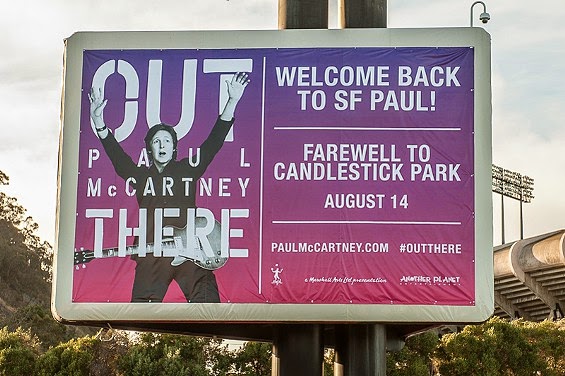
Paul McCartney Plays Final Concert at Candlestick Park 08-14-2014


San Francisco said goodbye on Thursday to Candlestick Park -- the stadium where the city's beloved Giants and 49ers celebrated some of their greatest triumphs.

The storied venue shut down after an evening concert by former Beatle Paul McCartney that finished around midnight. It will then be demolished to make way for a housing, retail and entertainment development.
The Stick, as it is known, opened more than 50 years ago and served as the home field for the 49ers and Giants. It hosted greats from both teams, including Joe Montana, Jerry Rice and Willie Mays, and was the site of The Catch -- Montana's touchdown pass to Dwight Clark to win the NFC championship game in January 1982 that sent the 49ers to their first Super Bowl.


The Giants played their last game at Candlestick in September 1999. The 49ers will play at a new stadium about 45 miles south starting this year.
Candlestick was also the site of a 1987 mass by Pope John Paul II and the Beatles' last live concert in 1966.

"Anyone you talk to about Candlestick Park is going to have mixed emotions about it: It's not a pleasant place physically. It gets windy and cold, but it's where the Giants and 49ers played for so many years," said Greg Breit, 50, before the concert's start. "There's so much history here. You can't deny it."
Fans savored the final event at The Stick by holding tailgate parties and taking snapshots of the stadium before the late-afternoon fog rolled in.


San Francisco police warned people attending Thursday's concert not to take any chairs or other mementos from the stadium, saying anyone caught with such items could face vandalism charges.


"We don't want people to be trying to take any pieces of Candlestick Park," officer Gordon Shyy told KGO-TV. "Just come enjoy the concert tonight and have a safe night."

Source: http://www.billboard.com/articles/news/6221743/paul-mccartney-closes-san-franciscos-candlestick-park

You can hear this concert in full here:
http://tela.sugarmegs.org/MostListened.aspx

July 19, 2014

Ron Howard to Direct New Beatles Documentary Focusing on Band's Early Years

July 16, 2014 9:00 AM ET Ron Howard,Courtesy Imagine Entertainment When Ron Howard was 9 years old, he was already a national television star on The Andy Griffith Show – and there was only one thing he wanted for his next birthday. "The gift that I was begging for was a Beatle wig," he tells Rolling Stone with a laugh. "And on March 1st, 1964, that's what I got: the Beatle wig of my dreams."

Now the Academy Award-winning director is coming full circle with his Fab Four obsession, having signed on to direct and produce an authorized, as-yet-untitled documentary about the touring years of the band’s career (approx. 1960-1966), a period in which the Beatles crossed the globe, sparked Beatlemania and released several classic albums (including A Hard Day’s Night and Rubber Soul). For it, he will interview surviving members Paul McCartney and Ringo Starr, as well as talk with Yoko Ono and Olivia Harrison (wife of the late George Harrison).

"What's so compelling to me is the perspective that we have now, the chance to really understand the impact that they had on the world," Howard says. "That six-year period is such a dramatic transformation in terms of global culture and these remarkable four individuals, who were both geniuses and also entirely relatable. That duality is something that is going to be very interesting to explore."

Howard is joined by Nigel Sinclair, the Grammy-winning producer behind the documentaries George Harrison: Living in the Material World and No Direction Home: Bob Dylan, as well as the producers Brian Grazer (Apollo 13, Get on Up) and Scott Pascucci (George Harrison). They will have access to the vast archives of Apple Corps, the Beatles’ company, as well as incorporate fan-sourced amateur video footage to recreate previously unseen concerts. It's Howard’s second music documentary, following last year’s Jay-Z festival film Made in America.

"We are going to be able to take the Super 8 footage that we found, that was all shot silent. We'll not only be able to digitally repair a lot of that, but we've also been finding the original recordings," explains Howard. "We can now sync it up and create a concert experience so immersive and so engaging, I believe you're going to actually feel like you're somewhere in the Sixties, seeing what it was like to be there, feeling it and hearing it. And as a film director, that's a fantastic challenge."

Sinclair says the team has already unearthed some surprising footage from the Beatles’ final concert at San Francisco's Candlestick Park in 1966. "Their last concert in ’66, when they were probably the most famous people on the planet, [they] ended up carrying their own amps onstage. I think that’s almost emblematic of the charm of this story," he says. Also a longtime Beatles fan, he saw the band in Glasgow in 1964. "It was a memory to treasure."

The film will also explore the "multigenerational quality" of Beatles fandom, according to Howard. "I hope we find some of that in the footage," he says. "We may have a shot of a boy or a girl very early in their life at a concert, and then we may be able to find them today and talk to them, and talk to their grandchildren and see what their relationship is with the Beatles, and understand how multiple generations find tremendous value and relevance in their music."

The documentary is scheduled for a tentative late-2015 release, and Howard says he is eager to begin interviewing McCartney and Starr. Turns out, he has a history with his heroes; half of the band met him on the set of his hit 1970s sitcom Happy Days. "We got word that John Lennon wanted to come by and bring his son [Julian], and he was a big Fonzie fan. I managed to sneak in a picture," he recalls. "He was graciously cool, but mostly it was for his kid, which we all really appreciated."

Howard adds, chuckling, "A year or so later, Ringo and Keith Moon wandered by. I don't know what they were doing in the lot, and I'm not even sure they knew where they were, but they seemed happy to be there."

Source: Read more: http://www.rollingstone.com/music/news/ron-howard-directing-new-beatles-doc-focusing-on-bands-early-years-20140716#ixzz37w28bbfe
Follow us: @rollingstone on Twitter | RollingStone on Facebook

July 04, 2014

Review: Essential Beatles movie 'A Hard Day's Night' is back on DVD

There should be a law that “A Hard Day's Night,” which was just re-released by the Criterion Collection on DVD, should never be allowed to go out of print. It is a movie that was a landmark film when it was released in 1964 and still is today.
Movie critics, including the late Roger Ebert, praised it to the skies. “It was clear from the outset that 'A Hard Day's Night' was in a different category from the rock musicals that had starred Elvis and his imitators,” he wrote in “Roger Ebert: The Great Movies.” “It was smart, it was irreverent, it didn't take itself seriously, and it was shot and edited by Richard Lester in an electrifying black-and-white semi-documentary style that seemed to follow the boys during a day in their lives.”

The new Criterion DVD does what the company is famous for – present movies in an intelligent setting for film fans. It starts, of course, with the movie, which looks absolutely fantastic, sharper and cleaner and than ever thanks to a transfer from the original negative.

The audio got a big improvement with this new DVD over the previous Miramax version, which only featured a mono soundtrack. The new DVD features both a Dolby stereo and 5.1 surround audio supervised by Giles Martin. His mix makes the music sound dimensional.

The new DVD reorganized the special features from the Miramax set and includes most, though not all. Some of the DVD-ROM interviews on the Miramax set have been incorporated as commentary. Also included is “The Making of 'A Hard Day's Night,'” which included comments by Ebert and Roger McGuinn, plus Phil Collins showing where exactly he was in the movie.

Two of the new features are especially great. “The Road to 'A Hard Day's Night'” is an interview with author Mark Lewisohn about the history of the movie. The new DVD also includes an over-the-film commentary taken from a discussion from the special features of the Miramax DVD. Not that it's bad, but since it was not made specfically for a commentary track, it sounds disjointed since few of the comments match what's happening onscreen. There's also a new feature called “Picturewise” that looks at Lester's movie style.

There are two versions of the release: a single disc regular DVD and the dual-format version that includes Blu-ray and two regular DVDs which include everything on the Blu-ray. Spend the extra and get the dual-format, which also comes with a great little book with an interview with Richard Lester and rare movie pictures, some in color. You won't regret it.

But don't get rid of that Miramax DVD just yet. While it was criticized in some circles and unfairly for the overabundance of special features, a strange complaint, some of those features are missing in the new DVD, among them access to the shooting script. And the video for “I'll Cry Instead” from the original MPI DVD (and the earlier Voyager CD-ROM) isn't here, either.

Criterion has a respected reputation for its film releases. “A Hard Day's Night,” which will be released in England July 21, is no exception and well worth getting.
(Note: Pattie Boyd will appear at a special 50th anniversary screening this Sunday at Catalina Island in Southern California. You can find information here. Also, "A Hard Day's Night" will open a special theatrical engagement July 4. The theaters are listed on the Janus Films website.)

Source:

July 02, 2014

A Digitally Restored 'Hard Day's Night'


The 1964 screen debut of The Beatles became a cultural phenomenon. Take a look at scenes from the movie. Bruce and Martha Karsh/Janus Films. Rock movies were never the same after "A Hard Day's Night."


The 1964 screen debut of The Beatles was meant to cash in on the wave of Beatlemania sweeping the band's native England and produce a soundtrack album that American movie studio United Artists could market through its music division. It did that and more: Like its stars, the movie became a cultural phenomenon.
"It elevated the art of the pop-music film," said Beatles biographer Mark Lewisohn, author of "Tune In: The Beatles: All These Years." After a string of peppy jukebox musicals in the late 1950s such as "Rock Around the Clock," the Beatles film set a new standard. "It was the first of its kind to treat the subject with some intelligence and a more sophisticated level of humor."


Janus Films will release a digitally restored version of the film in about 100 cities on July 4, commemorating the 50th anniversary of its premiere at the Pavilion Theatre in London's Piccadilly Circus. The Criterion Collection released a DVD/Blu-Ray edition Tuesday.
"This is the film where we literally get to meet the Beatles," said Peter Becker, president of The Criterion Collection and a partner in Janus Films. The distributor, which released Academy Award-winning "The Great Beauty" digitally to theaters, said a digital projection of the Beatles movie allowed for a much wider simultaneous release than a film version. "It just plays like gangbusters," he said.
The loose-limbed comedy, directed by Richard Lester, follows the Fab Four—Paul McCartney, John Lennon, George Harrison and Ringo Starr—as they travel from Liverpool to London for a TV performance. Antics ensue, many instigated by a mysterious older man (Wilfrid Brambell) that Mr. McCartney claims is his grandfather. Mr. Starr goes on a walkabout. And when they're not singing, or on the run from screaming fans, the performers riff as only slightly exaggerated versions of themselves—making the most of clever one-liners concocted by screenwriter Alun Owen. 


The movie made an impact on generations of Beatles fans. Some of them grew up to direct their own pop-oriented films.

"To me it's probably the greatest rock film ever made," said Morgan Neville, a longtime director of music documentaries whose "20 Feet from Stardom" won the Academy Award this year. "There were a thousand ways that movie could have gone off the rails, but every other pop band since has tried to make it."
Mr. Neville credits much of the movie's success to Mr. Lester. The American filmmaker, then known for his work with British comedians Peter Sellers and Spike Milligan ("The Goon Show"), infused the film with a spirit of "sheer humor and anarchy," Mr. Neville said. It anticipated the work of ensembles like Monty Python's Flying Circus. "He was really at the forefront of the British new wave." Mr. Lester's inventiveness was such that when Lennon was unable to appear in part of the "Can't Buy Me Love" sequence, which was shot outdoors, the director stood in for him: He put on the absent Beatle's shoes and pretended to be Lennon holding the camera.


The film version of "A Hard Day's Night," whose title was taken from one of Mr. Starr's off-the-cuff comments and became the last song written for the film, has many other distinctions. One of the most conspicuous is the group's thick Liverpool accents. "The biggest pop star in Great Britain before the Beatles, Cliff Richard, had adopted a mid-Atlantic accent in the hope that he would be more acceptable to Americans for not sounding completely English," Mr. Lewisohn said. "The Beatles said, 'Here we are and this is us and you can take it or leave it.' Everyone took it."
The seminal Beatles film "A Hard Day's Night" is hitting more than 100 theaters July 4 in a digitally restored version. WSJ contributor Steve Dollar joins Tanya Rivero with a look at the revival of the 1964 classic and its influence. Photo: Janus Films 


The film also reveled in running jokes and sight gags that might slip by a casual viewer. The elderly gent played by Brambell is continually referred to as "clean." As an actor, he was better known as the grubby lead in the BBC comedy "Steptoe and Son," the basis for the American series "Sanford and Son." And in a moment typical of the film's attitude, there's a glimpse of John Lennon with a bottle of Coca-Cola raised to his nose. "Sniffing coke," Mr. Lewisohn said. "It's just there and it's gone."
Some of those subtleties may be more apparent in the restored film, which includes a soundtrack remixed for stereo and surround formats by Giles Martin, son of Beatles' producer George Martin. To ensure the highest fidelity, Mr. Martin went back to original source materials, including stock sound effects that were archived by the BBC. 


In other instances, the producer enlisted a little help to stir some extra Beatlemania. During the performance at the end of the movie, he instructed co-workers to shout out the names of individual Beatles, which weren't very audible in the film amidst all the shrieking. 


"There's a little girl who does the Internet here," Mr. Martin said. "She's the quietest character. She went ballistic. 'PAULLLLLL!!!'"
Despite such enduring enthusiasm, Mr. Martin was mindful of not overdoing it. "You want to have a feeling like you're there," he said. "But I'm not remixing a Michael Bay film."

Source: http://online.wsj.com/articles/a-digitally-restored-hard-days-night-1403814666


REVIEW: "A HARD DAY'S NIGHT"- RESTORED 50TH ANNIVERSARY THEATRICAL RELEASE 


By Mark Cerulli
After a meticulous 4K restoration by none other than the Criterion Collection, the Beatles’ first film, A Hard Days Night, was unveiled at LA’s Raleigh Studios. Yes, the image was crisp and clean, not a smudge or scratch in sight. (No surprise there as the film’s director Richard Lester personally approved the restoration.) And yes, the music sounded glorious in a new 5.1 mix. In fact, George Harrison’s iconic opening riff on the title track just about knocked this Cinema Retro scribe off his seat! But what was really special about this whimsical film was watching it through the prism of fifty years. From frame 1, we know how we lost both John Lennon and George Harrison. We are living with climate change, al-Qaeda, overpopulation and deforestation, so this movie is a welcome relief, capturing a simpler time in a quainter London which was then still throwing off the shadows of WW II. Most importantly, the film delivers The Beatles in close-up after close-up – all are young, strong and so full of life. To say they “stole the show” doesn’t apply, they ARE the show. The plot, about the trials and tribulations of getting the white-hot group to a live performance is basically filler between musical set pieces, but it earned writer Alun Owen a 1965 Oscar nomination. George Martin’s thumping score also landed an Oscar nod.


Along for the ride is Paul’s cranky grandfather (Wilfrid Brambell) who keeps the band and their managers (dour Norman Rossington and goofy John Junkin) on their toes. Odd looking and angular, Brambell, a major UK TV star at the time, was a sneering contrast to the Fab Four’s glowing charisma.


The film is as much about movement as it is music. The band is always on the move, - on foot, in trains, cars and a helicopter. Richard Lester’s cameras are on the move as well, with numerous hand-held shots and a beautiful aerial sequence where the band escapes a stuffy rehearsal to mess about in a playing field accompanied by Can’t Buy Me Love. With much of the dialogue improvised on the spot, A Hard Day’s Night has a breezy, cinéma vérité feel that obviously worked for its stars as they seem to be having a blast from start to finish.


When The Beatles finally go “live”, the climactic concert delivers vintage “Beatlemania” in all its screaming glory. The lads blast out Tell Me Why, If I Fell, I Should Have Known Better and She Loves You, intercut with an audience full of hysterical teens and the show’s harried director (Vincent Spinelli) having a meltdown in the control booth. It’s all innocent, upbeat and just simply, fun. Are there plot holes you could drive a double-decker bus through? Sure. But who cares? For a brief shining moment the Beatles are together again and all is well with the world.


On July 4th, Janus Films will re-release this restored version of A Hard Days Night in more than 50 cities across America.