November 08, 2023

Now and Then’ – a final gift from The Beatles


Just when I was starting to become somewhat disillusioned with the dearth of interesting new Beatles-related releases on the horizon, Christmas came early this month with Paul’s bombshell announcement that a “new” Beatles song had been completed and was being prepped for release later this year. Wow. Though it hasn’t been confirmed, the track is believed to be ‘Now and Then’, a late-1970s Lennon demo briefly worked on by the surviving Fabs in the mid-1990s as part of the Anthology project but ultimately discarded for one reason or another (which I’ll get into later). Apparently, the wonders of artificial intelligence (AI) technology have resolved any technical issues surrounding the quality of John’s vocal and, voila, Macca has fulfilled his long-standing wish to create a “final” Beatles song with contributions from all four members. The detail is still sketchy, but his comments have predictably sparked a firestorm of debate online. Should two Beatles be able to release a new track without the say-so of their absent bandmates? Does it even constitute a Beatles recording in the circumstances, never mind one good enough to carry the label of being their final presentation to the world? What form will the release take – will it be part of a bigger package, and are we now scraping the bottom of the barrel? I’ll be honest – for me, this is the holy grail of Beatles releases, one I’ve been waiting/hoping for over half my life, and I can’t fucking wait. But there is a lot to unpick here, so let’s get into it.

The history of ‘Now and Then’ is a tangled, and quite intriguing, one. Originally recorded by John as a piano demo in the late 1970s, it never aired on the otherwise exhaustive exploration of his personal archive on US radio from 1988-92, The Lost Lennon Tapes. Nonetheless, it was one of unfinished songs Yoko handed over to Paul, George and Ringo to work on and transform into ‘new’ Beatles tracks for the Anthology project of the mid-1990s. Two of these – ‘Free as a Bird’ and ‘Real Love’ – were completed, and led off the first two volumes of The Beatles Anthology archive collections, but ‘Now and Then’ was abandoned and the final Anthology set appeared in the autumn of 1996 without a third reunion song.


One of the bootlegs which has appeared documenting the 1990s reunion sessions


CD Collection Track Listing:
Remix (Overdubs)   
1-1        Sun King ('Love' Version Reversed)
1-2        Now And Then (Overdub Remix)
1-3        Free As A Bird (Anthology Remix)
1-4        Real Love (Speed Corrected Version, More Accuracy)
1-5        Grow Old With Me (Lennon Anthology Version)
1-6        Sour Milk Sea (Alternate Version)
1-7        I'm The Greatest (Ringo Version)
1-8        All Those Years Ago (Enhanced Mix)
1-9        Watching Rainbows (Long Version, Speed Corrected)
1-10      Drive My Car ('Love' Version Without Transitions)
1-11      Revolution 1 (Take 20)
1-12      India (More Clear Version With Overdubs)
1-13      Good Bye (Demo)
1-14      Coda

Demos   
2-1        Everybody Had A Hard Year (Demo)
2-2        Now And Then (Cleaned-Up Demo)
2-3        Free As A Bird (Demo)
2-4        Real Love (Double-Tracked Demo)
2-5        Grow Old With Me (Double-Tracked Demo)
2-6        Sour Milk Sea (Demo)
2-7        I'm The Greatest (John Version)
2-8        All Those Years Ago (Original Version)
2-9        Revolution (Promo Version)
2-10      India (Demo)
2-11      Free As A Bird (Acoustic Mix)
2-12      Real Love (Acoustic Mix)
2-13      Grow Old With Me (Alternate Take)
2-14      We Can Work It Out (Demo Excerpt)

I remember the feeling of huge disappointment when Apple announced this. There was no talk of ‘Now and Then’ officially at the time, but it was an open secret the three former Fabs (a.k.a. The Threetles) had been working on other songs. It was strongly rumoured that ‘Grow Old With Me’, a gorgeous tune that appeared in demo form on John’s posthumous Milk and Honey album in 1984, was on the tape Yoko had given them, and there were also whispers of a brand new McCartney-Harrison original, ‘All For Love’, which really set pulses racing. To the best of my knowledge, neither of these two numbers have ever been confirmed as Threetles works-in-progress (indeed, before recording a version of it for his 2019 album What’s My Name, Ringo claimed never to have heard ‘Grow Old With Me’), but talk of an unfinished third track was verified by Paul himself in 1997, while promoting that year’s Flaming Pie album. “George didn’t like it. The Beatles being a democracy, we didn’t do it,” he told Q magazine (interestingly, in another interview, he didn’t rule out that the song might be released one day). There were also reports that the quality of the original demo also posed major technical issues for the trio and producer Jeff Lynne. This became evident when the original Lennon version leaked out onto the bootleg market around this time. When a friend played me John’s demo recording in 1999, the loud buzz which accompanied it was definitely a problem. And while the tune itself was quite haunting, it also seemed a little ponderous and skeletal. Though their decision remained massively frustrating, I could kind of understand why the Fabs had passed on it.

Below is another version of the Now and Then 2CD set:


John’s demo version of the song (considerably improved from the version The Threetles had to work with)

Fast forward ten years or so, and Paul was reported to have said he remained interested in finishing the track off – something he reiterated when appearing on a BBC documentary about Jeff Lynne, Mr Blue Sky, in 2012. Despite again saying that George “went off it” (and, indeed, thought it was “fucking rubbish”), he added: “That one’s still lingering around…I’m going to nick in with Jeff and do it, finish it, one of these days.” Coincidentally or not, a new version of the Lennon demo began circulating online at around the same time, without the buzz and in much better audio quality. It was so good that fans began adding their own backing to it in an attempt to guestimate what a modern-day Beatles recording would have sounded like. One rendition, in particular, was stunning – not only allying John’s vocal with tasteful piano, guitar, bass and drum parts (and weaving in authentic harmonies here and there), it also revealed the song itself to be much more substantial than the original threadbare demo had indicated (and also belying Lynne’s assertion that “the song had a chorus but is almost totally lacking in verses.”) It demonstrated the art of the possible in fine style, even without the extra creative juice actual real Beatles could bring to the table.

Paul, Ringo and Jeff Lynne talk about the 1990s Beatles reunion sessions. Macca discusses ‘Now and Then’ at 07:55.

Despite all this, I was still very surprised to hear it was still on Paul’s radar as recently as 2021, when he mentioned his interest in returning to ‘Now and Then’ in an interview with The New Yorker in the lead-up to the airing of Peter Jackson’s The Beatles: Get Back documentary series. Still, after my excitement subsided, realism set in (or so I thought). Wasn’t it a little late in the day to be doing this, I reasoned? After all, it will soon be 30 years (gulp) since those Threetles sessions. And could he really do it when, by his own admission, George had so firmly rejected the possibility of releasing it? Yet here we are: with AI giving us a nice, clean Lennon vocal to enhance the 1990s Threetles backing tracks (and who knows what other embellishments Paul has added since), and the whole Beatles family on board with the project, a farewell Fab Four song will soon be with us.

Of course, there are some who believe this shouldn’t be happening at all. That it won’t really be ‘The Beatles’, because the four didn’t record it together and two of them aren’t here to give their approval. Those same naysayers are usually the same people who don’t consider ‘Free as a Bird’ or ‘Real Love’ to be part of the band’s ‘official’ canon. I’ve always found this view strange. Whether or not you like them, or think they are worthy of The Beatles’ name is one thing, but claiming they are not Beatles songs defies logic in my view. They were written by a Beatle (‘Free as a Bird’ is actually credited to all four, with finishing touches added by Paul, George and Ringo), feature all four Beatles and were approved and released by all three surviving Beatles, plus Yoko. Ah, I hear some say, but John would never have sanctioned their release. Well, I would hazard a guess that the four people John was closest to in his adult life would have a better idea of what he would’ve approved of than complete strangers who never met him. But they’re not part of that 1962-70 EMI catalogue, I hear others cry. So, does that mean all the pre-EMI, pre-Ringo songs released on Anthology Vol. 1 are not Beatles songs either? Nor the BBC radio sessions material? Who exactly is deciding what is ‘canon’ and what isn’t? Shouldn’t that be up to, er, The Beatles? Yes, other dissenting voices cry, but John isn’t really on these songs, they were effectively performing as a trio. Right. So, by that token, ‘Here Comes The Sun’ isn’t a Beatles song. Nor ‘I Me Mine’, or ‘For No One, or ‘Because’, or ‘Back in the USSR’. And I dread to think how these people will react when someone breaks it to them that tunes like ‘Yesterday’, ‘Julia’ and ‘Blackbird’ feature just a single Beatle. Clearly such tracks are seriously lacking in the authenticity stakes.

The undoubted elephant in the room with ‘Now and Then’, however, is George – more specifically, the degree of his approval and his participation. By Paul’s own admission, it was Harrison who brought the curtain down first time around, branding the track “fucking rubbish”. Paul has also said how George felt some of John’s songwriting towards the end of his life wasn’t up to scratch. Even with Macca’s renowned talent for revising history, it’s going to be interesting to see how he circumvents that one when the promotional bandwagon for the recording kicks into gear later this year. That said, George wasn’t against reworking John’s unfinished songs, as his spirited playing and singing on the two tunes that were released demonstrates. And the fact that he called a halt to work on ‘Now and Then’ shows how fiercely protective he was of The Beatles’ legacy, refusing to put anything out under their banner which he felt was sub-standard. What’s not clear, though, is whether he didn’t feel the song itself was strong enough, that the technical problems couldn’t be surmounted, or that The Threetles’ attempts to transform it into a fully-realised, viable recording were just not coming together. It could even have been a combination of all three. What we can reasonably surmise, however, is that the version about to be released today is considerably cleaned up, and most likely improved, from the one the Fabs worked on all those years ago. So George may have more amenable to its release were he around today; certainly, I don’t think Olivia and Dhani Harrison would’ve given their blessing to anything he would’ve been opposed to.
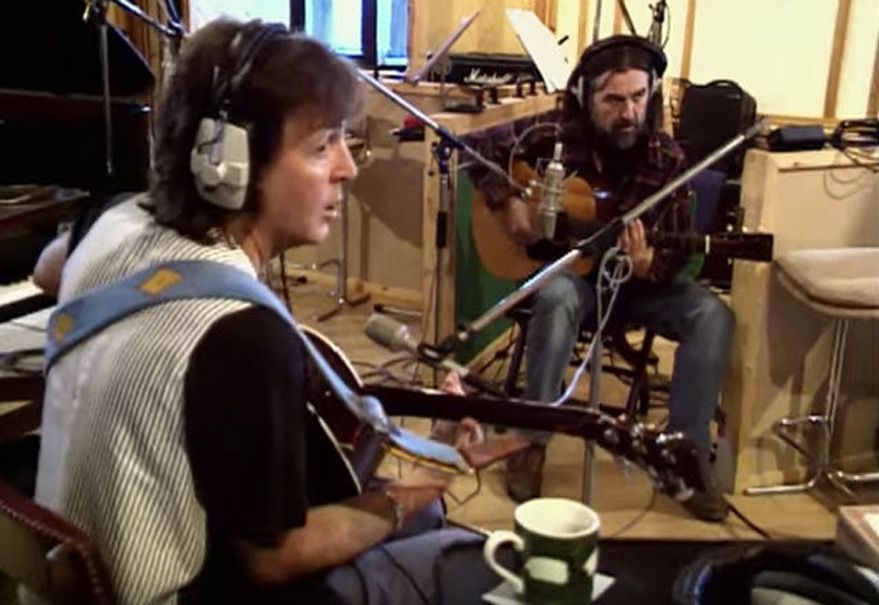
Paul and George pictured during the ‘Threetles’ reunion sessions at Macca’s Sussex studio, 1995

Which brings us to, how much Harrison playing (and possibly singing) will feature on the final record? Indeed, how much work did all three Fabs put into it during those reunion sessions before calling it a day? Lynne is on record as saying the band spent just “one day — one afternoon, really—messing with it. We did the backing track, a rough go that we really didn’t finish.” Yet some other sources claim the Threetles had several stabs at the song over the course of 1994/95, before giving up the ghost. Either way, it’s fair to assume George could’ve laid down a guitar riff, or a few licks, at the very least. He was always very careful and precise in mapping out his parts, so I doubt there would’ve been any half-arsed jamming involved which would in any way sully his memory. He might even have taken a pass at a solo or two. Paul and Ringo could easily have polished up their performances in the years since, of course, but what’s really key is whether McCartney and Harrison recorded any vocal lines – particularly the kind of dazzling harmonies which adorned ‘Free as a Bird’ and ‘Real Love’. I really hope so, particularly bearing in mind the deterioration in Macca’s voice over recent times. He can still sing, of course, but no amount of studio sweetening could cover up the difference in his vocal prowess between, er, now and then. Other questions abound. Has Jeff Lynne produced the new recording, or did Paul and Ringo turn to George Martin’s son Giles, overlord of all the recent Beatles archive remixes? Have they kept it simple or did they add some strings and/brass to give it a bit more of a lavish, late-era Beatles feel? Will it have a ‘classic rock’ arrangement, or will they try to inject a more contemporary vibe? Will Paul (perhaps with George) have written any new sections to flesh out the original demo? Mouthwatering stuff to consider, and we don’t have long to wait.
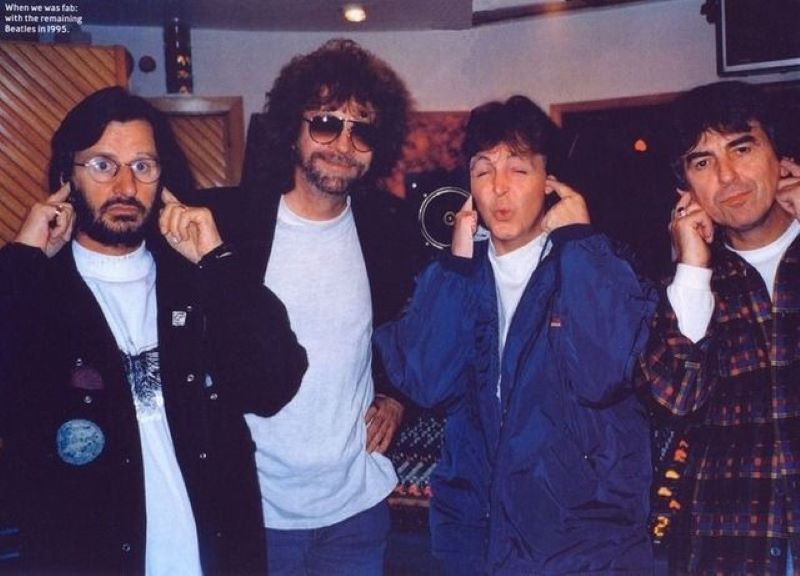
The Fabs with Jeff Lynne in 1994. Is it the buzz on the ‘Now and Then’ demo hurting their ears, or Jeff’s trademark drum sound?

Then there is the question of what form the song’s release will take. Surely they won’t just put it out as a standalone track to stream or download. As with the two Abba comeback songs in 2021, that would most probably result in a blaze of publicity and a flurry of interest for a few days, followed by a so-so chart placing and a collective shrugging of the shoulders as the world moves quickly on to the next showbiz sensation. To be fair, that will almost certainly happen anyway, but I would imagine Apple will want to monetise the song as much as possible, most likely by using it to spearhead a bigger Beatles release. I can’t see them sticking it on a remixed version of Rubber Soul, or something like that. I did wonder if they might use it to promote a long-overdue remaster of the Anthology albums, and add it onto Volume 3 as originally planned back in 1996, but well-placed sources say this isn’t the case. There is the possibility of a new, fourth Anthology collection, I suppose, rounding up other unreleased Beatles material, but with the ongoing series of expanded, deluxe versions of their studio albums mopping up all those odds and ends, I don’t see the point in that. There is always the grim possibility of another greatest hits album, expanding the mega-successful 1 compilation by adding the likes of ‘Please Please’ Me’, Strawberry Fields Forever’ and ‘Here Comes The Sun’, plus ‘Now and Then’. More tantalising is the prospect of a Threetles EP, placing the new song alongside ‘Free as a Bird’ and ‘Real Love’ in one package. The latter songs were remixed in 2015 for the 1+ DVD collection of Fabs promo films, but these versions remain unavailable on CD or streaming/download sites. Who knows, perhaps Apple have employed AI to freshen up John’s vocal on those numbers, too?

What I would dearly love to see, but sadly cannot envisage happening, is for ‘Now and Then’ to be released in some form alongside recordings of Paul, George (on acoustic guitars) and Ringo playing together at Harrison’s Friar Park home in the summer of 1994. Brief (but glorious) snippets of this session were included on the Anthology DVD set’s bonus disc in 2003, but we know they performed much more, mainly rock ‘n’ roll oldies and early Lennon-McCartney originals from their pre-fame days (the clip on the DVD where a grinning George leads Paul into ‘Thinking of Linking’, a half-forgotten tune penned by a teenage Macca, is just sublime). Such a release, echoing their skiffle beginnings as The Quarrymen, would be the perfect way to bookend their career. And we’ve already been given a taster, so why not let us enjoy the whole thing? Alas, John’s absence from the proceedings is likely to put a block on this, despite the aforementioned long history of The Beatles recording as a trio. Or maybe Apple is holding that back for another project in 20 years time, when there’ll be no Beatles left to create new product (and, sadly, not many of us current fans left around to care either way). It would be such a shame to leave this in the can, though, and ‘Now and Then’ offers an ideal opportunity to get it out. There must also be plenty of unused interview footage of the three of them together from that time, and there’s surely mileage in a book documenting the whole Anthology/Threetles period (Paul has said he kept a diary through the sessions for ‘Free as a Bird’, for example). We can but dream.
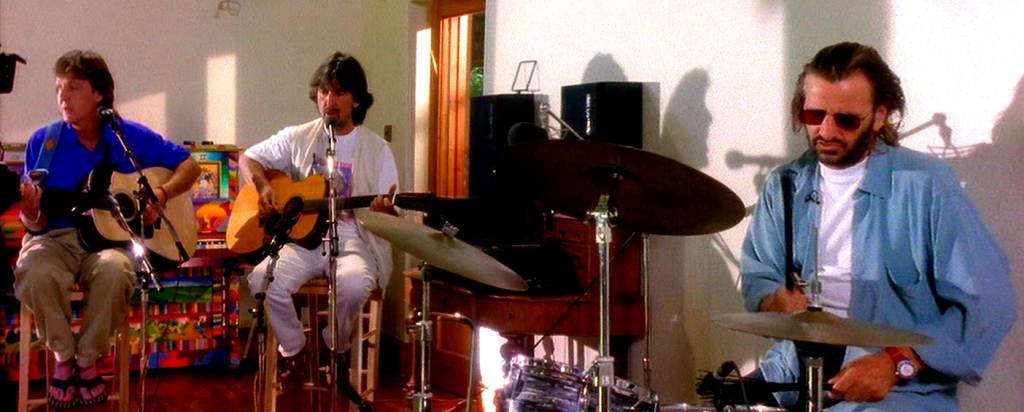
Paul, George and Ringo playing together at Friar Park, 1994. Apple, please put this out!

Whatever happens, the release of ‘Now and Then’ is a wonderful final gift from the band, one I’d pretty much given up on ever getting. Yes, there will be some (incredibly, Beatles fans among them) saying this is sacrilege, that they should just “let it be”, that it’s a self-promoting cash grab by Paul, and so on. But unlike in 1995, when the snide put-downs of the two reunion songs had me gnashing my teeth, these days I really couldn’t care less. Seriously, how can this one song – even if it isn’t very good – really besmirch The Beatles’ peerless legacy? More likely, it will bring immense joy for millions of people around the world who will get to savour one last Fab Four tune. And I don’t know about you, but I find the idea of McCartney completing a Lennon song more than 40 years after John started it quite beautiful, and perfectly Beatles. Certainly, it seems like an itch Paul’s been wanting to scratch ever since the Fabs worked on the demo back in the 1990s. This may or may not have something to do with Carl Perkins’ claim (apparently relayed to him by Linda McCartney soon after Lennon’s death in 1981) that the last words John said to Paul, face to face, were: “Think about me every now and then, old friend.” Either way, this new recording seems to have given Paul some sort of closure, and I reckon it will likely do the same for many more of us, too. Bring it on!

Source: https://freeasahub.wordpress.com/2023/06/25/now-and-then-a-final-gift-from-the-beatles/


August 15, 2023

The Beatles’ ‘Revolver’ Finally Gets the Deluxe Presentation It Deserves


Bruce Spizer previewed the Dolby Atmos mix and outtakes from the new “Revolver” set in Beatlefan #258. Here is an extended version of that article, addressing the complete box set. ….

Although quickly over-shadowed in 1967 by The Beatles’ follow-up LP, “Sgt. Pepper’s Lonely Hearts Club Band,” “Revolver” is now considered by many critics and fans to be the band’s best album.

It was issued at a time before The Beatles gained complete artistic control over their albums and singles released by Capitol Records in America, so the U.S. version of the album only had 11 of the 14 tracks contained on the British release. (The other three songs had been issued previously on Capitol’s “Yesterday and Today” collection, which came out about six weeks ahead of the early August 1966 release of “Revolver.”)

And, while the American version of “Revolver” is quite remarkable in and of itself, the 14-track British release is by far superior, unless you believe that three more John Lennon songs is a bad thing.

With “Revolver,” The Beatles were looking for more color in their recordings, trying new instruments and techniques. But, they were not using studio wizardry to cover weaknesses; they were looking for new sounds to enhance their already brilliant songs.

George Martin and the Abbey Road engineers effectively utilized 1966 technology to record an album unlike any that had preceded it. Each song had its own distinct sound and feel, yet the collection held together as a well-coordinated album.

Unlike today, where digital recording provides an endless number of tracks to separately record each voice and instrument, the Abbey Road crew was limited to a four-track recorder. This forced them to record multiple instruments and/or voices onto a single track, greatly restricting the placement of sounds in the final stereo mix. These limitations increased when two or more tracks were mixed down to a single track to free up tracks on the four-track for overdubs.

For example, if the bass, rhythm guitar and tambourine initially were recorded on separate tracks, but then mixed down to a single track, those instruments had to be placed together in the final stereo mix.

However, digital technology has enabled recordings from the 1960s to be remixed in ways previously not possible. The first big advance came when engineers were able to go back to the initial tracks before they had been mixed down, and then run them simultaneously with the later overdubs that had been recorded onto separate tracks. By going backward and running these separate tracks in sync, engineers often were able to expand the four tracks to eight or more, adding greater flexibility to the mix. But, that didn’t solve the problem of how to separate instruments and voices that initially were recorded on a single track. For example, if the bass, rhythm guitar and drums were on a single track from the start, those instruments had to be placed together in the stereo mix. The three instruments could be placed in the left channel, the right channel or in both channels, which would cause the sound to be heard from the center.
In the studio during sessions for “Revolver.” (Apple Corps Ltd.)


The breakthrough came with Sir Peter Jackson’s work on the “Get Back” project. The film’s soundtrack was recorded in 1969, on mono tape recorders. In many cases, conversations between Beatles were difficult to hear, due to other sounds on the mono tape, such as the band playing their instruments and/or others having their own conversations.

By using artificial intelligence technology to recognize the distinguishing features of different instruments and voices, Jackson’s WingNut Films was able to isolate and separate the multiple voices and instruments recorded on the mono tape, in effect, demixing the contents on the tape. This enabled Jackson to present clean-sounding conversations in the film without the other extraneous sounds.

For the new reissue, this same AI demixing process from WingNut was used on the original master tapes from the “Revolver” sessions. For example, on “Taxman,” the drums, bass and rhythm guitar all were recorded on a single track, meaning that those instruments had to be placed together in the stereo mix. But, after the WingNut AI demixing process, each instrument became, in effect, a separate track. This gave producer Giles Martin and engineer Sam Okell complete flexibility as to their remix, enabling them to place the drums in the center, and place the guitar and bass elsewhere. It was as if someone went back in time to 1966 and had the Beatles record “Revolver” on a 64-track recorder, rather than a mere four-track.

The results of the “Revolver” 2022 remix are breathtaking. The clarity of each instrument and vocal brings an intimacy to the listening experience that previously was not possible. The gritty guitar work on tracks such as “Taxman” and “She Said She Said” sounds even more powerful. The exquisite harmonies on “Here, There and Everywhere” and “Good Day Sunshine” surround the listener. “Eleanor Rigby” places the listener in the middle of a string quartet. The enhanced placement of the sound effects and odd-ball voices on “Yellow Submarine” adds to the song’s party atmosphere, while “Tomorrow Never Knows” sounds even freakier.

The 2022 remix fixes some of the oddities present in the original stereo mix. On the 1966 mix of “Eleanor Rigby,” Paul’s vocal on the first verse briefly is heard in the left channel before panning to the right channel. On the remix, Paul’s lead vocal is straight down the middle. And, in keeping with the policy of basing the stereo mix on the mono mix, the stereo remix of “Yellow Submarine” now has the acoustic guitar and Ringo’s vocal starting simultaneously at the beginning of the song. The 1966 stereo mix delayed the acoustic guitar until after Ringo had sung “In the,” with the first chord coming in on “town.”

The remixed album also gives the listener greater appreciation for all of George Harrison’s songs on the LP. While “Taxman” still is the standout, “I Want to Tell You” and “Love You To” shine, as well.

In addition to the 2022 stereo remix, the “Revolver” Super Deluxe Edition contains a 2022 remaster of the mono album. The mono vinyl was cut directly from the original analogue master tape from 1966, with cutting engineer Sean Magee guided by cutting engineer Harry Moss’ mastering notes from 1966. The mono CD was mastered by Thomas Hall from a 24-bit/96kHz digital recording of the 1966 master tape guided by those same notes.

The collection also includes an EP with 2022 stereo remixes and mono remasters of the two songs pulled from the sessions for exclusive single release, “Paperback Writer” and “Rain.”


But, for most fans, the most interesting part of the box set will be the two discs of outtakes and demos.  

While curious fans and music historians always want more outtakes, the two discs provide several revealing and memorable moments, as well as an enjoyable listening experience.

Fortunately, Apple has moved on from its policy of not repeating outtakes that previously appeared on “Anthology.” This is a welcome decision, as fans do not want to pull out “Anthology” to hear essential outtakes not included in the reissue box sets.

Although the outtakes were not put through the WingNut AI demixing process, the 2022 mixes of the outtakes take advantage of the latest technology and are superior to the earlier “Anthology” mixes, some of which were edited. Apple also has allowed more studio banter to accompany the outtakes.

The running order of the outtakes in the box set is chronological, according to when the track was recorded. This gives the listener an opportunity to hear how the remarkable recording session progressed.

The book included with the vinyl and CD box set discusses the tracks in the order of their appearance on the album, followed “Paperback Writer” and “Rain.”
Original tape box for “Taxman” and “And Your Bird Can Sing.” (Calderstone Productions Ltd.)

As was the case with “Anthology,” the box set contains Take 11 of the album’s opening track, “Taxman.” This has a guitar bit not in the finished master, as well as the “Anybody got a bit of money, anybody got a bit of money?” falsetto refrain that would be replaced by the more stylish references to Mr. Wilson and Mr. Heath. The new version is remixed in the same style as the 2022 album remix, and is vastly superior to the “Anthology 2” version. It also has a little bit more of banter at the beginning and a sliding bass note at the end.

After the recording of the first take of the string octet backing for “Eleanor Rigby,” George Martin had a discussion with Paul McCartney regarding whether the musicians should add vibrato or play it straight. At Martin’s request, the musicians play the same segment with and without vibrato. After Paul admits he can’t really tell the difference, Martin makes the right call, telling the musicians to play the song without vibrato. This fascinating discussion is included in the box set prior to Take 2, an instrumental backing that has subtle differences from the take selected for the master. “Anthology 2” contains the instrumental string backing of the master take.

The new box set contains the same rehearsal fragment of “I’m Only Sleeping” found on “Anthology 2,” but with a little bit of added banter and notes at the end. “Anthology 2” also contains Take 1 of the April 29 attempted remake of “I’m Only Sleeping,” with John on lead vocal and acoustic guitar, Paul providing a harmony vocal, George on electric guitar and Ringo on tambourine. John’s presong announcement of “I’m Only Sleeping, Take 1” is actually from the April 27 session. While the box set does not rerun Take 1, it does contain Take 2 from the April 29 session, which breaks down at about the 1:15 mark, although the tape runs for another minute, capturing Martin’s discussion about the balance of the guitars, banter from John and instrumental noodling.

The box set also contains Take 5 from April 27. The group, knowing that the tape of the song would be slowed down to give the track a dream-like effect, played the song at a fast pace, with John on acoustic guitar, Paul on bass and Ringo on drums, all recorded on a single track of the four-track recorder. John is heard in a few places with off-mic vocals to mark the place in the song.

Finally, the box set includes Mono Remix 1 (“MR1”), which was sent to Capitol for inclusion on its “Yesterday and Today” album. Martin later remixed the song for the British mono release.

While “Anthology 2” has no outtakes of “Love You To,” the “Revolver” box set contains three. First up is Take 1 of the song, with George on vocal and acoustic guitar, accompanied by Paul on harmony vocal. At this stage, the song was in the key of D minor (considered by classical composers to the most melancholy of the keys). The box set also contains a rehearsal with George on sitar and Paul on tamboura (a four-string Indian drone instrument). The later takes of the song were played in C minor.

The box set also contains Take 7, complete with Paul’s harmony vocal, but without the song’s instrumental introduction, which was edited to the front of the master take. Kevin Howlett’s notes in the box set’s book confirm that George did indeed play the intricate sitar part on the song. Harrison also overdubbed a fuzz guitar part. The track does not have bass guitar.

Also in the box set is Take 6 of “Here, There and Everywhere,” which is one of only two complete takes of the song. The track features Paul’s electric guitar and lead vocal, backed by George on electric 12-string guitar and Ringo on drums. Even without the three-part harmony backing vocals of John, Paul and George, the song’s beauty comes through strongly, although Paul’s lead vocal is more tentative than on Take 13, which was selected for the master.

“Yellow Submarine” always has been viewed as a children’s fantasy song written by Paul for Ringo, but a two-part songwriting work tape included in the box set demonstrates that the  verses evolved from a deeply personal and stark song that John was working on. Backed only by his acoustic guitar, John sings: “In the place where I was born / No one cared, no one cared / And the name that I was born / No one cared, no one cared.” Toward the end of tape, John changes the opening line to “In the town where I come from.”


However, what started as a Bob Dylan/Woodie Guthrie-type song magically was transformed into a song for children of all ages when John’s fragment (keeping the same melody) was merged with Paul’s catchy chorus about a yellow submarine. The second part of the tape features a new set of lyrics that replace John’s somber words with lines retrofitted to go with Paul’s upbeat chorus. When John suggests that Paul sing the rewritten verses, Paul tells him: “No … you know how to sing it.” After John responds, “oh yeah, OK,” Paul asks him: “Can you read that?”

This implies that John will need to read the lyrics that were handwritten by Paul. John then strums his acoustic guitar and sings the new set of words over his original melody: “In the town where I was born / Lived a man who sailed to sea / And he told me of his life / And the land of submarines.”

This is followed by the same second verse as the finished version of the song. The chorus, sung by John and Paul, isn’t yet in its final form and contains a silly call-and-response: “We all live in a yellow submarine (Look out!), yellow submarine (Get down!), yellow submarine.” After the song breaks down, Paul does an impersonation of George Martin: “Now, come on, chaps. Cut it out! We gotta get a song done.” They then do the song again, this time repeating the same verses and chorus two times, except John sings “And he told us of his life,” instead of “told me.” At this stage, only the first and second verses had been written.

This fascinating work tape is followed by Take 4 of the song, featuring Ringo on lead vocal, prior to the addition of the sound effects and extraneous vocal shenanigans. The final piece of the story is a mix that showcases the sound effects, preceded by a spoken introduction, similar to the version of the song contained on the “Real Love” maxi-CD that was released in conjunction with “Anthology 2.”

By the time John recorded a demo tape of “She Said She Said,” he had changed his original lyrics from “He said” (referring to Peter Fonda) to “She said.” The box set contains John’s demo, complete with the temporary line, “it’s making me feel like my trousers are torn.”

The box set also contains Take 15, which is an instrumental backing with John and George on guitars, Ringo on drums and Paul on bass, putting to rest speculation that George overdubbed bass after Paul stormed out of the session. (Paul did leave prior to the superimposition of the vocals, so only John and George are heard singing on the finished master.)

In the box set, the track is preceded by John encouraging the lads: “Keep going. Last track! Last track!” (This studio banter actually took place before an earlier take.)

Although the “Revolver” box does not contain any outtakes of “Good Day Sunshine,” Howlett’s notes provide some previously unknown information regarding the recording of the song. While the tape box and recording sheet for the session show three takes of “Good Day Sunshine,” the tape reel contains six takes, with the one designated as Take 1 marked as “BEST.”  Track 1 has the instrumental backing, consisting of Paul on piano, George on bass, John on tambourine and Ringo on drums. The overdubbed vocals and additional instruments were recorded on the remaining three tracks.

The box set contains three outtakes of “And Your Bird Can Sing,” which originally was titled “You Don’t Get Me.” The first version of the song, recorded on April 20, features John on rhythm guitar, George on his 12-string Rickenbacker, Paul on bass and Ringo on drums. The box set contains Take 2, with its instrumental backing and the first set of backing vocals. The song has a Byrds-like quality. “Anthology 2” has a version of this take during which John and Paul got a case of the giggles when recording their second set of vocals over the backing track. The box set has this same take, but with the straight vocal track mixed out to enable the listener to better hear John and Paul cracking up.

The group recorded a remake of the song on April 26. The early takes consisted of John on rhythm guitar, Paul on bass, George on lead guitar and Ringo on drums. Take 5 initially was considered the best, and was given overdubs, including vocals by John and Paul. This performance is included in the box set. John jokingly describes the song’s tempo as “moderato foxtrot.” It has a totally different feel than the earlier version and the finished master, sounding more like a very talented bar band, with Ringo bashing his drums and cymbals. The group wisely recorded additional takes with a different sound before settling on Take 10 as the new “BEST” recording.

The box set contains the instrumental backing of “For No One” prior to the addition of Paul’s vocal and Alan Civil’s French horn solo. This stripped-down version enables the listener to hear more clearly Paul playing clavichord (mixed left).

The box set also contains Take 7 of the unedited version of “Doctor Robert,” which clocks in at nearly 3 minutes. When the instrumental backing for Take 7 was recorded, the group accidently played the middle eight three times instead of two. John realized this mistake and the following notation was made on the tape box: “On remix 3RD 8 to be cut out.” The version appearing on the “Revolver” album, with the third middle eight edited out, runs slightly over 2 minutes.

The box set offers very little insight into the recording of “I Want to Tell You,” although we do get to hear studio banter from the start of the session, regarding the name of the song. The track starts with Martin asking, “What do you call it, George?” John responds with “Granny Smith Part Friggin’ Two,” in reference to the initial “Granny Smith” title given to “Love You To.” Engineer Geoff Emerick suggests another brand of apple, “Laxton’s Superb.” This is followed by Take 4, which quickly breaks down.

“Got to Get You Into My Life” is represented by three tracks. The first is the same outtake of the first version of the song selected for “Anthology 2” (Take 5), but with studio banter preceding the performance of the song, which fades earlier on the “Anthology 2” mix. This is followed by a mono mix of the second version of the song, made prior to the brass overdubs that were recorded over tracks that contained fuzz guitar riffs (replaced by the horn riffs), a second bass part by Paul and falsetto backing vocals by John and George. This fascinating mix enables the listener to hear yet another phase in the evolution of the song.

Finally, the box set contains Take 8, with the original horn overdubs over two tracks before they were mixed down to a single track. This instrumental backing also contains a guitar part that was not transferred over during the reduction mix that was made to free up a track for the superimposition of Paul’s vocal.


A publicity shot for the “Revolver” album. (Apple Corps Ltd.)

“Tomorrow Never Knows” is represented in the box set by two tracks. First is Take 1, which was one of the highlights of the “Revolver” tracks selected for “Anthology 2.” This fascinating early version of the song appears in a superior mix, with the drums in the center. The box set also contains Mono Remix 11 (“MR 11”) of “Tomorrow Never Knows,” which appeared only on a limited number of the first pressings of the mono album before Martin had the master for the album recut with MR 8. (It has been estimated that only 3,000 to 4,000 copies of the mono LP were pressed with MR 11.) The inclusion of this relatively rare mix is a nice bonus for completists and collectors.  

The sessions discs also include outtakes of the single pulled from the sessions. First up are Takes 1 and 2 of the backing track for “Paperback Writer.” After Take 1 breaks down, the boys quickly move on to Take 2, which was used for the finished master. This backing would be given numerous overdubs to form the finished master.

Although many fans were aware that the instrumental track for “Rain” was recorded at a fast pace and then slowed down, to give it a heavier sound, the box set’s inclusion of the unaltered Take 5 (augmented by Paul’s overdubbed bass at the same speed) lets listeners hear what the backing originally sounded like. The song’s rapid tempo is jaw-dropping. While Ringo’s drumming on the single is one of his finest moments, it is even more impressive when one hears how fast and precise he was actually playing.

This is followed by Take 5, after the tape was slowed down from 50 kilocycles per second to 42 kilocycles for the superimposition of John’s lead vocal. The unaltered Take 5 of “Rain” runs for 2:35, while the slowed down version is 3:07 long.

The “Revolver” box set’s incredible selection of outtakes and demos will, of course, leave many fans and music historians (including me!) wishing that even more such tracks were included on the discs. While each of the two CDs easily could have accommodated several more tracks, I suspect the reason this was not done was to have the content on the two CDs match the content on the two vinyl discs, which cannot contain as much music as CDs.

Unlike the earlier releases in the Beatles album reissue series, there is no Blu-ray disc in this box set, which means there is no 5.1 mix included, although an Atmos mix is available separately for download.

The box sets in the album reissue series have been evolving, as those involved find ways to tweak the packaging and content. Apple Corps seems to have settled on a full album-size box for both the CD version and the vinyl version, with the number of CDs matching the number of vinyl discs. The use of an EP for the related singles also seems here to stay.

Howlett’s notes also are getting more comprehensive, which is a good thing.

The super deluxe edition of “Revolver” rates another solid “A” grade for Apple and all involved. The book is both informative and attractive. It contains a forward by McCartney, an introduction from Giles Martin, a guest essay from Questlove, an extract from cover artist Klaus Voormann’s graphic novel on the creation of the album’s famous cover, and extensive notes from Howlett on the recording sessions and reception of the album. The illustrations include several studio and time-appropriate images, including tape boxes from the sessions.

The CD sleeves for the outtake discs feature Robert Freeman’s unused design for the front album cover on the front and alternate Robert Whitaker photographs on the back. Freeman’s cover design is particularly impressive on the full-size album jacket in the vinyl edition of the box set, which is recommended highly for those who appreciate quality vinyl releases.

Overall, the reissue’s musical content — the 2022 remix, the 2022 mono remaster and the discs of outtakes — creates an enjoyable listening experience, as well as providing a fascinating history lesson on the making of an incredible album.

Bruce Spizer

Source: https://beatlefansomethingnew.wordpress.com/2022/11/03/the-beatles-revolver-finally-gets-the-deluxe-presentation-it-deserves/