The Beatles, 1962-1968, Unsurpassed Broadcasts
(Second Edition)
Due to the surfacing of some new and some upgrades of the recordings The Beatles did for the BBC in 1962-1965, the old Beatles at the Beeb catalogue has gotten a facelift. It is being re-released in full, and is starting to appear as individual releases, packaged as bundled flac and cue files on the internet, together with artwork for those who still like to store physical media on their shelves. It is a 13 disc collection with the final disc being a CDROM filled with artwork.
The releases is the undertaking of a single collector, who has done improvements to the material in the following fashion:


Teenager's Turn rcd 7th March / txd 8th March 1962
01. Dream Baby A
02. Memphis Tennessee A
03. Please Mr. Postman A
Here We Go rcd 11th June / txd 15th June 1962
04. Ask Me Why A
05. Besame Mucho A
06. A Picture Of You A
07. Interview with Monty Lister part 1 P
08. A Taste Of Honey (excerpt from People And Places tv show) A
09. Interview with Monty Lister part 2 P
10. Love Me Do (single version)
Here We Go rcd 16th Jan / txd 25th Jan 1963
11. Chains (excerpts) A
12. Please Please Me (incomplete) A
13. Ask Me Why (incomplete) A
Saturday Club rcd 22nd Jan / txd 26th Jan 1963
14. Some Other Guy G
15. Announcer M
16. Love Me Do M
17. Please Please Me (excerpts) C
18. Keep Your Hands Off My Baby A
19. Beautiful Dreamer G
The Talent Spot rcd 22nd Jan / txd 29th Jan 1963
20. Ask Me Why A
Here We Go rcd 6th March / txd 12th March 1963
21. Misery A
22. Do You Want To Know A Secret? A
23. Please Please Me A
Saturday Club txd live 16th March 1963
24. I Saw Her Standing There A
25. Chat A
26. Misery A
27. Too Much Monkey Business G
28. I'm Talking About You C
29. Chat A
30. Please Please Me A
31. Hippy Hippy Shake A
Easy Beat rcd 3rd April / txd 7th April 1963
32. Gerry Marsden A
33. From Me To You A


Swinging Sound '63 recorded 18th April 1963 / txd live
01. Twist And Shout A, C
02. From Me To You A
Side By Side recorded 1st April 1963 / txd 22nd April 1963
03. Side By Side Theme (partial) H
04. Chat / Do You Want To Know A Secret? (fragment) P
Side By Side recorded 1st April 1963 / txd 13th May 1963
05. Chat P
06. Long Tall Sally A
07. Chat A
08. A Taste Of Honey A
09. Chains A
10. Chat A
11. Thank You Girl A
12. Chat A
13. Boys A
Side By Side recorded 4th April 1963 / txd 24th June 1963
14. Side By Side Theme A
15. Announcer A
16. Too Much Monkey Business A
17.Chat A
18. Boys A
19. Chat A
20. I'll Be On Way A
21. From Me To You A
Saturday Club recorded 21st May 1963 / txd 25th May 1963
22. Announcer A
23. I Saw Her Standing There A, P
24. Chat A
25. Do You Want To Know A Secret? A
26. Boys A
27.Chat A
28. Long Tall Sally A
29. Chat A
30. From Me To You A
31. Money A
Steppin' Out recorded 21st May 1963 / txd 3rd June 1963
32. Please Please Me A
33. I Saw Her Standing There A
Pop Go The Beatles (1) recorded 24th May 1963 / txd 4th June 1963
34. Announcer A
35. Everybody's Trying To Be My Baby A
36.Chat A
37. Do You Want To Know A Secret? A
38. Announcer A
39. You Really ot A Hold On Me A
40. Misery A
41. Chat A
42. The Hippy Hippy Shake A


Pop Go The Beatles (2) recorded 1st June 1963 / txd 11th June 1963
01. Too Much Monkey Business A
02. Chat A
03. I Got To Find My Baby A
04. Announcer A
05. Young Blood A
06. Announcer A
07. Till There Was You A
08. Chat A
09. Baby It's You A
10. Announcer A
11. Love Me Do A
12. Pop Go The Beatles (long theme) A
Pop Go The Beatles (3) recorded 1st June 1963 / txd 18th June 1963
13. Pop Go The Beatles (short theme) A
14. Announcer A
15. A Shot Of Rythm And Blues A
16. Chat X
17. Memphis Tennessee X
18. Chat A
19. A Taste Of Honey A
20. Announcer A
21. Sure To Fall A
22. Announcer A
23. Money A
24. Chat X
25. From Me To You X
Easy Beat recorded 19th June 1963 / txd 23rd June 1963
26. Some Other Guy A
27. Chat J
28. A Taste Of Honey J
29. Thank You Girl A
30. Announcer A
31. From Me To You A
Pop Go The Beatles recorded 17thJune 1963 / txd 25th June 1963
32. I Saw Her Standing There A
33. Announcer A
34. Anna A
35. Chat A
36. Chat A
37. Boys B
38. Chat L
39. Chains L
40. Chat M
41. P.S. I Love You M
42. Chat M
43. Twist And Shout M
44. Announcer M
45. Pop Go The Beatles (long theme) A
Saturday Club recorded 24th June 1963 / txd 29th June 1963
46. I Got To Find My Baby A
47. Chat A
48. Memphis Tennessee A
49. MoneyA
50. Till There Was You A
51. Chat A
52. From Me To You A
53. Roll Over Beethoven A
The Beat Show recorded 3rd July1963 / txd 4th July 1963
54. A Taste Of Honey A
55. Twist And Shout A


Pop Go The Beatles (5) rcd 2nd July / txd 16th July 1963
01. Pop Go The Beatles (short version) A
02. Announcer P
03. That's All Right Mama P
04. Chat P
05. There's A Place A
06. Announcer D
07. Carol D
08. Chat D
09. Soldier Of Love D, A
10. Announcer D
11. Lend Me Your Comb D
12. Chat D
13. Clarabella D
Announcer P
Easy Beat rcd 17th July / txd 21st July 1963
14. I Saw Her Standing There A
15. Shot Of Rhythm And Blues A
16. There's A Place A
17. Twist And Shout A
Pop Go The Beatles (6) rcd 10th July / txd 23rd July 1963
18. Chat P
19. Sweet Little Sixteen B
20. Chat P
21. A Taste Of Honey B
22. Announcer A
23. Nothin' Shakin B'
24. Announcer A
25. Love Me Do B
26. Chat B
27. Lonesome Tears In My Eyes B
28. Chat A
29. So How Come No One Loves Me B
30. Announcer A
31. Pop Go The Beatles (long version) A
Pop Go The Beatles (7) rcd 10th July / txd 30th July 1963
32. Memphis Tennessee A, B
33. Chat A
34. Do You Want To Know A Secret? A
35. Chat A
36. Till There Was You A
37. Chat B
38. Matchbox B
39. Announcer A
40. Please Mr. Postman O, A
41. Chat A
42. The Hippy Hippy Shake B
43. Announcer A
44. Pop Go The Beatles (long version) A
Pop Go The Beatles (8) rcd 16th July / txd 6th August1963
45. Pop Go The Beatles (short version) A
46. Announcer A
47. I'm Gonna Sit Right Down And Cry (Over You) B
48. Chat A, M
49. Crying, Waiting, Hoping M
50. Kansas City/Hey Hey Hey Hey A,
51. Announcer A
52. To Know Her Is To Love Her M
53. Chat M
54. The Honeymoon Song M
55. Announcer A
56. Twist And Shout A
57. Announcer A
58. Pop Go The Beatles (long version) A


Pop Go The Beatles (9) rcd 16th July / txd 13th August 1963
01. Pop Go The Beatles (short version) A
02. Announcer A
03. Long Tall Sally B
04. Announcer A
05. Please Please Me A
06. Announcer A
07. She Loves You A
08. Announcer A
09. You Really Got A Hold On Me A
10. Announcer A
11. I'll Get You A
12. I Got A Woman B
13. Announcer A
14. Pop Go The Beatles (long version) A
Pop Go The Beatles (10) rcd 16th July / txd 20th August 1963
15. She Loves You A
16. Announcer A
17. Words Of Love A
18. Announcer A
19. Glad All Over B
20. Announcer A
21. I Just Don't Understand B
22. Announcer A
23. Devil In Her Heart B
24. Announcer A
25. Slow Down B
Saturday Club rcd 30th July / txd 24th August 1963
26. Long Tall Sally H
27. She Loves You A
28. Glad All Over X
29. Chat X
30. Twist And Shout X
31. Chat X
32. You Really Got A Hold On Me
33. I'll Get You X
Pop Go The Beatles (11) rcd 1st August / txd 27th August 1963
34. Ooh! My Soul A
35. Chat B
36. Don't Ever Change B
37. Twist And Shout A
38. Chat A
39. She Loves You A
40. Announcer A
41. Anna A
42. A Shot Of Rhythm And Blues B
Pop Go The Beatles (12) rcd 1st August / txd 3rd September 1963
43. Pop Go The Beatles (short version) A
44. Announcer A
45. From Me To You A
46. I'll Get You A
47. Chat A
48. Money A
49. Announcer A
50. There's A Place A
51. Honey Don't B
52. Chat A
53. Roll Over Beethoven A


Non Stop Pop rcd 30th July / txd 30th Aug 1963
01. 'Pop Chat' interview with Phil Tate - Q
Pop Go The Beatles (13) rcd 3rd Sept / txd 10th Sept 1963
02 Pop Go The Beatles (short version) A
03. Announcer A
04. Too Much Monkey Business B
05. Chat A
06. Love Me Do A
07. Chat A
08. She Loves You A
09. I'll Get You A
10. Chat A
11. A Taste Of Honey A
12. Chat M
13. The Hippy Hippy Shake M
Pop Go The Beatles (14) rcd 3rd Sept / txd 17th Sept 1963
14. Pop Go The Beatles (short version) A
15. Announcer A
16. Chains A
17. Chat A
18. You Really Got A Hold On Me A
19 Misery A
20. Announcer A
21. Lucille A
22. Announcer A
23. From Me To You A
24. 'Brackets!' A
25. Chat A
26. Boys A
Pop Go The Beatles (15) rcd 3rd Sept / txd 24th Sept 1963
27. Pop Go The Beatles (short version) A
28. Announcer A
29. She Loves You A
30. Announcer A
31. Ask Me Why A
32. Announcer A
33. Devil In My Heart A
34. Chat A
35. I Saw Her Standing There A
36. Chat M
37. Sure To Fall M
38. Chat A
39. Twist And Shout A
40. Announcer / Theme From The Flowerpot Men A
41. Pop Go The Beatles (long version) A
Saturday Club rcd 7th Sept / txd 5th Oct 1963
42. Saturday Jump / Announcer A
43. I Saw Her Standing There J
44. Memphis Tennesse A, J
45. Happy Birthday Saturday Club J
46. Continuity / Announcer Q
47. I'll Get You J
48. Announcer
49. She Loves You J
50. Lucille J
51. Announcer / Saturday Jump A
Easy Beat rcd 16th Oct / txd 20th Oct 1963
52. Announcer A
53. I Saw Her Standing There A
54. Announcer A
55. Love Me Do A
56. Please Please Me A
57. Chat A
58. From Me To You A
59. She Loves You A


Radio Newsreel rcd 16th Oct 1963 / txd 16th Oct 1963
01. Interview with Peter Woods - Q
The Ken Dodd Show rcd 3rd Oct 1963 / txd 3rd Nov 1963
02. She Loves You C
The Public Ear rcd 9th Oct 1963 / txd 3rd Nov 1963
03. Interview with Michael Colley - Q
Saturday Club rcd 17th Dec 1963 / txd 21st Dec 1963
04. All My Loving A
05. Chat M
06. This Boy M
07. All I Want For Christmas A
Chat A
08. I Want To Hold Your Hand A
09. Till There Was You A
10. Roll Over Beethoven A
11. Chat A
12. She Loves You J
13. Crimble Medley A
From Us To You (1) rcd 18th Dec 1963 / txd 26th Dec 1963
14. From Us To You M
15. Announcer M
16. She Loves You A
17. Announcer A
18. All My Loving A
19. Roll Over Beethoven A
20. Chat A
21. Till There Was You A
22. Chat C
23. Chat A
24. Boys A
25. Money M
26. I Saw Her Standing There A
27. Tie Me Kangaroo Down, Sport M
28. Chat M
29. I Want To Hold Your Hand Z
30. Announcer M
31. From Us To You A
Saturday Club rcd 7th Feb 1964 / txd 8th Feb 1964
32. Malcolm Davis in New York - Z
33. Interview with Murray The 'K' - Z
34. Interviews with fans at Kennedy Airport - Z
35. Arrival at Kennedy Airport - Z
36. Interviews with fans outside Plaza Hotel - Z
37. Beatles phone interview with Brian Matthew - Z
BONUS TRACKS:
Dateline London rcd 10th Dec 63 / txd early 1964
38. Interview with Dibbs Mather for the BBC Transcription Service - P, K
From Us To You (1) rcd 18th Dec 1963 / txd 26th Dec 1963
39. I Want To Hold Your Hand (1996 BBC edit) M
40. I Want To Hold Your Hand (1996 edit with missing sections inserted) M, Z


Saturday Club rcd 7th Jan / txd 15th Feb 1964
01. Announcer A
All My Loving A
02. Money A
03. Chat A
04. The Hippy Hippy Shake A
05.Chat A
06. I Want To Hold Your Hand (rcd 17th Dec 1963) A
07. Roll Over Beethoven A
08. Announcer A
09. Johnny B. Goode A
10. Announcer A
11. I Wanna Be Your Man A
Saturday Club rcd 22nd Feb / txd 22nd Feb 1964
12. Phone interview with Brian Matthew
from London Airport - Z
The Public Ear rcd 18th March / txd 22nd March 1964
13. Letter from listener / Ringo - Q
14. George and Ringo request tk1 - Q
15. George and Ringo request tk2 - N
16. John reads from In His Own Write - Q
17. George and Ringo read the credits - Q
From Us To You (2) rcd 28th Feb / txd 30th March 1964
18. From Us To You A
19. Announcer A
20.. You Can't Do That A
21. Chat J
22. Roll Over Beethoven J
23. Chat J, A
24. Till There Was You J
25. Chat J
26. I Wanna Be Your Man J
27. Chat A
28. Please Mr. Postman F
29. All My Loving J
30. Chat A,
31. This Boy W
32. Chat A, O
33. Can't Buy Me Love J
34. Announcer A
35. From Us To You J, F
Saturday Club rcd 31st March / txd 4th April 1964
36. Announcer A
37. Everybody's Trying To Be My Baby A
38. Announcer A
39. I Call Your Name A
40. I Got A Woman E
41. Chat J, A
42. You Can't Do That J
43. Chat A
44. Can't Buy Me Love A
45. Chat J,A
46. Sure To Fall J
47. Long Tall Sally E


From Us To You (3) rcd 1st May / txd 18th May 1964
01. From Us To You A
02. Chat / Whit Monday To You A
03. I Saw Her Standing There A
04. Kansas City/Hey Hey Hey Hey A
05. Chat A
06. I Forgot To Remember To Forget A
07. Chat A
08. You Can't Do That A
09. Sure To Fall A
10. Chat A
11. Can't Buy Me Love A
12. Chat A
13. Matchbox A
14. Honey Don't A
15. From Us to You A
Top Gear rcd 14th July / txd 16th July 1964
16. Promo Q
17. Promo (outtake) Q
18. Long Tall Sally J
19. Announcer A
20. Things We Said Today J
21. Chat J
22. A Hard Day's Night J
23. Chat J, A
24. And I Love Her J
25. Announcer's intro to album track A
26. If I Fell A
27. You Can't Do That A
28. Announcer / Top Gear Theme A
From Us To You (4) rcd 17th July / txd 3rd August 1964
29. From Us To You A
30. Chat A
31. Long Tall Sally A
32. If I Fell A
33. I'm Happy Just To Dance With You A
34. Chat A
35. Things We Said Today A
36. I Should Have Know Better A
37. Chat A
38. Boys A
39. Kansas City/Hey Hey Hey Hey A
40. It's For You (performed by Cilla Black) A
41. Chat A
42. A Hard Day's Night A
43. From Us To You A
BONUS TRACKS:
From Us To You (4) recording session 17th July 1964
44. From Us To You (outtake) A
45. From Us To You (no voice-over) A
46. I'm Happy Just To Dance With You (backing track) A
47. I Should Have Known Better (false start) A
48. I Should Have Known Better (no harmonica / single-tracked vocal) A
Top Gear recording session 17th Nov 1964
49. I'll Follow The Sun (outtake) P
50. Studio chat / I Feel fine (false start) Q
51. I Feel Fine (single-tracked vocal) Q
52. Studio chat Q


Top Gear rcd 17th Nov / txd 26th Nov 196
01. Chat A
02. I'm A Loser B
03. Chat A
04. Honey Don't (edited by Transcription Services) J
05. She's A Woman B
06. Chat J
07. Everybody's Trying To Be My Baby B
08. I'll Follow The Sun B
09. Chat A
10. I Feel Fine B
Saturday Club rcd 25th Nov / txd 26th Dec 1964
11. Announcer A
12. Rock And Roll Music J
13. Chat A
14. I'm A Loser (rcd 17th Nov 1964) J
15. Everybody's Trying To Be My Baby (rcd 17th Nov 1964) J
16. Chat A
17. I Feel Fine (rcd 17th Nov 1964) J
18. Chat A
19. Kansas City/Hey Hey Hey Hey J
20. Announcer A
21. She's A Woman (rcd 17th Nov 1964) J
Pop Inn txd live 13th April 1965
22. Interview with Keith Fordyce - M
The Beatles Invite You To Take A Ticket To Ride rcd 26th May / txd 7th June 1965
23. Ticket To Ride (extract) J
24. Announcer A
25. Everybody's Trying To Be My Baby A
26. I'm A Loser A
27. Chat A
28. The Night Before A
29. Honey Don't A, Z
30. Chat A
31. Dizzy Miss Lizzy J
32. She's A Woman A
33. Announcer A
34. Ticket To Ride (with 'bye now' intro) A, J
BONUS TRACKS:
Top Of The Pops show 32 (*) rcd Spring 1965 / txd July 1965 (overseas only)
35. Chat O
36. Chat O
37. Ticket To Ride (with clean intro - rcd 26th May 1965) J
British Information Service rcd 30th July 1965 / txd 1965
38. Interview with Dibbs Mather for the BBC Transcription
Service (broadcast in the US only) N
Top Gear rcd 17th Nov / txd 26th Nov 1964
39. Honey Don't (unedited original version) A


The World Of Books rcd 16th June / txd 3rd July 1965
01. John discusses his writing and drawing with Wilfred De'Ath - Q, K
The Beatles Abroad rcd August 1965 / txd 30th Aug 1965
02. US tour interviews with Brian Matthew - Q
Pop Profile rcd 30th Nov 1965 / txd March 1966
03. John talks with Brian Matthew - Q
Pop Profile rcd 30th Nov 1965 / txd March 1966
04. George talks with Brian Matthew - Q
Saturday Club rcd 29th Nov 1965 / txd 25th Dec 1965
05. Chat with Brian Matthew (unedited session tape) A
Saturday Club rcd 2nd May 1966 / txd 4th June 1966
06. Chat with Brian Matthew - P
Pop Profile rcd 2nd May 1966 / txd 1966
07. Ringo talks with Brian Matthew - Q
Pop Profile rcd 2nd May 1966 / txd 1966
08. Paul talks with Brian Matthew - Q
The Lennon And McCartney Songbook rcd 6th Aug / txd 29th Aug 1966
09. John and Paul talk with Keith Fordyce - P, Q
Top Of The Pops rcd 20th March 1967 / txd 1967 (overseas only)
10. Penny Lane (extract)
John and Paul talk with Brian Matthew - Q
Scene And Heard 13th Sept / txd 30th Sept 1967
11. Interview with George - Q
Where It's At rcd Nov 1967 / txd 25th Nov 1967
12. John talks with Kenny Everett and Chris Denning (extracts) - Q
13. All Together On The Wireless Machine (Paul, Kenny Everett & Chris Denning) M, P


The Lennon And McCartney Songbook rcd 6th Aug / txd 29th Aug 1966
01. John And Paul Talk To Keith Fordyce
The Ivor Novello Awards For 1966 rcd 20th March / txd 27th March 1967
02. Pesentation And Interview with Brian Matthew
Top Of The Pops Show 127 rcd 20th March / txd May 1967 (OS only)
03. John And Paul talk with Brian Matthew
Where It's At rcd May / txd 20th May 1967
04. Paul Promo
05. John Introduces Sgt. Pepper
06. Ringo talks with Kenny Everett
07. John Introduces Lucy In The Sky With Diamonds
08. John talks to Kenny Everett
09. Paul talks to Kenny Everett
10. Paul talks to Kenny Everett
11. Paul Promo
Where It's At rcd June / txd 1st July 1967
12. Paul talks with Kenny Everett
Scene And Heard rcd 13th Sept / txd 30th Sept 1967
13. George Talks with Kenny Everett
Scene And Heard rcd 13th Sept / txd 7th Oct 1967
14. George Talks with Kenny Everett
Scene And Heard rcd 14th Sept / txd 14th Oct 1967
15. Ringo talks with Miranda Ward
Where It's At rcd Nov / txd 25th Nov 1967
16. John talks with Kenny Everett and Chris Denning
Kenny Everett rcd 6th June 1968 / txd 9th June 1968
17. John talks with Kenny Everett
18. Unedited Chat with John, Paul and Ringo
BONUS TRACK
19. All Together On The Wireless Machine (Paul Jingle)


01. From Us To You Theme (Edited)
02. All My Loving
03. Chat
04. Till There Was You
05. Chat
06. Roll Over Beethoven
07. Chat
08. I Wanna Be Your Man
09. Chat
10. Can't Buy Me Love
11. From Us To You Theme (Edited)
12. Opening Theme
13. Link
14. Link
15. Long Tall Sally
16. Chat
17. A Hard Days Night
18. Link
19. Things We Said Today
20. Closing Theme And Sign-off
21. Opening Theme And Link
22. A Long Nose
23. Link
24. I'm A Loser
25. Chat
26. She's A Woman
27. Link
28. I Feel Fine
29. Closing Theme And Sign-off
30. Chat
31. I'll Follow The Sun
32. Chat
33. Everybody's Trying To Be My Baby
34. I Feel Fine
35. Opening Theme
36. Link
37. Chat
38. Kansas City
39. Link
40. Honey Don't
41. Link
42. Rock And Roll Music
43. Closing Theme And Sign-off
44. Opening Theme
45. Link
46. Link
47. Dizzy Miss Lizzy
48. Chat
49. Everybody's Trying To Be My Baby
50. Link
51. Ticket To Ride
52. Closing Theme And Sign-off
53. Chat (1967)
54. Alternate Intro To Show 00
55. Alternate Links For Things We Said Today
Sources:
The From Us To You special is reconstructed from the 1982 Beatles At The Beeb retrospective and the Westwood one cds of 'The BBC Beatles Tapes'. Most of the Top Of The Pops shows are from lossless copies of the original transcription discs, except for Show 8 where I had to take excerpts from 'The
Beeb's Lost Beatles Tapes'. That show also provided the 1967 appearance, and the 1982 special provided the final track.
Complete BBC sessions on 13 CD
The following sources were used:
A = At The Beeb Vols 1-12 (Yellow Dog 2002)
B = Live At The BBC (Masterfraction 2002)
C = The Complete BBC Sessions (Purple Chick 2004)
X = BBC Trailer Collection (Yellow Dog 1999)
J = The BBC Beatles Tapes: The Original Masters (1990)
Vinyl:
D = Four By The Beatles (1979 EP)
E = The Beatles Broadcasts (Circuit Records 1980)
F = Rough Notes (Unknown - 1978)
G = The Beatles At The Beeb With Pete Best (Drexel 1988)
H = Rare Unreleased Beatles Tracks (Picture disc 1985)
W = Johnny & The Moondogs: Silver Days (Warwick 1981)
Z = The Beatles At The Beeb Vols 1-14 (Beeb Transcription Records 1986-89)
O = The Beatles At The Beeb (1983 special)
Tape:
Q= The Beeeb's Lost Beatles Tapes (1988 special)
K = In My Life: John Lennon Remembered (1990 special)
L = The Beatles At The BBC (1996 special)
M = The Beatles At The Beeb (2009 special)
N = The Beatles Story (1972 special)
P = private tape
(Second Edition)
Due to the surfacing of some new and some upgrades of the recordings The Beatles did for the BBC in 1962-1965, the old Beatles at the Beeb catalogue has gotten a facelift. It is being re-released in full, and is starting to appear as individual releases, packaged as bundled flac and cue files on the internet, together with artwork for those who still like to store physical media on their shelves. It is a 13 disc collection with the final disc being a CDROM filled with artwork.
The releases is the undertaking of a single collector, who has done improvements to the material in the following fashion:
- new and better versions of quite a number of songs were broadcast by the BBC last year and has been included,
- some vinyl-only bootlegs have been found to contain material in better quality than previous CD releases,
- audio equipment for the home computer has improved and has been put to good use in 'cleaning up' the sound quality.


Teenager's Turn rcd 7th March / txd 8th March 1962
01. Dream Baby A
02. Memphis Tennessee A
03. Please Mr. Postman A
Here We Go rcd 11th June / txd 15th June 1962
04. Ask Me Why A
05. Besame Mucho A
06. A Picture Of You A
07. Interview with Monty Lister part 1 P
08. A Taste Of Honey (excerpt from People And Places tv show) A
09. Interview with Monty Lister part 2 P
10. Love Me Do (single version)
Here We Go rcd 16th Jan / txd 25th Jan 1963
11. Chains (excerpts) A
12. Please Please Me (incomplete) A
13. Ask Me Why (incomplete) A
Saturday Club rcd 22nd Jan / txd 26th Jan 1963
14. Some Other Guy G
15. Announcer M
16. Love Me Do M
17. Please Please Me (excerpts) C
18. Keep Your Hands Off My Baby A
19. Beautiful Dreamer G
The Talent Spot rcd 22nd Jan / txd 29th Jan 1963
20. Ask Me Why A
Here We Go rcd 6th March / txd 12th March 1963
21. Misery A
22. Do You Want To Know A Secret? A
23. Please Please Me A
Saturday Club txd live 16th March 1963
24. I Saw Her Standing There A
25. Chat A
26. Misery A
27. Too Much Monkey Business G
28. I'm Talking About You C
29. Chat A
30. Please Please Me A
31. Hippy Hippy Shake A
Easy Beat rcd 3rd April / txd 7th April 1963
32. Gerry Marsden A
33. From Me To You A


Swinging Sound '63 recorded 18th April 1963 / txd live
01. Twist And Shout A, C
02. From Me To You A
Side By Side recorded 1st April 1963 / txd 22nd April 1963
03. Side By Side Theme (partial) H
04. Chat / Do You Want To Know A Secret? (fragment) P
Side By Side recorded 1st April 1963 / txd 13th May 1963
05. Chat P
06. Long Tall Sally A
07. Chat A
08. A Taste Of Honey A
09. Chains A
10. Chat A
11. Thank You Girl A
12. Chat A
13. Boys A
Side By Side recorded 4th April 1963 / txd 24th June 1963
14. Side By Side Theme A
15. Announcer A
16. Too Much Monkey Business A
17.Chat A
18. Boys A
19. Chat A
20. I'll Be On Way A
21. From Me To You A
Saturday Club recorded 21st May 1963 / txd 25th May 1963
22. Announcer A
23. I Saw Her Standing There A, P
24. Chat A
25. Do You Want To Know A Secret? A
26. Boys A
27.Chat A
28. Long Tall Sally A
29. Chat A
30. From Me To You A
31. Money A
Steppin' Out recorded 21st May 1963 / txd 3rd June 1963
32. Please Please Me A
33. I Saw Her Standing There A
Pop Go The Beatles (1) recorded 24th May 1963 / txd 4th June 1963
34. Announcer A
35. Everybody's Trying To Be My Baby A
36.Chat A
37. Do You Want To Know A Secret? A
38. Announcer A
39. You Really ot A Hold On Me A
40. Misery A
41. Chat A
42. The Hippy Hippy Shake A


Pop Go The Beatles (2) recorded 1st June 1963 / txd 11th June 1963
01. Too Much Monkey Business A
02. Chat A
03. I Got To Find My Baby A
04. Announcer A
05. Young Blood A
06. Announcer A
07. Till There Was You A
08. Chat A
09. Baby It's You A
10. Announcer A
11. Love Me Do A
12. Pop Go The Beatles (long theme) A
Pop Go The Beatles (3) recorded 1st June 1963 / txd 18th June 1963
13. Pop Go The Beatles (short theme) A
14. Announcer A
15. A Shot Of Rythm And Blues A
16. Chat X
17. Memphis Tennessee X
18. Chat A
19. A Taste Of Honey A
20. Announcer A
21. Sure To Fall A
22. Announcer A
23. Money A
24. Chat X
25. From Me To You X
Easy Beat recorded 19th June 1963 / txd 23rd June 1963
26. Some Other Guy A
27. Chat J
28. A Taste Of Honey J
29. Thank You Girl A
30. Announcer A
31. From Me To You A
Pop Go The Beatles recorded 17thJune 1963 / txd 25th June 1963
32. I Saw Her Standing There A
33. Announcer A
34. Anna A
35. Chat A
36. Chat A
37. Boys B
38. Chat L
39. Chains L
40. Chat M
41. P.S. I Love You M
42. Chat M
43. Twist And Shout M
44. Announcer M
45. Pop Go The Beatles (long theme) A
Saturday Club recorded 24th June 1963 / txd 29th June 1963
46. I Got To Find My Baby A
47. Chat A
48. Memphis Tennessee A
49. MoneyA
50. Till There Was You A
51. Chat A
52. From Me To You A
53. Roll Over Beethoven A
The Beat Show recorded 3rd July1963 / txd 4th July 1963
54. A Taste Of Honey A
55. Twist And Shout A


Pop Go The Beatles (5) rcd 2nd July / txd 16th July 1963
01. Pop Go The Beatles (short version) A
02. Announcer P
03. That's All Right Mama P
04. Chat P
05. There's A Place A
06. Announcer D
07. Carol D
08. Chat D
09. Soldier Of Love D, A
10. Announcer D
11. Lend Me Your Comb D
12. Chat D
13. Clarabella D
Announcer P
Easy Beat rcd 17th July / txd 21st July 1963
14. I Saw Her Standing There A
15. Shot Of Rhythm And Blues A
16. There's A Place A
17. Twist And Shout A
Pop Go The Beatles (6) rcd 10th July / txd 23rd July 1963
18. Chat P
19. Sweet Little Sixteen B
20. Chat P
21. A Taste Of Honey B
22. Announcer A
23. Nothin' Shakin B'
24. Announcer A
25. Love Me Do B
26. Chat B
27. Lonesome Tears In My Eyes B
28. Chat A
29. So How Come No One Loves Me B
30. Announcer A
31. Pop Go The Beatles (long version) A
Pop Go The Beatles (7) rcd 10th July / txd 30th July 1963
32. Memphis Tennessee A, B
33. Chat A
34. Do You Want To Know A Secret? A
35. Chat A
36. Till There Was You A
37. Chat B
38. Matchbox B
39. Announcer A
40. Please Mr. Postman O, A
41. Chat A
42. The Hippy Hippy Shake B
43. Announcer A
44. Pop Go The Beatles (long version) A
Pop Go The Beatles (8) rcd 16th July / txd 6th August1963
45. Pop Go The Beatles (short version) A
46. Announcer A
47. I'm Gonna Sit Right Down And Cry (Over You) B
48. Chat A, M
49. Crying, Waiting, Hoping M
50. Kansas City/Hey Hey Hey Hey A,
51. Announcer A
52. To Know Her Is To Love Her M
53. Chat M
54. The Honeymoon Song M
55. Announcer A
56. Twist And Shout A
57. Announcer A
58. Pop Go The Beatles (long version) A


Pop Go The Beatles (9) rcd 16th July / txd 13th August 1963
01. Pop Go The Beatles (short version) A
02. Announcer A
03. Long Tall Sally B
04. Announcer A
05. Please Please Me A
06. Announcer A
07. She Loves You A
08. Announcer A
09. You Really Got A Hold On Me A
10. Announcer A
11. I'll Get You A
12. I Got A Woman B
13. Announcer A
14. Pop Go The Beatles (long version) A
Pop Go The Beatles (10) rcd 16th July / txd 20th August 1963
15. She Loves You A
16. Announcer A
17. Words Of Love A
18. Announcer A
19. Glad All Over B
20. Announcer A
21. I Just Don't Understand B
22. Announcer A
23. Devil In Her Heart B
24. Announcer A
25. Slow Down B
Saturday Club rcd 30th July / txd 24th August 1963
26. Long Tall Sally H
27. She Loves You A
28. Glad All Over X
29. Chat X
30. Twist And Shout X
31. Chat X
32. You Really Got A Hold On Me
33. I'll Get You X
Pop Go The Beatles (11) rcd 1st August / txd 27th August 1963
34. Ooh! My Soul A
35. Chat B
36. Don't Ever Change B
37. Twist And Shout A
38. Chat A
39. She Loves You A
40. Announcer A
41. Anna A
42. A Shot Of Rhythm And Blues B
Pop Go The Beatles (12) rcd 1st August / txd 3rd September 1963
43. Pop Go The Beatles (short version) A
44. Announcer A
45. From Me To You A
46. I'll Get You A
47. Chat A
48. Money A
49. Announcer A
50. There's A Place A
51. Honey Don't B
52. Chat A
53. Roll Over Beethoven A


Non Stop Pop rcd 30th July / txd 30th Aug 1963
01. 'Pop Chat' interview with Phil Tate - Q
Pop Go The Beatles (13) rcd 3rd Sept / txd 10th Sept 1963
02 Pop Go The Beatles (short version) A
03. Announcer A
04. Too Much Monkey Business B
05. Chat A
06. Love Me Do A
07. Chat A
08. She Loves You A
09. I'll Get You A
10. Chat A
11. A Taste Of Honey A
12. Chat M
13. The Hippy Hippy Shake M
Pop Go The Beatles (14) rcd 3rd Sept / txd 17th Sept 1963
14. Pop Go The Beatles (short version) A
15. Announcer A
16. Chains A
17. Chat A
18. You Really Got A Hold On Me A
19 Misery A
20. Announcer A
21. Lucille A
22. Announcer A
23. From Me To You A
24. 'Brackets!' A
25. Chat A
26. Boys A
Pop Go The Beatles (15) rcd 3rd Sept / txd 24th Sept 1963
27. Pop Go The Beatles (short version) A
28. Announcer A
29. She Loves You A
30. Announcer A
31. Ask Me Why A
32. Announcer A
33. Devil In My Heart A
34. Chat A
35. I Saw Her Standing There A
36. Chat M
37. Sure To Fall M
38. Chat A
39. Twist And Shout A
40. Announcer / Theme From The Flowerpot Men A
41. Pop Go The Beatles (long version) A
Saturday Club rcd 7th Sept / txd 5th Oct 1963
42. Saturday Jump / Announcer A
43. I Saw Her Standing There J
44. Memphis Tennesse A, J
45. Happy Birthday Saturday Club J
46. Continuity / Announcer Q
47. I'll Get You J
48. Announcer
49. She Loves You J
50. Lucille J
51. Announcer / Saturday Jump A
Easy Beat rcd 16th Oct / txd 20th Oct 1963
52. Announcer A
53. I Saw Her Standing There A
54. Announcer A
55. Love Me Do A
56. Please Please Me A
57. Chat A
58. From Me To You A
59. She Loves You A

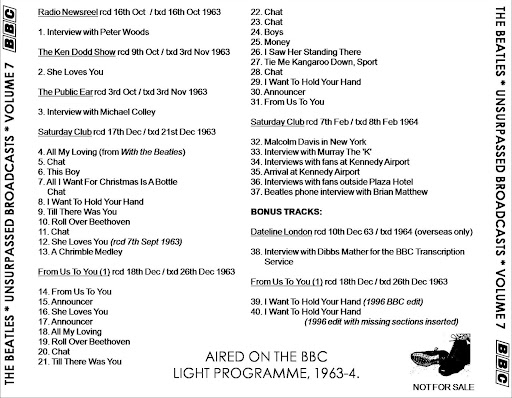
Radio Newsreel rcd 16th Oct 1963 / txd 16th Oct 1963
01. Interview with Peter Woods - Q
The Ken Dodd Show rcd 3rd Oct 1963 / txd 3rd Nov 1963
02. She Loves You C
The Public Ear rcd 9th Oct 1963 / txd 3rd Nov 1963
03. Interview with Michael Colley - Q
Saturday Club rcd 17th Dec 1963 / txd 21st Dec 1963
04. All My Loving A
05. Chat M
06. This Boy M
07. All I Want For Christmas A
Chat A
08. I Want To Hold Your Hand A
09. Till There Was You A
10. Roll Over Beethoven A
11. Chat A
12. She Loves You J
13. Crimble Medley A
From Us To You (1) rcd 18th Dec 1963 / txd 26th Dec 1963
14. From Us To You M
15. Announcer M
16. She Loves You A
17. Announcer A
18. All My Loving A
19. Roll Over Beethoven A
20. Chat A
21. Till There Was You A
22. Chat C
23. Chat A
24. Boys A
25. Money M
26. I Saw Her Standing There A
27. Tie Me Kangaroo Down, Sport M
28. Chat M
29. I Want To Hold Your Hand Z
30. Announcer M
31. From Us To You A
Saturday Club rcd 7th Feb 1964 / txd 8th Feb 1964
32. Malcolm Davis in New York - Z
33. Interview with Murray The 'K' - Z
34. Interviews with fans at Kennedy Airport - Z
35. Arrival at Kennedy Airport - Z
36. Interviews with fans outside Plaza Hotel - Z
37. Beatles phone interview with Brian Matthew - Z
BONUS TRACKS:
Dateline London rcd 10th Dec 63 / txd early 1964
38. Interview with Dibbs Mather for the BBC Transcription Service - P, K
From Us To You (1) rcd 18th Dec 1963 / txd 26th Dec 1963
39. I Want To Hold Your Hand (1996 BBC edit) M
40. I Want To Hold Your Hand (1996 edit with missing sections inserted) M, Z


Saturday Club rcd 7th Jan / txd 15th Feb 1964
01. Announcer A
All My Loving A
02. Money A
03. Chat A
04. The Hippy Hippy Shake A
05.Chat A
06. I Want To Hold Your Hand (rcd 17th Dec 1963) A
07. Roll Over Beethoven A
08. Announcer A
09. Johnny B. Goode A
10. Announcer A
11. I Wanna Be Your Man A
Saturday Club rcd 22nd Feb / txd 22nd Feb 1964
12. Phone interview with Brian Matthew
from London Airport - Z
The Public Ear rcd 18th March / txd 22nd March 1964
13. Letter from listener / Ringo - Q
14. George and Ringo request tk1 - Q
15. George and Ringo request tk2 - N
16. John reads from In His Own Write - Q
17. George and Ringo read the credits - Q
From Us To You (2) rcd 28th Feb / txd 30th March 1964
18. From Us To You A
19. Announcer A
20.. You Can't Do That A
21. Chat J
22. Roll Over Beethoven J
23. Chat J, A
24. Till There Was You J
25. Chat J
26. I Wanna Be Your Man J
27. Chat A
28. Please Mr. Postman F
29. All My Loving J
30. Chat A,
31. This Boy W
32. Chat A, O
33. Can't Buy Me Love J
34. Announcer A
35. From Us To You J, F
Saturday Club rcd 31st March / txd 4th April 1964
36. Announcer A
37. Everybody's Trying To Be My Baby A
38. Announcer A
39. I Call Your Name A
40. I Got A Woman E
41. Chat J, A
42. You Can't Do That J
43. Chat A
44. Can't Buy Me Love A
45. Chat J,A
46. Sure To Fall J
47. Long Tall Sally E


From Us To You (3) rcd 1st May / txd 18th May 1964
01. From Us To You A
02. Chat / Whit Monday To You A
03. I Saw Her Standing There A
04. Kansas City/Hey Hey Hey Hey A
05. Chat A
06. I Forgot To Remember To Forget A
07. Chat A
08. You Can't Do That A
09. Sure To Fall A
10. Chat A
11. Can't Buy Me Love A
12. Chat A
13. Matchbox A
14. Honey Don't A
15. From Us to You A
Top Gear rcd 14th July / txd 16th July 1964
16. Promo Q
17. Promo (outtake) Q
18. Long Tall Sally J
19. Announcer A
20. Things We Said Today J
21. Chat J
22. A Hard Day's Night J
23. Chat J, A
24. And I Love Her J
25. Announcer's intro to album track A
26. If I Fell A
27. You Can't Do That A
28. Announcer / Top Gear Theme A
From Us To You (4) rcd 17th July / txd 3rd August 1964
29. From Us To You A
30. Chat A
31. Long Tall Sally A
32. If I Fell A
33. I'm Happy Just To Dance With You A
34. Chat A
35. Things We Said Today A
36. I Should Have Know Better A
37. Chat A
38. Boys A
39. Kansas City/Hey Hey Hey Hey A
40. It's For You (performed by Cilla Black) A
41. Chat A
42. A Hard Day's Night A
43. From Us To You A
BONUS TRACKS:
From Us To You (4) recording session 17th July 1964
44. From Us To You (outtake) A
45. From Us To You (no voice-over) A
46. I'm Happy Just To Dance With You (backing track) A
47. I Should Have Known Better (false start) A
48. I Should Have Known Better (no harmonica / single-tracked vocal) A
Top Gear recording session 17th Nov 1964
49. I'll Follow The Sun (outtake) P
50. Studio chat / I Feel fine (false start) Q
51. I Feel Fine (single-tracked vocal) Q
52. Studio chat Q

Top Gear rcd 17th Nov / txd 26th Nov 196
01. Chat A
02. I'm A Loser B
03. Chat A
04. Honey Don't (edited by Transcription Services) J
05. She's A Woman B
06. Chat J
07. Everybody's Trying To Be My Baby B
08. I'll Follow The Sun B
09. Chat A
10. I Feel Fine B
Saturday Club rcd 25th Nov / txd 26th Dec 1964
11. Announcer A
12. Rock And Roll Music J
13. Chat A
14. I'm A Loser (rcd 17th Nov 1964) J
15. Everybody's Trying To Be My Baby (rcd 17th Nov 1964) J
16. Chat A
17. I Feel Fine (rcd 17th Nov 1964) J
18. Chat A
19. Kansas City/Hey Hey Hey Hey J
20. Announcer A
21. She's A Woman (rcd 17th Nov 1964) J
Pop Inn txd live 13th April 1965
22. Interview with Keith Fordyce - M
The Beatles Invite You To Take A Ticket To Ride rcd 26th May / txd 7th June 1965
23. Ticket To Ride (extract) J
24. Announcer A
25. Everybody's Trying To Be My Baby A
26. I'm A Loser A
27. Chat A
28. The Night Before A
29. Honey Don't A, Z
30. Chat A
31. Dizzy Miss Lizzy J
32. She's A Woman A
33. Announcer A
34. Ticket To Ride (with 'bye now' intro) A, J
BONUS TRACKS:
Top Of The Pops show 32 (*) rcd Spring 1965 / txd July 1965 (overseas only)
35. Chat O
36. Chat O
37. Ticket To Ride (with clean intro - rcd 26th May 1965) J
British Information Service rcd 30th July 1965 / txd 1965
38. Interview with Dibbs Mather for the BBC Transcription
Service (broadcast in the US only) N
Top Gear rcd 17th Nov / txd 26th Nov 1964
39. Honey Don't (unedited original version) A


The World Of Books rcd 16th June / txd 3rd July 1965
01. John discusses his writing and drawing with Wilfred De'Ath - Q, K
The Beatles Abroad rcd August 1965 / txd 30th Aug 1965
02. US tour interviews with Brian Matthew - Q
Pop Profile rcd 30th Nov 1965 / txd March 1966
03. John talks with Brian Matthew - Q
Pop Profile rcd 30th Nov 1965 / txd March 1966
04. George talks with Brian Matthew - Q
Saturday Club rcd 29th Nov 1965 / txd 25th Dec 1965
05. Chat with Brian Matthew (unedited session tape) A
Saturday Club rcd 2nd May 1966 / txd 4th June 1966
06. Chat with Brian Matthew - P
Pop Profile rcd 2nd May 1966 / txd 1966
07. Ringo talks with Brian Matthew - Q
Pop Profile rcd 2nd May 1966 / txd 1966
08. Paul talks with Brian Matthew - Q
The Lennon And McCartney Songbook rcd 6th Aug / txd 29th Aug 1966
09. John and Paul talk with Keith Fordyce - P, Q
Top Of The Pops rcd 20th March 1967 / txd 1967 (overseas only)
10. Penny Lane (extract)
John and Paul talk with Brian Matthew - Q
Scene And Heard 13th Sept / txd 30th Sept 1967
11. Interview with George - Q
Where It's At rcd Nov 1967 / txd 25th Nov 1967
12. John talks with Kenny Everett and Chris Denning (extracts) - Q
13. All Together On The Wireless Machine (Paul, Kenny Everett & Chris Denning) M, P


The Lennon And McCartney Songbook rcd 6th Aug / txd 29th Aug 1966
01. John And Paul Talk To Keith Fordyce
The Ivor Novello Awards For 1966 rcd 20th March / txd 27th March 1967
02. Pesentation And Interview with Brian Matthew
Top Of The Pops Show 127 rcd 20th March / txd May 1967 (OS only)
03. John And Paul talk with Brian Matthew
Where It's At rcd May / txd 20th May 1967
04. Paul Promo
05. John Introduces Sgt. Pepper
06. Ringo talks with Kenny Everett
07. John Introduces Lucy In The Sky With Diamonds
08. John talks to Kenny Everett
09. Paul talks to Kenny Everett
10. Paul talks to Kenny Everett
11. Paul Promo
Where It's At rcd June / txd 1st July 1967
12. Paul talks with Kenny Everett
Scene And Heard rcd 13th Sept / txd 30th Sept 1967
13. George Talks with Kenny Everett
Scene And Heard rcd 13th Sept / txd 7th Oct 1967
14. George Talks with Kenny Everett
Scene And Heard rcd 14th Sept / txd 14th Oct 1967
15. Ringo talks with Miranda Ward
Where It's At rcd Nov / txd 25th Nov 1967
16. John talks with Kenny Everett and Chris Denning
Kenny Everett rcd 6th June 1968 / txd 9th June 1968
17. John talks with Kenny Everett
18. Unedited Chat with John, Paul and Ringo
BONUS TRACK
19. All Together On The Wireless Machine (Paul Jingle)


01. From Us To You Theme (Edited)
02. All My Loving
03. Chat
04. Till There Was You
05. Chat
06. Roll Over Beethoven
07. Chat
08. I Wanna Be Your Man
09. Chat
10. Can't Buy Me Love
11. From Us To You Theme (Edited)
12. Opening Theme
13. Link
14. Link
15. Long Tall Sally
16. Chat
17. A Hard Days Night
18. Link
19. Things We Said Today
20. Closing Theme And Sign-off
21. Opening Theme And Link
22. A Long Nose
23. Link
24. I'm A Loser
25. Chat
26. She's A Woman
27. Link
28. I Feel Fine
29. Closing Theme And Sign-off
30. Chat
31. I'll Follow The Sun
32. Chat
33. Everybody's Trying To Be My Baby
34. I Feel Fine
35. Opening Theme
36. Link
37. Chat
38. Kansas City
39. Link
40. Honey Don't
41. Link
42. Rock And Roll Music
43. Closing Theme And Sign-off
44. Opening Theme
45. Link
46. Link
47. Dizzy Miss Lizzy
48. Chat
49. Everybody's Trying To Be My Baby
50. Link
51. Ticket To Ride
52. Closing Theme And Sign-off
53. Chat (1967)
54. Alternate Intro To Show 00
55. Alternate Links For Things We Said Today
Sources:
The From Us To You special is reconstructed from the 1982 Beatles At The Beeb retrospective and the Westwood one cds of 'The BBC Beatles Tapes'. Most of the Top Of The Pops shows are from lossless copies of the original transcription discs, except for Show 8 where I had to take excerpts from 'The
Beeb's Lost Beatles Tapes'. That show also provided the 1967 appearance, and the 1982 special provided the final track.
Complete BBC sessions on 13 CD
The following sources were used:
A = At The Beeb Vols 1-12 (Yellow Dog 2002)
B = Live At The BBC (Masterfraction 2002)
C = The Complete BBC Sessions (Purple Chick 2004)
X = BBC Trailer Collection (Yellow Dog 1999)
J = The BBC Beatles Tapes: The Original Masters (1990)
Vinyl:
D = Four By The Beatles (1979 EP)
E = The Beatles Broadcasts (Circuit Records 1980)
F = Rough Notes (Unknown - 1978)
G = The Beatles At The Beeb With Pete Best (Drexel 1988)
H = Rare Unreleased Beatles Tracks (Picture disc 1985)
W = Johnny & The Moondogs: Silver Days (Warwick 1981)
Z = The Beatles At The Beeb Vols 1-14 (Beeb Transcription Records 1986-89)
O = The Beatles At The Beeb (1983 special)
Tape:
Q= The Beeeb's Lost Beatles Tapes (1988 special)
K = In My Life: John Lennon Remembered (1990 special)
L = The Beatles At The BBC (1996 special)
M = The Beatles At The Beeb (2009 special)
N = The Beatles Story (1972 special)
P = private tape
1 comment:
-
LiborioFriki said...

- http://www.filefactory.com/file/32k8klrqliy1/n/08.part09.rar
http://www.filefactory.com/file/2qzoy3efqck5/n/08.part08.rar
http://www.filefactory.com/file/597x6ymcaqen/n/08.part10.rar
http://www.filefactory.com/file/3yq4rkdxpynt/n/08.part07.rar
http://www.filefactory.com/file/3927yh7uut6r/n/08.part06.rar
http://www.filefactory.com/file/3k4ph9lykvn9/n/08.part05.rar
http://www.filefactory.com/file/22fmohgruj5h/n/08.part04.rar
http://www.filefactory.com/file/2290twa8zh7p/n/08.part03.rar
http://www.filefactory.com/file/77p94ru3k15d/n/08.part02.rar
http://www.filefactory.com/file/gci4nf7ozdt/n/08.part01.rar


4OBQR8EuOUCw~~60_35.JPG)


