November 29, 2024

Listen to all 12 Beatles Christmas Messages in Auto Play + Christmas Songs from John & Paul


For this year, if you would like to listen to a full hour of Beatles Christmas Messages, you can stream them all in great fidelity at the below link. These are the Christmas messages included here:

Beatles - Wish you a Happy Xmas 1963/1969:
1-Crimble medley (BBC Saturday Club 12-21-1969).
2-Christmas time is here again(edit version 1995).
3-From us to you 1963.
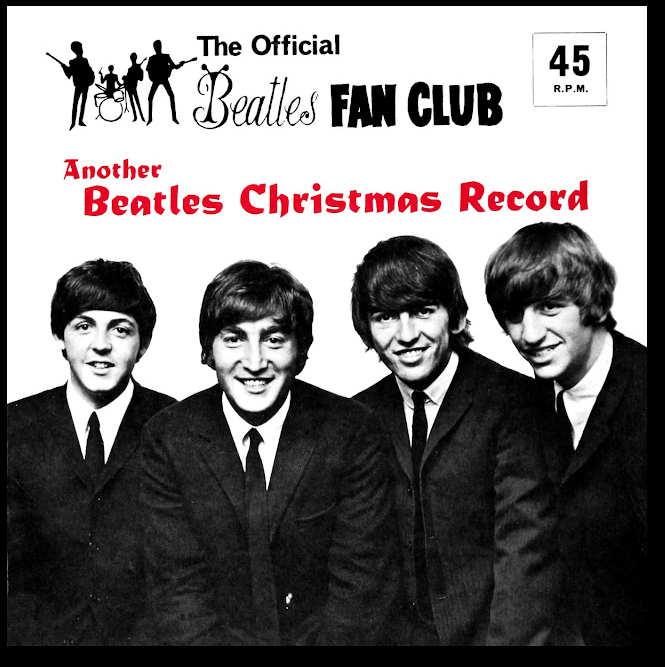
4-Another Beatles Christmas 1964.
5-Third Christmas record 1965.
6-Everywhere it's Christmas 1966.
7-Christmas time is here again 1967.
8-1968 Christmas record.
9-Seventh Christmas record 1969.
10-Hello Dolly(1964 outtake).
11-Speech(1964 outtake).
12-Christmas time is here again (full version).


Two more Christmas songs from John and Paul:


From John, Happy Christmas War Is Over, and
From Paul, Wonderful Christmas Time... Enjoy


The Beatles Christmas Messages are available on the below collections along with outtakes:


November 28, 2024

Christmas Messages Covers- Updated HQ Scans

Each year the Beatles would send a studio message thanking all their fan club members for a wonderful year. Below are the covers for each year from 1963 thru 1969 and a link where you can get them. Enjoy http://returntopepperland.blogspot.com/2006/11/beatles-christmas-records.html


1963 -


1964 -


1965

-


1966 -


1967 -


1968 -


1969 -


The Beatles Bootleg BBC Recordings 1963 on iTunes


April 17, 2024

Restored Let It Be film coming to Disney+ 05-08-24

The Beatles’ 1970 film Let It Be is coming to Disney+ on 8 May 2024.

The film, directed by Michael Lindsay-Hogg in January 1969, has been commercially unavailable since the 1980s. A documentary about the making of the film and Let It Be album, The Beatles: Get Back, was directed by Peter Jackson and released in November 2021.

In January 2019, at the time of the documentary’s announcement, a line in the press release stated: “Following the release of this new film, a restored version of the original Let It Be movie directed by Michael Lindsay-Hogg will also be made available.” However, in the intervening five years there was no further news.

Jackson’s Park Road Post Production company restored the film from the 16mm negatives, including sound restoration using his machine-assisted learning (MAL) technology which was used in both The Beatles: Get Back and the ‘Now And Then’ single.

Although there is no word on a physical edition, the press release mentions that the film will “launch exclusively” on Disney+, suggesting a wider release to follow.

Here’s the full press release:

BURBANK, Calif. (April 16) – Today, Disney+ announced that Let It Be, director Michael Lindsay-Hogg’s original 1970 film about The Beatles, will launch exclusively on Disney+ May 8, 2024. This is the first time the film is available in over 50 years.

    First released in May 1970 amidst the swirl of The Beatles’ breakup, Let It Be now takes its rightful place in the band’s history. Once viewed through a darker lens, the film is now brought to light through its restoration and in the context of revelations brought forth in Peter Jackson’s multiple Emmy Award®-winning docuseries, The Beatles: Get Back. Released on Disney+ in 2021, the docuseries showcases the iconic foursome’s warmth and camaraderie, capturing a pivotal moment in music history.

    Let It Be contains footage not featured in the Get Back docuseries, bringing viewers into the studio and onto Apple Corps’ London rooftop in January 1969 as The Beatles, joined by Billy Preston, write and record their GRAMMY Award®-winning album Let It Be, with its Academy Award®-winning title song, and perform live for the final time as a group. With the release of The Beatles: Get Back, fan clamour for the original Let It Be film reached a fever pitch. With Lindsay-Hogg’s full support, Apple Corps asked Peter Jackson’s Park Road Post Production to dive into a meticulous restoration of the film from the original 16mm negative, which included lovingly remastering the sound using the same MAL de-mix technology that was applied to the Get Back docuseries.

    Michael Lindsay-Hogg says, “Let It Be was ready to go in October/November 1969, but it didn’t come out until April 1970. One month before its release, The Beatles officially broke up. And so the people went to see Let It Be with sadness in their hearts, thinking, ‘I’ll never see The Beatles together again. I will never have that joy again,’ and it very much darkened the perception of the film. But, in fact, how often do you get to see artists of this stature working together to make what they hear in their heads into songs. And then you get to the roof and you see their excitement, camaraderie and sheer joy in playing together again as a group and know, as we do now, that it was the final time, and we view it with full understanding of who they were and still are and a little poignancy. I was knocked out by what Peter was able to do with Get Back, using all the footage I’d shot 50 years previously.”

    “I’m absolutely thrilled that Michael’s movie, Let It Be, has been restored and is finally being re-released after being unavailable for decades,” says Peter Jackson. “I was so lucky to have access to Michael’s outtakes for Get Back, and I’ve always thought that Let It Be is needed to complete the Get Back story. Over three parts, we showed Michael and The Beatles filming a groundbreaking new documentary, and Let It Be is that documentary – the movie they released in 1970. I now think of it all as one epic story, finally completed after five decades. The two projects support and enhance each other: Let It Be is the climax of Get Back, while Get Back provides a vital missing context for Let It Be. Michael Lindsay-Hogg was unfailingly helpful and gracious while I made Get Back, and it’s only right that his original movie has the last word… looking and sounding far better than it did in 1970.”

    Let It Be, directed by Michael Lindsay-Hogg, stars John Lennon, Paul McCartney, George Harrison, and Ringo Starr, with a special appearance by Billy Preston. The film was produced by Neil Aspinall with The Beatles acting as executive producers. The director of photography was Anthony B Richmond.

    Let It Be will debut exclusively on Disney+ May 8, 2024.


Source: https://www.beatlesbible.com/2024/04/16/restored-let-it-be-film-coming-to-disney-plus/


Let It Be Movie Restored and Streaming on Disney+ 05-08-24

Word started to spread a few days ago, that the Let It Be documentary film from 1970, directed by Michael Lindsay-Hogg, was about to finally become available again. Yesterday, I was told that the film will debut on Disney+ in May, and will be released on physical media later this year.

I wrote about it over on my Norwegian Wood blog, and made a mock-up of a blu-ray cover, just as an illustration. Over on Facebook, I published the same picture on the Daily Beatle Facebook page, with no words, as I figured news would be out in an official capacity soon.

I was rewarded just a few hours later, when the official social media accounts of the Beatles displayed the photo teaser seen above, with the sentence “There will be an answer.” Which, of course, is from the lyrics of the song “Let It Be”. And which song did Paul McCartney perform in public just a few days ago at the Jimmy Buffett tribute at the Hollywood Bowl?

People have been asking why do we need the “Let It Be” movie, we have already been given more than seven hours of that era in Peter Jackson’s “Get Back” documentary, which has been available on Disney+ since November 2021.

There are many reasons for “Let It Be” to be available. Remember those few glimpses we get in Jackson’s TV documentary of the 31 January recordings? The day after the rooftop concert? The three songs they recorded then, “Let It Be”, “The Long and Winding Road and “Two Of Us” are represented with complete footage and audio in Michael Lindsay-Hogg’s “Let It Be”. And there are plenty more interruptions of songs in the rooftop segment in Jackson’s documentary. There are lots more interviews with people on the street and much more footage of the police, waiting and eventually going up on the rooftop to stop the show. There are fewer interviews and less police scenes in Lindsay-Hogg’s film, allowing us to enjoy fuller versions of the songs.

For complete satisfaction and an uninterrupted concert though, one has to settle for the album “Get Back (Rooftop Performance)” which is available from several streaming platforms.


It is important that Lindsay-Hogg’s film is available, as it’s one of The Beatles’ films made when they were together, alongside “A Hard Day’s Night”, “Help!”, “Magical Mystery Tour” and “Yellow Submarine”. And it’s important that it is available on a disc, because: Where are those other iconic Beatles films available on streaming platforms? I believe perhaps you might be able to find “A Hard Day’s Night”, but forget about finding the others. Streaming movies are for the mass consumption market for the general public, not for those interested in niches or cult films.

Anyway, you need not worry. Even if the rumours about a physical release should prove to be untrue, bootleggers will make available the film as soon as they have recorded it from Disney+.

Of course now speculations are all about the format, and whether or not Jackson has applied the same method of enhancing the picture quality as he did with “Get Back”, where faces are somewhat plastic looking in places. Will this new release be “Let It Be” as rebuilt by Peter Jackson, sticking to the same scenes as Lindsay-Hogg? In a January 2022 interview, Lindsay-Hogg claims that for the last two or three years, he has been working with the director of photography Tony Richmond on the print, so it looks totally different, and Giles Martin has been working on the soundtrack.

One problem with the original “Let It Be” film is that sometimes the wrong sound was overdubbed, like a different take of the song or you can see an out of place instrument being picked. For the sake of being true to the original, will these flaws be kept in? We’ll find out soon enough.

TIMELINE: LET IT BE (movie)
1969: 16mm footage of the Beatles filmed in January for proposed TV Special and album, “Get Back”. Directed by Michael Lindsay-Hogg.

1969: The Beatles all attend a screening of a rough cut of the movie on July 20. Director Michael Lindsay-Hogg recalled that it was about an hour longer than the released version.

1969: Film and album shelved for now, new album “Abbey Road” recorded and released.

1969-70: Footage reworked for movie screening, to fulfill 3 film contract with United Artists.

1970: Theatrical release. Film has been blown up to 35mm, sound is in mono, retitled “Let It Be”.

1975: BBC 1 shows the film on Boxing Day. 16mm version, mono.

1979: Four years later, BBC 1 again shows the film on Boxing Day. 16mm version, mono.

1980: John Lennon is killed.

1981: Home Video release (USA) of 35mm film pan-and-scan: VHS, Betamax, Laserdisc and Videodisc on 20th Century Fox/Magnetic Video Corporation. Mono.

1982: TV screening (UK) of 16mm cropped version on BBC TV. Mono.

1983: TV screening (West Germany – Bayerische Rundfunk). 16mm version, mono. The film was also shown on TV in several other countries, Finland and Australia among them, but we have no full overview of this. And of course, the film was also shown on TV in the seventies.

1992: Original 16mm film restored by Ron Furmanek for Apple, with remastered sound mixed by Furmanek, assisted by George Martin, in stereo when multitracks exist.

1995: Restored footage from film and outtakes shown on “The Beatles Anthology” TV series.

1997: VCI (UK) announces plans to release “Let It Be” on VHS. It doesn’t happen.

2001: George Harrison succumbs to cancer.

2002: Paul McCartney says plans for DVD release alongside “Let It Be…Naked”.

2003: Original 16mm film plus outtakes restored by Bob Smeaton.

2003: “Let It Be…Naked” album released. Outtakes from “Let It Be” film used in promotion of album. No sign of the film on DVD.

2003: Movie director Lindsay-Hogg says 2 DVDs with the film and outtakes ready for 2004.

2004: A review of a 3 disc version appears online.

2005: “The Toronto Sun” features interview with Bob Smeaton who says a DVD will come out that year.

2006: In a US radio show, Bob Smeaton gives three possible release dates in 2006 for the DVD.

2007: Apple Corps Ltd register the domain name letitbemovie.com.

2007: Neil Aspinall says the film is still too controversial for release.

2008: Yoko Ono says the DVD will not be released yet.

2008: “The Daily Express” (UK) says DVD was cancelled by Paul and Ringo.

2009: Unidentified “insider” claims Yoko Ono is the one blocking the release.

2009: Theatrical screening at a film club in Philadelphia, PA. Good print, poor mono sound.

2010: BBC radio show says DVD is still considered for release at a future date.

2011: Original film and outtakes re-transferred again in higher resolution for future release.

2012: Film due out for 50th anniversary of “Love Me Do”, but plans are again scrapped.

2012: Richard Porter learns from insider that the film may be released in 2014 or 2015.

2012: Ringo says: “One day that will come out, but we’re not thinking about it right now”.

2013: The “Let It Be…Naked” album released on iTunes and two videos made available for download: “Get Back” and “Don’t Let Me Down” – both compiled in 2003 of outtakes from the original “Let It Be” movie.

2013: “Help!”, “Magical Mystery Tour” and “Yellow Submarine” restored and released on Blu-ray.

2014: “A Hard Day’s Night” released on Blu-ray.

2015: Ringo confirms that “Let It Be” will eventually be released, just not this year.

2015: The last 34 minutes of Furmanek’s unpublished 1992 restoration uploaded on YouTube

2015: Apple releases a collection of The Beatles’ promotional films on Blu-ray and DVD. The material from “Let It Be” looks unrestored. This triggers speculation that Apple saves the restored version for a later stand-alone release.

2016: Bootleg company HMC releases the 1992 restoration of the film on a DVD+CD package in NTSC and an aspect ratio of 4:3, with the lower part of the picture cropped.

2016: Paul tells Rolling Stone that he keeps promoting a release of the film internally.

2017: In an interview with the film’s Cinematographer Tony Richmond in February, it was revealed that “Since then, we remastered it for DVD and there were so many outtakes that weren’t used in the film that really show the acrimony between all of the Beatles. But that’s still being held up by George Harrison’s estate and his wife and Yoko Ono because they don’t want the acrimony shown.”

2018: A new movie is being planned: In an interview with a radio station in Quebec, Canada in September, Paul McCartney was asked about the fate of the Beatles’ “Let It Be” film. “We keep talking about that,” Paul confirmed, “we have meetings at Apple”. Paul thinks there is “some talk” about making a new movie, re-editing it from the same footage. “Who knows, that may be happening in a year or two,” Paul concludes, obviously knowing a lot more about the subject.

2019: In January, in celebration of the fiftieth anniversary of the rooftop concert, The Beatles announced that a new film will be made, culled from the 55 hours of Get Back film footage available. The new film will be directed by Sir Peter Jackson. A release date is not announced, but the announcement says that a restored original “Let It Be” film will also be made available in conjunction with the new film. However, while there were plans to show the new documentary in cinemas starting in 2020, no plans were made to screen the original “Let It Be” film that year.

2020: On December 20,  Peter Jackson introduced a “sneak peek” – teaser for the upcoming film. The footage looks better than ever before. During the pandemic, the film has morphed into a TV series, Jackson keeps adding more and more footage in order to tell the whole story of the “Let It Be” album in his series.

2021: On June 17, 2021, it was announced that the Peter Jackson film is not going to theatres after all, it will be expanded to three two hour episodes and will debut on the Disney+ channel on November 25, 26 and 27. No word about the fate of the original “Let It Be” film.

2022: The Get Back series debuts on DVD and blu-ray in the States, only blu-ray elsewhere. A faulty first run is recalled and it takes time to ship the replacement discs. Meanwhile, several bootleggers have released their own product featuring the series, with more languages available as subtitles than the official product, and bonus material, sometimes including the full “Let It Be” film.

2022: In an interview with Cigar Aficionado, Michael Lindsay-Hogg says that “Let It Be” will come out, but he is unsure of how. “For the last two or three years, the director of photography Tony Richmond and I have been working on the print, so it looks totally different and Giles Martin has been working on the soundtrack”.

2023: In August, the U.S. Beatles fanzine Beatlefan reported of an upcoming relaunch of “Let It Be” that it was exactly as it originally was in 1970 with an upgraded soundtrack made possible by Jackson’s crew, remixed by Giles Martin and Paul Hicks. At the same time, Michael Lindsay-Hogg said in an interview that he was hoping for the relaunch to happen in 2023 or early 2024.

2024: Let It Be finally becomes available on the Disney+ streaming platform in May.

See also this timeline explained in detail here.

Source: 
https://webgrafikk.com/blog/news/let-it-be-at-last/


January 01, 2024

Beatles - The Ultimate 'Sessions' Collection

Sessions was a cancelled compilation album of previously unreleased tracks by the Beatles, planned for release by EMI in 1985 but never issued officially, due to objections by the surviving Beatles. The album consists of 13 finished but unreleased Beatles songs. A planned single containing two of the tracks from Sessions – "Leave My Kitten Alone", backed with an alternative version of "Ob-La-Di, Ob-La-Da" – was also left unissued. The idea was resurrected in 1995 as the greatly expanded three-volume double CDs called The Beatles Anthology with an accompanying six-hour documentary.

However, other bootleg labels came up with their own sets of unreleased tracks.

The Beatles Ultimate Sessions Collection is a 2 CD set. It has a nice selection of rare tracks in very good sound quality. It has appeared under several labels. I have been enjoying revisiting this collection. A detailed track listing appears below.


DISC ONE - US black and white version, includes original "Sessions" mixes taken from DESS "Sessions" (Version 2)

01 Come And Get It
02 Leave My Kitten Alone
03 Not Guilty
04 I'm Looking Through You
05 What's The New Mary Jane
06 How Do You Do It
07 Besame Mucho
08 One After 909
09 If You've Got Trouble
10 That Means A Lot
11 While My Guitar Gently Weeps
12 Mailman, Bring Me No More Blues
13 Christmas Time (Is Here Again)
14 Revolution 1 (take 18) - Sessions (Fake Apple) ST 12373/4 (2LP set)
15 And Your Bird Can Sing (take 2) - Purple Chick Revolver Deluxe Edition
16 She's A Woman (take 7) - Purple Chick Beatles For Sale Deluxe Edition
17 Yes It Is (rechannelled stereo) - Past Masters Vol. 1 (left channel-stereo mixed to mono/right channel-OOPsed version)
18 For You Blue ("Get Back" album version) - Purple Chick Let It Be Deluxe Edition
19 Free As A Bird (outfake) - Upgraded Collection-Highlights
20 Come And Get It (take 5) - Sessions (Fake Apple) ST 12373/4 (2LP set)
21 I'm A Loser (take 2) - Purple Chick Beatles For Sale Deluxe Edition
22 Don't Bother Me (take 10) - Purple Chick With The Beatles Deluxe Edition
23 Dizzy Miss Lizzy ("backing track" outfake) - Help (OOPSed)
24 Revolution (take 15)
25 Hello Goodbye (take 1) - Miscelleneous Tracks (Yellow Dog 2005)

DISC TWO - UK colour version - fake EMI PROMO CD configuration, All tracks taken from Another Sessions...PLUS

01 Hello Little Girl - Hope We Passed The Audition (Purple Chick)
02 Love Of The Loved - Hope We Passed The Audition (Purple Chick)
03 How Do You Do It (Ultra Rare Trax mix) - Please Please Me Deluxe Edition (Purple Chick)
04 Do You Want To Know A Secret (take 7) - Please Please Me Deluxe Edition (Purple Chick)
05 One After 909 (true stereo outfake) - DESS "Sessions" (Version 2)
06 That Means A Lot (stereo version) - Help! Deluxe Edition (Purple Chick)
07 Shout (complete - mostly stereo) - Anthology 1 + Around And Around (Silent Sea)
08 Leave My Kitten Alone (stereo version) - Beatles For Sale Deluxe Edition (Purple Chick)
09 I'm Looking Through You (alt. stereo mix) - Rubber Soul Deluxe Edition (Purple Chick)
10 Paperback Writer (alt. stereo mix) - Anthology VHS
11 Strawberry Fields Forever (takes 4,25,26) - Sgt. Pepper Deluxe Edition (Purple Chick)
12 The Fool On The Hill (demo) - Anthology 2
13 I Am The Walrus (reference mix) - DESS Casualties
14 While My Guitar Gently Weeps (unedited take 1)
15 What's The New Mary Jane (complete alt. mix) - Another Sessions...PLUS + Miscelleneous Tracks (Yellow Dog 2005)
16 Not Guilty (unedited take)
17 I Me Mine (acetate) - Acetates (2002)
18 Goodbye (acetate) - Acetates (2002)

HIDDEN TRACKS:
19 Like Dreamers Do - Hope We Passed The Audition (Purple Chick)
20 Besame Mucho (Ultra Rare Trax mix) - Hope We Passed The Audition (Purple Chick)
21 If You've Got Trouble (alt. stereo mix)
22 Christmas Time Is Here Again (alt. stereo mix)
23 Mailman, Bring Me No More Blues (stereo reconstruction using "Sessions" configuration)
24 Come And Get It (stereo demo)

BONUS TRACKS (from original US versions):
25 Medley: Obladi Oblada/Christmas Time (Is Here Again) - Ultra Rare Trax Vol. 5
26 Real Love (video mix) - Anthology DVD

Below are similar albums under different labels.


More info available here:

https://www.guitars101.com/threads/the-beatles-the-ultimate-sessions-collection-sbd.757666/

https://superdiscografiathebeatles.blogspot.com/2021/09/2021-ultimate-sessions-collection.html

https://music-that-we-adore.blogspot.com/2023/07/the-beatles-bootleg-albums-320kbps.html

https://we.tl/t-jXwqIAaSYg


December 02, 2023

George & Giles Martin: Remixing The Beatles- The Making of the Love Album

When the Beatles' record company tempted their producer out of retirement for one last project, no-one had any idea how radical the resulting album would be.


Part high-concept mash-up, part elaborate restoration job, the Beatles' Love was originally conceived as the soundtrack to Cirque du Soleil's Las Vegas show, but became much more. Upon its release as an album, listeners were invited to play spot-the-elements, as well as to hear new mixes of classic recordings. The project also marked the first collaboration between George Martin and his son Giles. The legendary producer, who turned 81 in January, had in fact gone into retirement, but the thought of returning to the Beatles' masters proved too tantalising a prospect.

"It's a funny word, 'retirement'," he says. "Because it suggests you're giving up everything, and I certainly haven't done that. But I've given up recording, because my ears aren't good enough. This, however, was an offer I couldn't refuse, when they asked me to produce the music for the show. It was such a challenge. But I couldn't have done it without Giles. He's my ears."

"He refuses to get old, which is great," laughs Giles. "I would rush forward and do stuff, then find myself lost without him. Even though his hearing is bad, he has a great ability in his brain to work things out."

"One day," George recalls with a smile, "I was apologising to Giles because I couldn't hear the top. He said 'Dad, how many 80 year-old people do you know who're experts in sound?'"

Through The Ages

Martin joined EMI as a producer in 1950, initially working mostly on classical recordings. "But of course you'd have to chop up the music into little bits and pieces," he explains. "Four minutes, 15 seconds was about the length of a disc. So if you've got a 15-minute overture, you have to chop it up into four parts. You, the producer, had to tell the conductor where he should end. You had to say 'I think the good place is bar 191, but resolve the chord so it doesn't sound too bad, and when we start again we'll start with that chord, OK?' And that's the way you did it."

Branching out into comedy recordings with the likes of Peter Sellers and Spike Milligan and enjoying crooner hits with Matt Monro, Martin was on the lookout for a rock & roll band when Brian Epstein brought the Beatles in to audition. Three years later, in 1965, when his contract with EMI expired, he made the shrewd move into independent production.

"I was forced into it," he recalls. "Before I met the Beatles, I had been lobbying my bosses, saying 'I want some kind of recognition of the sales I'm achieving. Your salesman are getting a commission on their sales. I'm making the damn things and I'm getting nothing.' I was on a salary of £3200 a year, no car and nothing else. When the Beatles came along I was making a fortune for EMI."

Sitting in the small studio ('At the end of the corridor next to the loos,' Giles points out) in Abbey Road where the majority of the work on Love was done, I wonder if it's strange for George Martin, returning to a building where's worked on and off for close to 60 years. "Well, the building itself hasn't changed at all," he states. "Number Two studio is very, very similar to the time with the Beatles. The control room is different: when I first came here, the control room of Number Two was on the ground floor because we didn't have tape machines then. We had lathes in the control rooms cutting discs. We had to wear a suit and a tie and the engineers wore white coats. Nobody sat down. We did have tape machines but they were considered to be rather inferior, which they were. Because the tape in those days was pretty raw stuff and the signal-to-noise ratio wasn't very good so you got a hell of a hiss, which you never got on the disc. The disc was a very clean sound. And of course everything was mono: 78rpm shellacs, which were breakable."

Give The Drummer His Due

Something that both producers agree on is that Ringo Starr is the star of Love. "Listening to this recording, he drives that band right through the show," says George. "Fantastic stuff. And it isn't just the technique of playing the drums, but it's also thinking up what he's going to play. If you listen to 'Come Together', for example, his work on that is very, very thoughtful and very clever. And the stuff he did on 'Day In The Life' with the toms... magic."

"It's great that his drumming has come out so well," Giles agrees. "He's not even louder, it's just I guess his drums are slightly bigger than they were. I've had the ability to take Ringo off the Beatles' records and put them back on, and the great thing is that he plays stuff you wouldn't imagine a drummer playing. As a producer or a musician, you can go 'Right, what would I have the drummer doing now?' And it's never what Ringo plays."

Chopping & Changing

It's incredible to think that George Martin has been working with sound for so long that he's not only seen shellac made obsolete by tape, but has watched tape lose out to DAWs. "Isn't it incredible?" he says, gesturing towards the Apple Mac studio display.

"He finds it amazing what can be done," says Giles. "At first he said 'Why don't we use tape?' I said 'Well Dad, you know I'm enthusiastic about that world, but we couldn't do this on tape.' The way that we worked was I would do the chopping and changing and play it to him and he sort of produced me doing it. One day he watched me grab something and turn it around and he said 'My God, sound is like putty nowadays, you can just mould it into any shape you want.'"

"The brief on this show," George says, "was that I should use all previous recordings in any form I wanted. It gave us carte blanche to muck about."

Preliminary work on Love began in November 2003, when Apple Records' Neil Aspinall gave Giles a brief to create a mash-up demo of 'a gig that never happened,' using elements of the Beatles' catalogue. The resulting 13-minute piece comprised the opening section of Love, from the 'A Hard Day's Night' guitar chord through to 'Get Back', a 5.1 mix of 'I Am The Walrus' and his clever pasting of 'Within You Without You' over 'Tomorrow Never Knows'.

Speaking of the latter, George says "It was Giles's idea and he did it without my being here. I thought, fantastic. So did Ringo, he thought it was amazing."

"To begin with," Giles continues, "it was just going to be the Beatles remixed, and the idea of chopping and changing didn't really come to fruition until we tried stuff out. Apple are the four Beatles' families, so we played them to Paul, to Ringo, to Yoko, to Olivia Harrison, and they gave the green light for the whole thing to go ahead. There wasn't actually that much politics, it was just 'Does it sound good or not?'"

Wasn't Giles slightly intimidated by the thought of setting to work on the Beatles' masters? "Yeah. But I didn't believe it was going to happen, to be honest. When I first came to Abbey Road, in people's eyes they were looking at me thinking 'You're only going to get so far into doing this.' Because it's kind of like the Holy Grail. I thought it was never going to see the light of day, so that kind of helped me. I just launched into it without worrying too much, presuming that things were going to go wrong. The funny thing about Beatles stuff is that if the Beatles aren't happy, then no-one hears it. There's no A&R teams or record companies, there's only them and my Dad involved, so it kind of makes it easier in a way. The pressure is really whether you are gonna get fired or get the job!"

The Tools For The Job

Once he'd secured the job, Abbey Road engineers set to work building a studio to Giles's specifications ("Which is always nice," he laughs). He chose to work in Pro Tools ("They've only just updated me — I was on 6.4 for ages") run on a Mac, using Adam S3A monitors ("They're the best cross between nearfield and big studio speakers").

The Love project began life as the soundtrack for Cirque du Soleil's Las Vegas show.


His first task when work got under way properly in 2004 was to load almost all of the old Beatles' one-inch four-track and eight-track masters into Pro Tools. "I realised that none of the Beatles' tapes had been backed up properly at Abbey Road, so I thought that might be a good idea! It also gave me a chance — and my Dad, to be honest — to listen to all the stuff again. So we went through everything, and we did it by album. It's catalogued as albums, singles, 'B' sides, miscellaneous. We listened to absolutely everything and backed it up. Everything that's been released we loaded up. We wanted to use the best takes possible, trusting that my Dad had chosen the best takes before, and also to use as many elements of the songs as possible. The way the Beatles worked is they'd lay something down and if they weren't happy with the take, then they'd lay nothing more on top.

"We were trying to keep a clean signal path, so we just went straight from a tape machine into Pro Tools. The whole idea was to copy the tapes as exactly as possible. I had a Pro Control desk as a way of having faders for my Dad. We kept on running out of RAM after a while. The funny thing is, even if I'm compiling songs, I'm not really going above 16 or 20 tracks. So I didn't really need as much as perhaps someone making a modern record."

Critics of the choice of material on Love have pointed out its bias towards mid-to-late-period Beatles. There is, however, as Giles insists, a fairly obvious technical reason for this. "The earlier stuff is sonically similar. It lacks the imagery the later stuff has. Bearing in mind we're doing a show, 'Lucy In The Sky With Diamonds' lends itself more to a visual thing perhaps than 'I Should Have Known Better'. On top of that, a lot of the earlier Beatles stuff has no separation on it at all. We were pushed by the Beatles to change things: they wanted experimentation, and you can't really do that with the earlier stuff. A lot of people say to me 'Why didn't you use the drums from this?' But there's only a certain number of clean drum tracks in the entire Beatles catalogue. There's not much stuff from Let It Be, because it's all live with no separation."

In returning to the earlier masters, Abbey Road's Allan Rouse came up with a suggestion that would help shape the sound of songs like 'Eleanor Rigby': going back to the original, unbounced masters as well as using the mixed-down four-tracks. "We would sync up the fours to fours," Giles says. "So 'Eleanor Rigby' was recorded originally on a four-track one-inch as a double string quartet, and then we'd sync the bounce of the strings that was done, so we could then have a six-track of a four-track."

Keep To The Rules

The Martins set themselves two fairly severe rules for the creation of Love: never to loop the drums or pitch-change the voices. And they managed to stick to them. Almost. "We mucked about with rhythms," says George, "but we never sampled anything, we thought that was wrong. We wanted to keep the performances, particularly in the rhythm sections, so that if you hear Ringo playing, it's Ringo playing. It's not a sample of one bar and then repeating it. The only thing that was anywhere near [a time-stretch] was 'Octopus's Garden', because we had to chop it up into pieces so it fitted a slow orchestral section at the beginning, which it wasn't designed for. But it worked very well."

"Of course," Giles goes on, "On 'Within You Without You/Tomorrow Never Knows' the voice has been stretched. The screams in 'I Want You (She's So Heavy)/Helter Skelter' I put down a tone. The end of 'Strawberry Fields' has been looped, but after a very long period of time, and there's a slight loop in 'Drive My Car', but generally it's them playing. When I started doing it, I was using modern techniques, as it were. I put a tempo map out which was 122.5bpm and put in the drums from the intro of 'Get Back', and then put 'Get Back' in time with it and it just sounded like I'd removed all the soul from the Beatles."

"Another complication," George adds, "was that a lot of the recordings I did with the Beatles we used to record at different speeds. Not necessarily at half-tone intervals, but just a wee bit off. You know, maybe instead of being 60 cycles, we'd be 59 cycles, or 61. We didn't care too much about tuning, about making the things work together and run into each other. So when we came to merge these tracks, sometimes they were out of tune with one of the other ones. So one of my jobs was to physically tune them, bring them into pitch, just slightly up or down to make them work within the limits of the even-tempered scale."

Giles remembers: "With 'Here Comes The Sun', I realised that the original was much brighter-sounding, and it's actually up a quarter tone. So I went back and reimported everything at a quarter tone up in order to make it like the original. So we did actually keep to the originals as much as possible. 'Here Comes The Sun' not sped-up sounds like a different record. It makes such a difference, varispeed."

One happy accident occurred when the pair pasted a live recording of 'I Want To Hold Your Hand' from the Hollywood Bowl over the studio master. "I wanted to use the Hollywood Bowl recordings, the atmosphere of the Beatles live in the early days," George explains. "But they weren't awfully good from the point of view of the technology. So we overlaid the studio recording on top of the Hollywood Bowl recordings, which meant matching every beat so that you couldn't tell the difference. Giles painstakingly plastered in each beat, and the result was that we got the Hollywood Bowl recording with all the tremendous screams in the audience and these great sounds."

"It probably took about three days," Giles says. "The funny thing is you had to do it before you realised it was going to work. The Hollywood Bowl sits behind the other one. It's amazing how loud the screams are."

Getting The Sound

Of the more traditional restoration mixes on Love, tracks such as 'I Am The Walrus' and 'Being For The Benefit Of Mr. Kite!' come across as less psychedelic, revealing the band arrangements more. Starr's drums and McCartney's bass, in particular, enjoy more 21st century punch.

"I love his bass lines," Giles enthuses. "In fact the bass took a lot of work. McCartney's bass is such a great sound, so myself and [remix engineer] Paul Hicks re-looked at it because I wasn't happy with it. We didn't get it quite right at the beginning. For 'Walrus' we could suddenly open it out — we had nine tracks or something to play around with — there's two drum kits. I think the original is really nicely claustrophobic and ours is more of an in-your-face rock number."

Revisiting 'Mr. Kite' reminded George of the incredible work that had gone into creating the effects on the original. "John was never definitive," he remembers, "he lived in a kind of dreamworld. He would have an adjective, he would talk about 'orange sounds'. With 'Kite', he said 'I want it to sound like a circus, I want to smell the sawdust.' I said we should have a calliope and he was thinking about the Magic Roundabout signature tune, the little pipey sound. I said 'Yeah, I was thinking of the little organ that the seven dwarfs played in Snow White.' We laid it down with organs first of all. The double-speed technique came in because I couldn't handle all those chromatic runs at real speed. Then we cut the steam-organ tapes into 18-inch sections, threw them up in the air and joined them up again. That was the background mush that made the thing sound effective."

The elder producer admits that, particularly around the time of Sgt. Pepper, he found himself in a more experimental mood which matched the ambitions of the Beatles perfectly. "They were continually coming to me saying 'What can we do here, George? What other instruments can we use?' I would show them how to do backwards sounds or how we could edit things and make them different and change the speed of the tape to give us a different sound on the bass drum. They wallowed in this, they thought it was great. The backwards sound, the first time I used it was on 'Rain', and when John heard it, he didn't believe it was his voice and they loved it so much they wanted to do everything backwards."

In terms of modern effects for Love, was Giles at all wary of using digital reverbs and delays?

"We'd use mostly all old gear, just because it sounds good. The only digital thing we used a lot of was Waves' Z-Noise. It's really good at taking hiss off tracks. On 'While My Guitar Gently Weeps', we used that on the vocal and guitar and it gave us more of a dimension without affecting the sound. We used the old plates in Studio Two, we used the old compressors, the Neves, the Fairchilds. We used a lot of the EMI EQs in the desks and there's a company called Chandler who make copies of the EMI limiters and compressors and we used a couple of their things as well. We just tried to keep it as analogue as possible. We used the original delays. Occasionally we'd rig up a tape delay or we'd just use the Pro Tools digital delay. All we were looking for was something really simple. Sometimes we'd ADT things using a tape machine, the same way that it was done 40 years ago."

New Guitar Strings
Given the nature of the project, of course, there are hardly any new sounds or recordings on Love, apart from the birdsong atmospherics that backdrop 'Because'. However, George Martin did write a new string arrangement, recorded at his AIR Studio in London, for George Harrison's demo of 'While My Guitar Gently Weeps'. George recalls: "Dominic Champagne, the director of the show, loved George's demo recording of 'While My Guitar Gently Weeps', and it is very touching. It's in a lower key than the master; it's also slower, much more gentle and shorter. He wanted to put it in the show and Olivia didn't think it was good enough — it had always sounded what it was, a demo, she said. It was done here, take three. So this was a revival and Dominic said 'Well, what if we make it more official? Why don't we ask George to write a score?' I was put on the spot, y'know, because his widow is going to listen to it... But she did love it, thank the Lord."

Going To The Circus

When it came to the mastering of Love the album, Giles opted for both digital and analogue approaches. "We were running at 96k for the whole project and we mastered onto Pro Tools, but we mastered on two-inch eight-track as well, and we ended up using the tape and not Pro Tools to cut the album, because it sounded better. Tape seems to join sounds together in the way that digital gives you separation."

The audio production for Love, the show, was a more complicated affair. Giles travelled to Montreal, where Cirque du Soleil were rehearsing the show, and then to Las Vegas, where a purpose-built theatre had been erected at the cost of $120 million. In both locations, the Abbey Road studio had been replicated almost to the millimetre.

"The funny thing is I'm fairly slapdash," Giles states. "I'm very perfectionist when it comes to sound, but studios are just a space to work in. They'd measured everything and put my piano in the same place, even my old Yamaha beatbox that I use to tap tempos. It was like walking into the Giles and George Martin museum. Then they had the same thing in the Mirage in Vegas. I had hand-recognition systems to go into my room because of the security around the Beatles' drives."

The Love auditorium boasts 360-degree sound through 8000 speakers. A mixing nightmare? "It's done in sections. We'd mix at night off laptops and then we'd bounce our mixes onto a 16-track Gigasampler, all the effects and everything. It means that we can have things flying around your head. For 'A Day In The Life', we have left and right in the headrests and a centre speaker in the seat in front of you, so I stuck John's voice right in your head and the band 50 feet away, up in the rafters. It's the same principles as 5.1, but a lot more outputs."

Giles admits that the hairiest part of the project was letting the ex-Beatles hear the results of his three years of work. "With 'Lady Madonna' I put 'Hey Bulldog' in the middle. I remember thinking 'What's Paul going to think?' Because he arranged the song. And he said 'That's the single, that's cool'. We played him stuff loud in the theatre and he said 'You've taken our music and you've been so sympathetic with it and yet you've added stuff to it that I wouldn't even think of.' So we went out and got absolutely hammered. Well, I did, anyway."

I Wanna Shake Your Hand

George Martin reckons that Love will be the last airing for the Beatles' masters: "I would think so. It'll be my last for sure." His son, however, begs to differ. "I don't know... he's lied before about this stuff."

Even if he has clearly enjoyed the process of putting together Love, George Martin insists that he isn't one for nostalgia. "Not really. I don't really look back, I look forward. In fact, until we'd decided to do the Anthology, I hadn't really listened to the old stuff at all. You don't dig 'em out and say, 'Let's listen to this again.' You've done it, you move on. So there's an awful lot of records I've made which I have a great affection for... but in the main I don't go back."

It's a measure of Martin's characteristic modesty that even as an octogenarian he still can't quite get his head around the fact that he's regularly named the most successful and influential record producer of all time. He shakes his head and chuckles at the memory of the PLASA (Professional Lighting And Sound Association) show at Earl's Court that he attended last year. "I was there for a purpose," he recalls. "I had to present an award but also [he laughs] I was on the scrounge for stuff for my Montserrat auditorium. As I walked through the show, people would come up to me and say 'Can I shake your hand?' And that's a bit cringe-making really. I say 'Well, that's very kind of you, thank you very much.'"

Ultimately, it seems, George Martin, like the rest of us, is still trying to get to grips with exactly what he achieved with the Beatles. He allows himself a polite laugh. "In the end," he says, "it's quite difficult to come to terms with, really."


Source: https://www.soundonsound.com/people/george-giles-martin-remixing-beatles


December 01, 2023

Beatles Love Album Details

George Martin and his son Giles began work on Love after getting permission from Paul McCartney, Ringo Starr, Yoko Ono, and Olivia Harrison (the latter two representing John Lennon and George Harrison, respectively). In discussing the project, Giles Martin noted that elements were utilized from recordings in The Beatles catalogue, "the original four tracks, eight tracks and two tracks and used this palette of sounds and music to create a soundbed." George Martin also promised a prize to those who could crack a "code" found in the album.

Giles Martin said in an interview that he was afraid they wouldn't get the green light to do the project, so he started by making digital back-ups of the original multi-track recordings just to get started on the project. He also said that he and his father mixed more music than was eventually released, including "She's Leaving Home" and a version of "Girl" that he was particularly fond of.


McCartney and Starr, the two living members of The Beatles after the release of "Love", responded very positively to the album. McCartney noted that "This album puts The Beatles back together again, because suddenly there's John and George with me and Ringo". Starr commended George and Giles Martin for the album and said that the album is "really powerful for me and I even heard things I'd forgotten we'd recorded."

The album was first played publicly on Virgin Radio's The Geoff Show. Virgin Radio DJ Geoff Lloyd, a self-proclaimed fan of The Beatles, chose to play the entire album uninterrupted to allow younger fans to experience an album premiere.

Love placed at #3 in the UK Albums Chart during its first week of release, trailing Westlife's The Love Album and Oasis' Stop the Clocks compilation. It was also successful in the United States, debuting at #4 in the Billboard 200, where it was certified Platinum in late 2006.

At the 50th annual Grammy awards on 10 February 2008, the album won Grammys in two categories—Best Compilation Soundtrack Album and Best Surround Sound Album.


Love contains elements from 130 individual recordings of The Beatles. While a complete list has not been disclosed, highlights of how the elements were mixed have been noted by the press.

* "Because" – An interview in Entertainment Weekly revealed that the opening track includes the bird sounds used in the World Wildlife Fund version of "Across the Universe".In addition, a new recording of a Wood Pigeon was implemented "to make it more British," according to George Martin.
* "Get Back" – As reported, the track utilizes the opening guitar from "A Hard Day's Night", the drum and guitar solos from "The End", percussion from "Sgt. Pepper's Lonely Hearts Club Band (Reprise)", and the orchestral swell from "A Day in the Life".
* "I Want to Hold Your Hand" – An interview with George and Giles Martin stated that elements from both the studio recording and the Hollywood Bowl live performance were mixed to create this version.
* "Drive My Car"/"The Word"/"What You're Doing" – As reported, the medley features the guitar solo from "Taxman" and the horns section from "Savoy Truffle".
* "Gnik Nus" – As suggested in its title, the track contains the vocal arrangement of "Sun King" played in reverse.
* "Something" (with "Blue Jay Way" transition) – The track contains vocal elements from "Nowhere Man".
* "Strawberry Fields Forever" – A review of the album noted that this version builds from an acoustic demo. It includes the orchestral section from "Sgt. Pepper's Lonely Hearts Club Band", the solo piano from "In My Life", the brass included in "Penny Lane", the cello and harpsicord arrangement from "Piggies" and the coda of "Hello, Goodbye".
* "Within You Without You"/"Tomorrow Never Knows" – This track combines the vocals from "Within You Without You" with the bass and drums from "Tomorrow Never Knows."
* "Octopus's Garden" – According to USA Today and PopMatters, this track contains the string arrangement from "Good Night", sound effects used in "Yellow Submarine" and elements from "Lovely Rita" and "Helter Skelter".
* "Lady Madonna" – The song includes the guitar riff from "Hey Bulldog", Eric Clapton's guitar solo from "While My Guitar Gently Weeps" and Billy Preston's organ solo from "I Want You (She's So Heavy)".
* "Here Comes the Sun" (with "The Inner Light" transition) – As mentioned by Giles Martin, the track includes backing vocals from "Oh! Darling" and a bass line from "I Want You (She's So Heavy)".
* "While My Guitar Gently Weeps" – A BBC article reported that George Martin chose to use an early version of the recording for the album and wrote a new orchestral backing for the track. This was also stated in the fifth chapter of The Beatles 'LOVE' Podcast
From: wikipedia.

Track List:
01. Because
02. Get Back
03. Glass Onion
04. Eleanor Rigby / Julia (Transition)
05. I Am The Walrus
06. I Want To Hold Your Hand
07. Drive My Car / The Word / What You're Doing
08. Gnik Nus
09. Something / Blue Jay Way (Transition)
10. Being For The Benefit of Mr. Kite! / I Want You (She's So Heavy) / Helter Skelter
11. Help!
12. Blackbird / Yesterday
13. Strawberry Fields Forever
14. Within You Without You / Tomorrow Never Knows
15. Lucy In The Sky With Diamonds
16. Octopus's Garden
17. Lady Madonna
18. Here Comes The Sun / The Inner Light (Transition)
19. Come Together / Dear Prudence / Cry Baby Cry (Transition)
20. Revolution
21. Back In The U.S.S.R.
22. While My Guitar Gently Weeps
23. A Day In The Life
24. Hey Jude
25. Sgt. Pepper's Lonely Hearts Club Band (Reprise)
26. All You Need Is Love

There is also a version of the album released on 2 discs: a DVD in DTS 5.1 channel surround sound and the regular audio CD. This represents the 2nd surround sound release for the Beatles catalog. The first was the remastered Yellow Submarine.


Link:
http://depositfiles.com/es/files/3um5zc7s5
http://depositfiles.com/es/files/sldqw7k86


Source: http://beatlesmmt.blogspot.com/2009/06/love-release-history.html

November 10, 2023

Giles Martin on Producing the Beatles’ ‘Now and Then,’ Remixing the Red and Blue Albums, and How Technology Is Enabling a Mass Emotional Experience

Of the newly completed 'Now and Then': 'It's not some cynical marketing exercise to try and push catalog sales.… I think Paul just misses John and he wants to work on a song with him.'


Christmas has come early for Beatles fans… who fortunately have been granted a week between gifts, so they don’t have to choose which to unwrap first. There was Thursday’s release, of course, of the newsmaking “Now and Then” single, a track that features the late John Lennon and George Harrison that was recently completed by Paul McCartney and Ringo Starr, with Martin on board as McCartney’s co-producer. Following a week later, only slightly in the new song’s shadow, are new iterations of the “1962-66” and “1967-70” collections that came out in the early ’70s, featuring dozens of tracks newly remixed by Martin to be heard in modern stereo or Dolby Atmos.

Martin, the son of original Beatles producer George Martin, addressed both projects in a wide-ranging interview with Variety this week. In helping create the new versions of the “Red” and “Blue” hits sets, he well knew these were no mere greatest-hits collections for many fans, but an important part of many Beatlemaniacs’ lives in their own right. And his remixes on the early ’60s tracks prove that the same Peter Jackson-associated extraction technology that made the completion of “Now and Then” possible is also what is allowing all those dozens of favorite songs to come alive, anew. (The following Q&A has been lightly edited for length and clarity.) Merry Beatles-mas.

After all you’ve done with the Beatles’ catalog over so many years in the realm of compiling and remixing, did it feel like any kind of heavier weight to you that you were actually going to have your name on a Beatles track — the final new one — as a producer?

Yes, it did, in a way. At the same time, you can’t be (overindulge) this thought process, because otherwise you’d end up just being too nervous to make decisions. You’d end up thinking, “I can’t do this. I can’t do that.” It’s making a speech, where if suddenly you’re thinking about what you’re going to say every time you open your mouth, whatever comes out of your mouth is going to be terrible.  But then by the time you start working on the song, you end up thinking, OK, how do we do the best job we can? And this is very much Paul and Ringo, this isn’t just me. Paul brought the project to me, and kind of worked on the most of the song before I even got to it. So I had the protection of a very good maestro. My fall wasn’t going to be huge because I had Paul to catch me, or disagree with me if I got things wrong.

The orchestral scoring session you and Paul did at Capitol Studios in L.A. took place quite a while ago, we know. There’s such a thing as NDAs, but it’s still surprising that that many people could be involved and keep a secret, until Paul himself first spoke about it this spring.

Well, the orchestra didn’t know what they were playing on. They weren’t aware that this was a Beatles recording. I think they thought it was just a Paul McCartney project that I was working with him on. It’s one of those things that I didn’t really think about at the time. I’m thinking about the string arrangement, the players playing the right thing, all that stuff. But they weren’t privy to the information, so they had nothing to hide. A little knowledge is a dangerous thing. Not in this case: A little knowledge actually worked quite well. But it is funny how we finished this last year, and it hasn’t got out.

Speaking of the orchestral part, why did it feel important to do an orchestral part, in the ultimate expansion of John’s demo? Of course great orchestral parts are a big part of your lineage.

Paul came and played me the track he’d been working on, and I said, “Maybe we should add some strings to it.” He was like, “Well, yeah, we should try it, but I don’t want to make it too corny.” Also, I think he was nervous about us collaborating away from the other Beatles, funnily enough. How much do you add without them? I just said to him, “Why don’t we do something, and then we can always delete it? No one will know.” There’s no teams that hear stuff. It was just me and Paul, at that stage — and Ringo, obviously, and then Sean and Yoko and Olivia. It’s a very small network, so therefore you have that freedom to try things.

With the strings, I thought I might as well rip off my dad — which I did do. My dad was an amazing string arranger. If I’m gonna rip off my dad, you might as well do it for the last Beatles song. There were some times where Paul was like, “We shouldn’t do that, you’re going a bit too far, or “We should try and do this.” Because, even with my dad, even with “Yesterday,” the first string thing (with the Beatles), Paul would have very, very strong ideas about how you want things to sound. And generally, obviously, it’s the Beatles — he’s right. I’m pleased we added the strings. I just wanted it to be as Beatles as possible, basically. I wanted people to listen to this and go, “Yeah, this is a Beatles record.”

The songwriting didn’t seem quite complete in the demo John did that many people have heard. They would say it starts off strong and then loses something along the way. Compositonally, was it Paul’s job to bring it across the finish line?

Completely Paul’s job, as it should be. He wanted to finish this track, and his collaboration with John is, let’s face it, the most successful songwriting collaboration of all time. … What’s interesting is: Someone said, “Paul didn’t really write a middle-eight to it.” And I said, well, he put the guitar solo in [where a bridge might go] as a tribute to George, really. There’s no point in Paul writing a middle section just for the sake of it, so he could write a middle section, which he could have done easily. So that was purely down to him.

When you went back to what was done in the studio in the mid-‘90s, even though the time they spent working on the song then was short, was there enough of George on there that you were really able to use something of George’s?

More than something of George’s. George was playing acoustic and electric guitar on it. What was really interesting is what Paul would say to me [in the process of] doing the strings and then going through the arrangement. The strings are quite rhythmical, as you heard, the sort of chuggy “Eleanor Rigby” style kind of strings I’ve got in there. And Paul was very deliberate in saying to me, “Listen carefully — isolate George. Play it to me. We need to make sure that we are empathetic to the rhythm that George is trying to lay down here.” Because that’s what he was good at. That’s what I learned from Paul. You know, (George is) not here to say he doesn’t like the string arrangement. So let’s make damn sure that we respect his rhythm playing on the electric guitar when he’s playing it.

As far as placing Paul’s vocal in there, was there much conversation about how prominently to feature him versus John, and in which parts?

No, it’s just what feels right, really. You know, I’ve been answering questions recently on ethical choices behind mixing. It’s like, there’s enough ethical problems in the world without really thinking about doing them while you’re mixing, right now! And so, no, honestly, one just does what feels the right thing to do as far as vocal balance goes. It’s not like, “OK, Paul needs to be louder, John needs to be quieter on this bit.” It’s just like, what sounds right for the song, which is exactly how it should be. You know, people shouldn’t listen to technology, and they shouldn’t listen to the thought process. They should listen to the song. It’s the same thing we talk about when we do the (catalog remixes). It’s not like I want someone to go and re-listen to a mix. A lot of people do — but I want people to listen to the song.

It obviously struck you right, though, Paul’s idea to have a George-like slide guitar solo as the ultimate tribute, instead of a middle-eight, and that it would be right for the song as well, as have this emotional resonance for people.

I mean, if it was Paul answering… I’d do some stuff where Paul was like, “You shouldn’t be just doing it because it’s a Beatles track.” I think obviously in the style of the solo, Paul is giving a nod to George. But I think the solo’s there because it’s the right thing for the song, and not because George needs a tribute. Otherwise it would just be a bit corny. And I don’t think it is; I think it lifts it.

We recorded the string section in Capitol Studios, and I worked with a guy called Ben Foster, who Paul and I have worked with for a long time, a conductor-arranger. We got in quite a big string section, a much bigger string section than Beatles would normally have had. And I did pretty much realize, even though it seemed like a waste of money — and I know my dad would roll over in his grave… On the bulk of the song, we didn’t use all the strings, because it sounded too posh to be Beatles. It sounded too schmaltzy. But then you get to the (slide guitar) solo section, and I switched to using the full string section for that bit, because it sounds to me a bit like “Golden Slumbers.” You know, if you’re gonna refer to the Beatles in a song, do it on a Beatles song. But the Beatles themselves — my dad always said it — never liked to do the same thing. They never liked to refer to themselves in their own work.

As far as the technology that’s been talked about, is the Peter Jackson technology that was developed truly what was needed to finally make this happen? Would there have been any way to do it earlier?

I don’t think so. It’s so key for a project like this that you have John being John. And in the song itself, it sounds like John singing, and it is John singing, and then you can make the track sound good, and like the Beatles… I think that’s why George reacted (dismissively) when they were doing it all those years ago. Iit’s not because he didn’t like the song, because the song is good; it’s because it sounded crap with the vocal on it. Honestly, you’ve got to have the right material, and we wouldn’t have had the right material without the technology.

Speaking of that technology, let’s talk about how you put it to use on the “1962-66” and “1967-70” remixes, of which there are dozens of new versions you worked on. When we were last talking when the deluxe “Revolver” was coming out, you spoke about you said the technology was finally ready to go back and address the problems of remixing the band’s earliest material, with its strange stereo separations and everything being melded together onto a couple of tracks. Obviously, it was ready, we now see from how far you delved into their very earliest recordings for these two sets. Was that a joy for you, to be able to have the technology you needed to create real stereo mixes — and Atmos mixes? It almost sounds comical in a way, that there is an Atmos mix of something as basic as “Love Me Do,” if we’re just thinking about the stereotypical use of Atmos. But you obviously embraced doing it all.

You know what? I did. And I have to say that I think the Atmos mixes of these songs, or just the new stereos, are probably the most groundbreaking things that I’ve been involved with of the Beatles. I mean, I really do. I was surprised. And as you know, I do embrace this technological side. What’s great about the opportunities that I get is that I can apply new technology that we’re inventing to an old catalog that deserves it, and that has a tradition of breaking new ground and breaking new boundaries.

And when we like looked at “Twist and Shout” or “Please Please Me” or “Love Me Do” and these (earliest recordings), I didn’t think it was possible to get the results we’d get. What’s exciting to me is, the results we’ve got are the sound of the band in the studios, you know? It’s almost taking away the technology that was limiting them at the time, in order to create a mix where the band are in the room. We can now separate the drums, bass and guitar without any transients or anything being added. There’s no sort of AI creation of instruments. And then we can put (the Beatles) back into the studios, which we do, and then we can amp them and then we can make the records.

People weren’t expecting the Red and Blue collections necessarily to come out at this time. They — we — thought it might be a deluxe “Rubber Soul” next, working backward from what you last did with “Revolver.” And sometimes people disparage hits collections. Bbut I just know from my personal experience, when those albums came out in 1973 when I was a kid, I so immersed myself in them it was like a religious conversion, to the Beatles.

Yeah — for me, too. I think we’re that of generation. There’s certain generations where it’s like, “the Red and Blue albums, what are they?” And then there’s generations going, “Yeah, I know every song in the track listing on the Red and Blue albums.” There was a lot of thought behind the process of doing this, like obviously there’s going to be. But the conversations were, in essence, about this: the interesting thing about the Beatles’ catalog is that the tracks that are listened to by the new generations now aren’t necessarily the tracks that are on the No. 1s album (“1s,” a compilaton that came out in 2000), for example. The most streamed track is “Here Comes the Sun,” and that’s not on the No. 1s. So in a way, this compilation has a relevance to it (for younger people). But also, as stand-alone albums for people like you and me, us crusty blokes, who are of that generation… I mean, not to say you’re crusty, but, you know…

I’m good with “crusty.”

Well, you are crusty. I’ve known you for long enough to tell you you’re crusty. But the thing is, they (the Red and Blue compilations) are out there— they’re albums we know. It’s so weird that there are certain compilation albums that exist on their own (as iconic). Whether it’s the Eagles’ “Greatest Hits” or Queen “Volume 1,” there are certain albums that are identifiable, even though they’re greatest hits albums, as albums in their own right, and I think the Beatles’ Red and Blue are from that ilk.

With the tracks that were added for both “1962-66” and “1967-70,” whoever made those decisions, they’re interesting decisions. It’s not entirely just the biggest hits that weren’t on the original 1973 LPs. Also, on vinyl, it’s interesting that there is a sequence that’s adheres to the original vinyl sides, and puts all the added songs on additional discs, whereas the CD and digital versions place everything in chronological order — the original and newly added tracks.

Well, with the added tracks, where they come from, the original thought process was: “OK, how do we respect and honor what people listen to these days?” And a lot of the tracks you have as the added tracks are tracks that are really popular now, for whatever reason. But we sort of changed tack on that a little bit in the creation process. We were like: “Well, you can’t make a playlist” (of just the most-consumed songs). Do you know what I mean? That’s the world we’re in, but that doesn’t make any sense. It’s not very Beatles, as well. Even nowadays, we’re meant to be leading, as opposed to just going, “We looked at the (most played songs) and these are the greatest hits in the playlist.” It wouldn’t be very Beatles. So we ended up in the Red and Blue [instead of starting from scratch with an all-new, data-driven track list].

Let’s go back quickly to “Now and Then” for a moment. There is a backing group vocal track that was announced that people are wondering about. In the pre-release materials, it was compared to an outgrowth of something you did for the Las Vegas “Love” soundtrack, where you were able to use backing vocals done for one song on another track. But with what you did here with backing vocals, is there a way in which that counts as AI — the bogeyman that people bring up now? Or how would you describe it?

No, it’s not artificial or intelligent. No, it’s the same process that I used, as you say so rightly, in “Love.” And Paul was nervous about this, actually… My thought was this: that I really thought this needs to sound like the Beatles. And I have Paul, and he’s definitely the producer of this track, and I’m producing it with him. The band would have probably sang “ahhhhs” in those things, but they’re not around anymore. So I’m not using AI to recreate their voices in any way. I’m literally taking the multitrack tapes of “Eleanor Rigby,” some stuff from “Because” and “Here, There, and Everywhere,” just in the same way the Beatles are splicing that in.

So, no AI, no. It might have been easier if I used AI, but I didn’t. And it’s funny, because it gives a different quality. I was listening to the song today, and the backing vocals have a sort of tape feel to them, like they’re on tape. They feel like they’re from the Beatles, and they are from the Beatles. I think if they were from some machine learning program, they wouldn’t sound right.

Finally, just imagining what your dad would think about you being the producer on an actual Beatles track, as opposed to all the other functions you’ve had over the years, do you think that would surprise him or delight him, and do you have any kind of emotion around that?

[He pauses.] You’re the first person who’s asked me that question, actually… You know, I was incredibly close to my dad, and we had a long conversation when he was dying. He was immensely proud of me and what I did. And I know that sounds so arrogant, because I was always worried about trying to impress him.

I think he’d be delighted. And actually, we worked together on a thing similar to this, with a song called “Grow Old With Me,” where we didn’t have the same technology, obviously, because it was a long time ago. My dad had a string arrangement, I kind of produced it, and it was for John Lennon. But it was from the same cassette recording that John had… that Yoko had. So I did actually do this. And I always feel as though I have his hand on my shoulder when I’m working on this material. I always try and honor him as well as trying to honor the Beatles when I’m doing this, because they had a unique collaboration, which I can’t compete with in any way, obviously. But I can try and do the best I can with the abilities I have.

Paul’s trust in you is something that’s been not handed down exactly, but earned, over the course of everything you’ve done. That has got to be a great, great feeling, when he comes to you repeatedly, and now especially on “Now and Then,” and says, “Work with me on this.”

Yeah, and I love him. I’ve known him all my life, and he’s always been consistently kind to me, Paul. He knows I love him. And he knows that I don’t do this so I can go to the cocktail bar and tell people I’m doing it. I do this because I want it to be good, and there’s a sense of protection within it. But I’m consistently surprised by and don’t take for granted his trust. It’s funny, when someone trusts you, it does add pressure.

I did the “Rocketman” film, and they were going to do a playback of where we were with it, and Elton goes, “I don’t need to hear anything. I trust Giles completely. I’ll come watch the film when we’re at the premiere.” And you go, “Oh my God, that’s amazing” — and at the same time, “I’m going to screw it up, your trusting me with this.” It does give you confidence. At the same time it’s like being a kid, when they go, “You can look after the house.” You’re going, “Oh, I’m going to burn it down.”

We always want to ask you what’s next in rolling out Beatles stuff, and you never want to say or commit to what’s next. But is it safe to assume that if people now have fully half the tracks from “Rubber Soul” remixed for the new “1962-66,” that eventually they’ll get the remixes of the other half, and in fact all the tracks from the early albums everybody wants, at some point?

All I can say is that I’m definitely not doing it right now. I mean, as you know, the answer to that question will be the same. It’s that we’ve just done this, and… With Peter’s video, and the sensitivity around the project, I’m really proud of what we’ve done. I think it is emotional. And I think we have to let the dust settle on this first before we make any decisions about what we’re going to do next — that is my final answer on that. As you’d expect!

There is a lot of emotion associated with this, for you, and obviously for everybody involved, and there’s going to be a lot of emotions experienced by fans in the coming couple of weeks. It’ll be an interesting season for people not just to reconnect with the Beatles, but reconnect with times in their lives they associate with these songs, and experience them in a more vivid way, in some ways, with these catalog remixes. And that is even apart from “Now and Then,” which is going to be very touching for people.

You know, we live in such a shitty time right now, in all honesty. And it’s quite nice to think about something else. That’s what music should be there for.

You know, I was with my daughter in the car the other day, and she’s 16, and she goes, “You know, Dad, literally, recently, I’ve really been getting into music. I really love music.” I was like, well, that’s interesting! And what she meant is that “I’m suddenly hearing things, and listening.” And it’s not obligatory — you don’t have to do that. Some of the greatest music ever is what you put on when you’re not thinking, or you’re with a loved one. But I hope this resonates with people, because it comes from the right place.

It’s not some sort of cynical marketing exercise to try and push catalog sales. I love the fact that it’s Paul just having the cassette in his possession and… I think he just misses John and he wants to work on a song with him. It’s just as simple as that.

Source: https://variety.com/2023/music/news/beatles-giles-martin-now-and-then-producer-remixing-red-blue-albums-interview-1235778746/